TD
TD

Key Takeaways
- Stuffing is repetition without evidence — the same term appearing many times with nothing behind it.
- It rarely helps the score as much as people expect, and it reliably hurts the human read.
- The tell: read a sentence aloud. If it sounds like a list pretending to be a sentence, it is stuffed.
- The fix is not removing keywords — it is attaching each one to a specific, real piece of work.
- One well-placed mention beats five scattered ones.
Somewhere between "not enough keywords" and "keyword-stuffed" is the resume that actually works. Most advice pushes people toward the first failure without warning about the second. Here is how to tell if you have crossed the line, and how to walk it back.
What Stuffing Actually Looks Like
The skills-list version:
Skills: SQL, SQL Server, MySQL, PostgreSQL, database management, database administration, data querying, data analysis, data analytics, business intelligence, BI, reporting, dashboards, dashboarding, data visualization.
Fifteen phrases, several of them the same idea repeated. No evidence behind any of it.
The sentence version:
Results-driven, detail-oriented professional with strong communication, leadership, teamwork, problem-solving and analytical skills, seeking to leverage cross-functional collaboration and stakeholder management experience.
A sentence built entirely from adjectives and buzzwords, containing zero information about what you actually did.
The repetition version:
Managed the SQL database. Used SQL daily for reporting. SQL queries were written to extract data. SQL was the primary tool used across all projects.
"SQL" appears four times with the same weight and no additional information added by the third or fourth mention.
Why It Does Not Work as Well as People Think
Modern matching weighs context and evidence, not just raw frequency. A skill mentioned once inside a specific, concrete bullet often scores better than the same skill repeated five times in isolation, because the first version demonstrates the skill and the second only asserts it.
This means stuffing is frequently a wasted effort even on its own terms — the score gain from the fifth mention of "SQL" is close to nothing, while the same time spent adding one specific detail to an existing bullet would have helped more. See resume keyword density for the mechanics.
Why It Actively Hurts
Beyond being an inefficient way to spend effort, stuffing has a real cost once a human reads the resume — and a human always eventually does, if the resume clears the first filter.
It reads as manipulation. A recruiter who has seen thousands of resumes recognises a stuffed skills list immediately, and it reads as an attempt to game the system rather than a genuine account of experience.
It buries the real signal. When everything is bolded and listed, nothing stands out. A skills section with three genuinely relevant tools is more useful to a screener than one with twenty, because the twenty forces them to guess which ones matter.
It sets up interview failure. If your resume implies deep, repeated engagement with a tool you have only touched lightly, the interview will expose the gap, and that costs you more than a lower score would have. See improving your score without lying.
The Read-Aloud Test
This is the fastest diagnostic. Read each sentence and bullet on your resume aloud.
If it sounds like a person describing their work, it is fine. If it sounds like a list of nouns wearing sentence punctuation, it is stuffed. Compare:
❌ Leveraged strong SQL, Python, Tableau and Excel skills to drive data-driven decision-making and cross-functional stakeholder alignment.
✅ Built a weekly SQL report that flagged inventory discrepancies before they hit the P&L, saving the merchandising team roughly four hours a week.
The second sentence contains one tool, one concrete action, and one outcome. It reads as something a person actually did, and a parser can still find "SQL" in it.
How to Fix a Stuffed Resume
1. Find the repeats. Search your document for each keyword. If a term appears more than twice outside your skills section, look at whether each instance adds new information or just repeats the claim.
2. Cut the pure repeats. Keep the instance where the term sits inside the strongest, most specific evidence. Delete the rest, or replace them with a different real detail.
3. Trim the skills list to what is true and relevant. Ten focused items beat twenty-five scattered ones. Order by relevance to the posting, not by how many you can think of.
4. Attach each remaining keyword to a specific claim. For every skill you keep, make sure it appears at least once inside a bullet that proves it, not only in the list. See naming what you already did.
5. Delete adjective clusters. "Results-driven, detail-oriented, dynamic" — cut these entirely. They do not match well and they read as filler. See soft skills nobody can verify.
How Much Repetition Is Actually Fine
A skill appearing two or three times across a resume is normal and not stuffing, provided each mention is in a different, genuine context — once in the skills list, once in a relevant bullet, perhaps once in the summary if it is central to your target role.
The line is repetition without new information. Three mentions that each show a different real use of a skill are fine. Five mentions that all say the same thing are not.
What to Do Instead of Adding More Keywords
If your score is low and the instinct is to add more terms, redirect that instinct toward evidence instead:
- Take a keyword you already have and move it into a stronger, more specific bullet.
- Add a number to a claim that currently has none — see quantifying achievements.
- Check whether you are missing a required item you genuinely have but never wrote down at all — see which missing skills actually matter.
All three help more than adding a sixteenth entry to your skills list.
Frequently Asked Questions
How many times should a keyword appear? Two to three times across the whole resume, each in a genuinely different context, is reasonable. More than that with no new information is stuffing.
Does a long skills list hurt me? It can, if it dilutes focus and includes items with no supporting evidence anywhere else on the resume. Ten focused items usually beat twenty-five scattered ones.
Will removing keywords lower my score? Removing pure repeats rarely lowers the score meaningfully, because the extra mentions were not adding much. Removing the one instance that actually evidences a skill would hurt — keep that one.
Is white-text keyword stuffing ever worth the risk? No. It is detectable, treated as manipulation when found, and can disqualify an application outright.
How do I know if I've gone too far? The read-aloud test. If a sentence sounds like a list rather than something a person said, it has gone too far.
Check Your Actual Balance
Rather than guessing whether your resume has too many or too few keywords, see what a scan actually flags.
Run your resume against a posting and look at both lists — what matched and what is missing. If your skills section is long but the missing list is still substantial, you likely have volume without the right evidence, which is exactly what stuffing produces.
Free, about a minute. See also resume keyword density and weak resume bullets.
See which keywords you are missing
Scan your resume against the posting and get the exact terms it did not find.
Drop your resume here or choose a file
PDF only. Max 2 MB.
We never share your data or use it to train AI models.

Where those keywords actually go
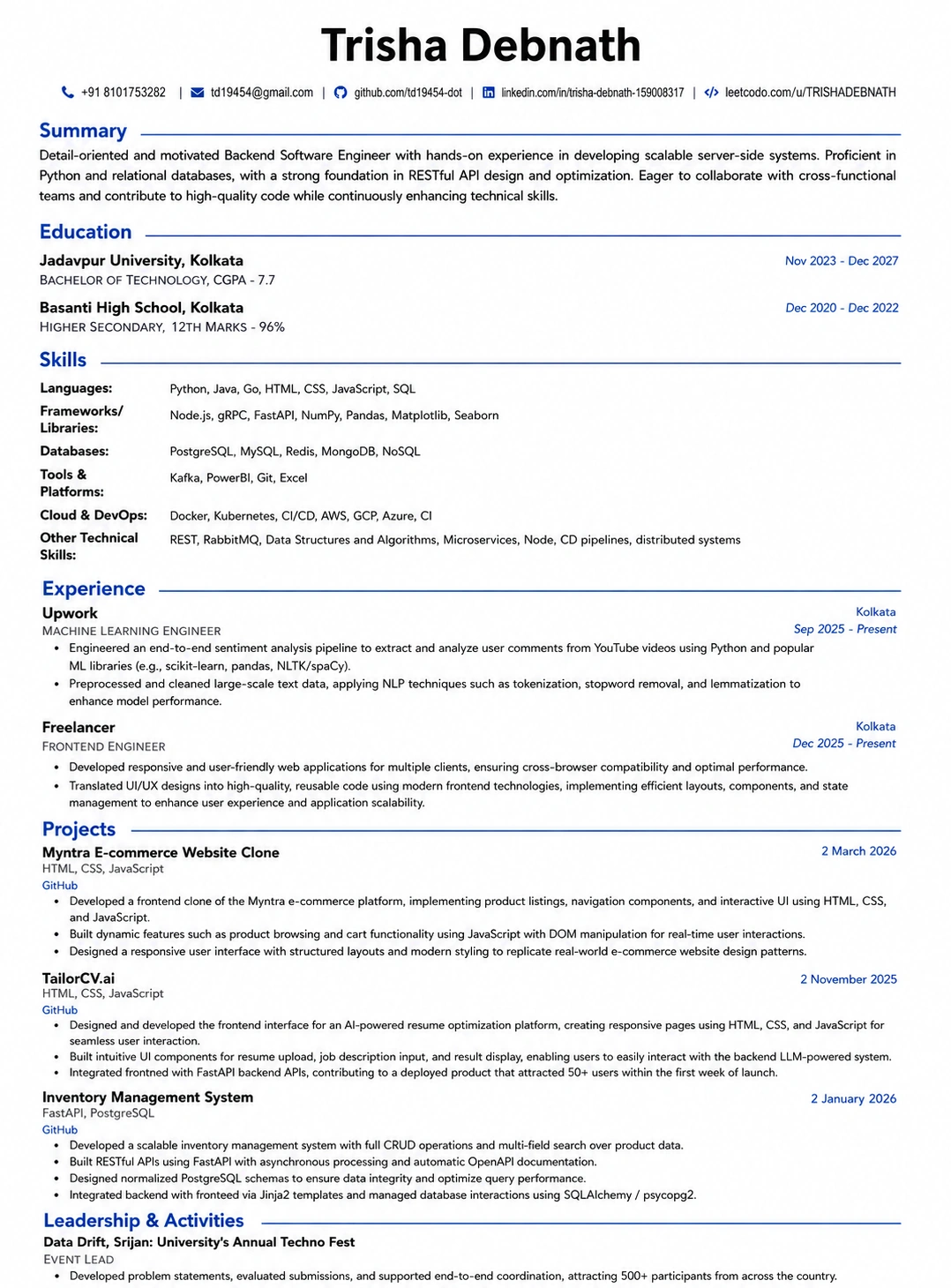
A layout with a real skills section gives the parser somewhere clean to find every term you just added.
Was this guide useful?
Be the first to rate it.