SS
SS
Key Takeaways
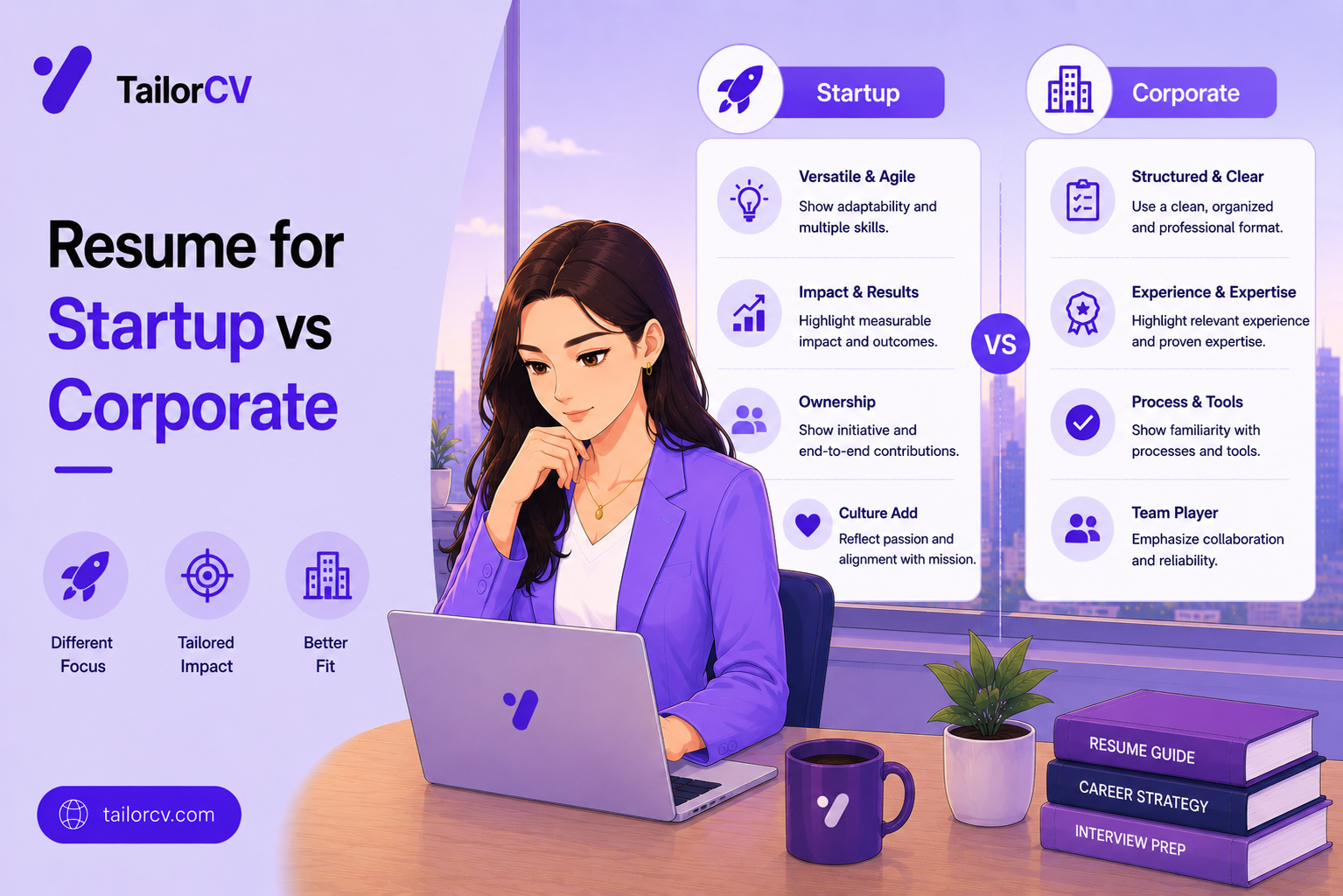
- Startups screen for range and autonomy; corporates screen for depth and process.
- The same experience can be framed for either, without changing any facts.
- Startups read scrappiness as capability; large organisations read it as inconsistency.
- Corporate applications are more process-driven, and formatting compliance matters more.
- Moving between them requires reframing, which is the main work in either direction.
What each environment values
The screening priorities, which genuinely differ.
Startups value breadth. Doing several jobs, moving fast and operating without support are the qualities being sought.
Corporates value depth and reliability. Deep expertise in a defined area, and evidence of working within established processes at scale.
Startups value ownership. Having built or run something end to end, with no one else to escalate to.
Corporates value influence. Having moved work through committees, stakeholders and other teams, which is a different and equally difficult skill.
Startups value adaptability, including comfort with ambiguity and changing priorities.
Corporates value rigour — documentation, governance, risk awareness and process adherence.
And both value results, though a startup wants speed to result and a large organisation frequently wants durability of result.
Reframing the same experience
How one career reads to two audiences.
| Your experience | Startup framing | Corporate framing |
|---|---|---|
| Built a reporting system alone | Owned it end to end, shipped in weeks | Designed and delivered, now business-critical |
| Worked across three functions | Wore several hats, filled gaps as needed | Cross-functional exposure across the value chain |
| Ran a project through committees | Navigated blockers to ship it | Managed governance and stakeholder alignment |
| Small team, large scope | High autonomy, minimal supervision | Delivered above grade with constrained resource |
| Large scale system | Handled serious volume | Operated at enterprise scale with SLAs |
The facts do not change; the emphasis does. This is legitimate tailoring rather than misrepresentation, and refusing to do it simply means half your applications are framed for the wrong reader.
Watch the vocabulary. Shipped, scrappy and ownership read well at a startup and can read as informal in a regulated corporate; governance, stakeholder and compliance read as competent in a large organisation and as bureaucratic in a small one.
And be honest about preference. Someone who genuinely wants structure will not thrive at a five-person company, and the reframing exercise is not a reason to apply everywhere.
Reading which one you are applying to
Company size is not the same as company culture.
Funding stage tells you more than headcount. An early company is building, a later one is scaling, and a mature one is optimising, and each wants different people.
Some large companies operate as collections of small teams, particularly in technology, and screen much more like startups than their size suggests.
Some small companies are highly structured, especially in regulated sectors, where a twenty-person firm may have more process than a large technology company.
The posting's own vocabulary is the best signal. A description full of ownership and ambiguity wants one profile; one full of governance and stakeholders wants another.
The interview process reveals it too. Structured competency frameworks indicate a process-driven organisation, while a founder conversation indicates the opposite.
And the team you would join matters more than the company, since a single team's culture can differ substantially from the organisation around it.
What each environment costs you
The trade-offs worth knowing before choosing.
Startups offer scope and speed at the cost of stability, structured development and frequently compensation.
Large organisations offer resources and progression at the cost of speed and individual visibility.
Startups give you more surface area early, which accelerates learning and can also overwhelm.
Large organisations give you specialists to learn from, which is genuinely valuable and rarely available in a small company.
Startup equity is a lottery ticket with a wide distribution of outcomes, and treating it as certain compensation is a common and expensive error.
Corporate progression is slower but more legible, with defined levels and clearer criteria.
And the risk profiles differ sharply, which is a personal circumstance question rather than a career quality one.
Mini checklist
- unchecked: Target environment identified before tailoring
- unchecked: Vocabulary matched to that environment
- unchecked: Breadth emphasised for startups
- unchecked: Depth and scale emphasised for corporates
- unchecked: Ownership examples ready for small companies
- unchecked: Process and governance examples ready for large ones
- unchecked: Formatting compliance checked for corporate applications
- unchecked: Honest preference considered
Scenarios
Scenario 1: Moving from corporate to startup
Lead with anything you owned end to end, any time you worked without support, and any result delivered quickly. The concern is that you rely on infrastructure you will not have.
Scenario 2: Moving from startup to corporate
Lead with scale, process and cross-team work. The concern is that you cannot operate within governance, so evidence of structured delivery answers it directly.
Scenario 3: Applying to both simultaneously
Maintain two versions. The differences are in emphasis and vocabulary rather than substance, and a single document optimised for neither performs worse than either.
Tip: The concern in each direction is the mirror of the other. A corporate hire is asked whether they can operate without support; a startup hire is asked whether they can operate within structure. Answer the relevant one explicitly and the rest of your experience speaks for itself.
Do's and Don'ts
Do
- Identify the environment before tailoring
- Match vocabulary to the reader
- Emphasise ownership for startups
- Emphasise scale and process for corporates
- Keep two versions if applying to both
- Consider which you would actually prefer
Don't
- Use one framing for both
- Change facts rather than emphasis
- Use startup vocabulary in regulated sectors
- Assume corporate experience transfers unexplained
- Ignore formatting requirements in large processes
- Apply everywhere without preference
Common Mistakes
- One document for both. It is optimised for neither.
- Wrong vocabulary. It signals a poor cultural read immediately.
- Unexplained corporate experience. Startups wonder about self-sufficiency.
- Unexplained startup experience. Corporates wonder about rigour.
- Changing facts. Reframing is legitimate; invention is not.
- Ignoring your own preference. Fit works in both directions.
Related Guides
Keep building on this with the related guides in this series:
- How to Read a Job Description Properly
- Job Description Red Flags
- Tailoring for Two Similar Roles
- Why the Same Resume for Different Jobs Fails
- How to Research a Company Before an Interview
You can also check your resume's ATS score for free, generate a tailored cover letter, or build a portfolio website in minutes.
Frequently Asked Questions
Should my resume differ for startups and corporates?
Yes, in emphasis and vocabulary. Startups screen for breadth, ownership and autonomy; large organisations screen for depth, scale and process. The facts stay identical.
How do I move from corporate to startup?
Lead with anything you owned end to end and delivered without extensive support. The concern is dependence on infrastructure that a small company does not have.
How do I move from startup to corporate?
Lead with scale, cross-team work and structured delivery. The concern is whether you can operate within governance and process rather than around it.
Is reframing the same experience dishonest?
No. Changing which aspects you emphasise is ordinary tailoring. Changing the facts themselves is not, and the line between them is clear.
Does vocabulary really matter?
Considerably. Shipped and scrappy read as capable at a startup and informal in a regulated corporate, while governance and compliance read as competent in one and bureaucratic in the other.
What if I am unsure which I prefer?
Apply to both with separate versions and pay attention to how the conversations feel. Fit runs in both directions and the interviews themselves are useful information.
How do I tell what kind of company I am applying to?
Funding stage tells you more than headcount, and the posting's own vocabulary is the strongest signal. Large companies can operate as small teams, and small regulated firms can be highly structured.
What are the trade-offs between the two?
Startups offer scope, speed and surface area at the cost of stability and structured development. Large organisations offer resources, specialists and legible progression at the cost of speed and visibility.
What is your resume scoring right now?
Scan it against a job description and get your ATS match score in about a minute.
Drop your resume here or choose a file
PDF only. Max 2 MB.
We never share your data or use it to train AI models.

Was this guide useful?
Be the first to rate it.