 SS
SS
Key Takeaways
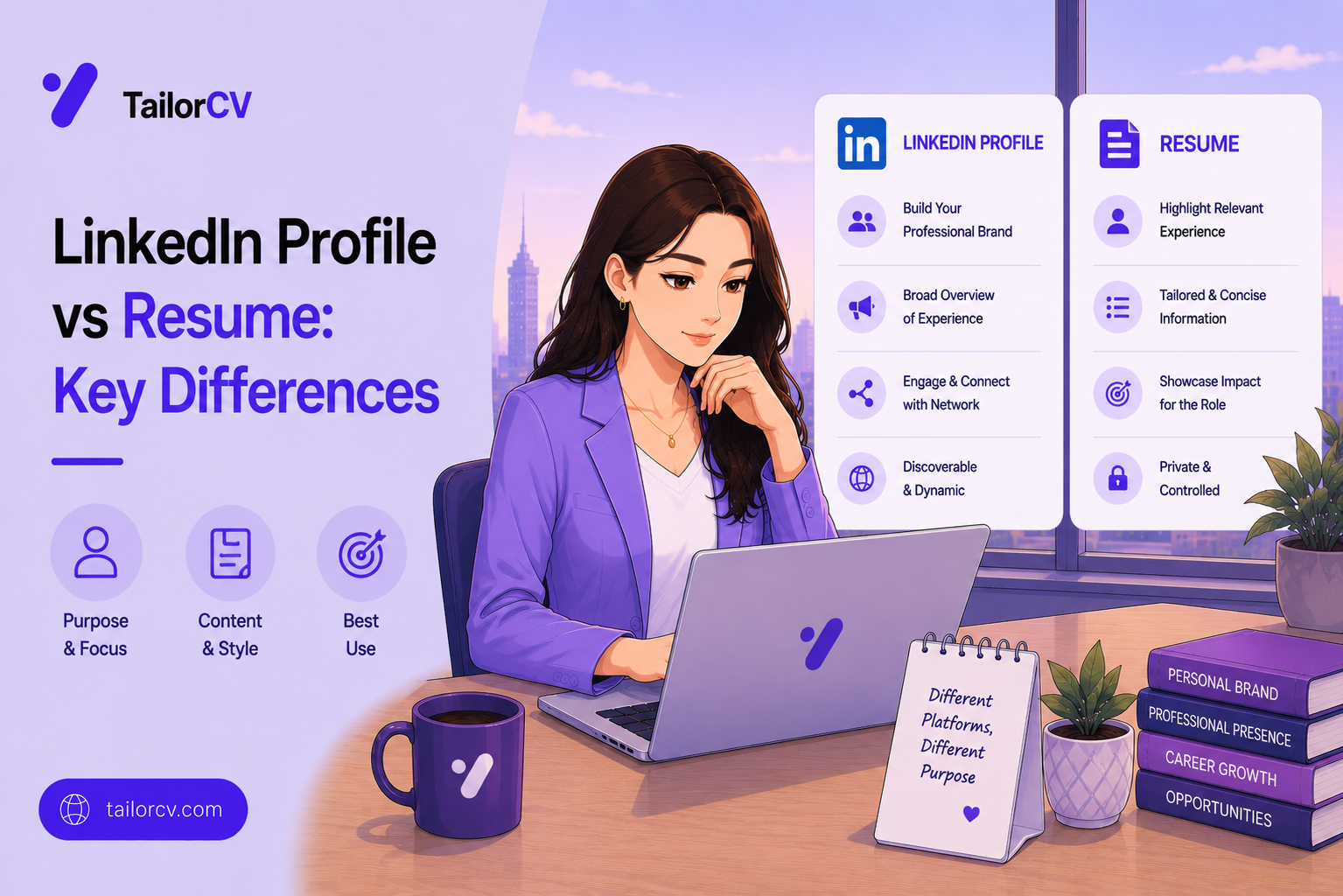
- The resume is targeted; the profile is general. One addresses a role, the other addresses everyone.
- They must agree on facts while differing in emphasis and length.
- The profile is found by search, so it carries the terms recruiters actually type.
- First person suits the profile, while the resume stays impersonal.
- The profile works while you do not, which is why it deserves attention even when you are not searching.
What each one is for
The different jobs they do.
The resume answers one question — are you right for this specific role — and everything in it should serve that.
The profile answers a broader one, describing what you do and what you are open to, for readers who arrive from many directions.
The resume is sent; the profile is found, which is why searchability matters far more in one than the other.
The resume has a length constraint; the profile effectively does not, and can carry detail the resume must cut.
The resume is a formal document; the profile permits a personal voice and reads oddly without one.
And the profile is persistent. It works continuously, surfacing in searches while you are doing something else entirely, which is a genuinely different function.
What differs and what must not
The boundary between tailoring and inconsistency.
| Element | Resume | Profile |
|---|---|---|
| Voice | Impersonal | First person |
| Length | Constrained | Expansive |
| Targeting | One specific role | General positioning |
| Dates and titles | Must match | Must match |
| Employers | Must match | Must match |
| Detail level | Selected for the role | Fuller history |
| Tone | Formal | Professional but human |
Dates, titles and employers must be identical. These are checkable facts, recruiters routinely view both, and a discrepancy raises a question you do not want asked.
Everything else may reasonably differ. The profile can include roles the resume cut for space, describe interests the resume has no room for, and use a warmer register throughout.
And the profile should be broader than any single resume, since it must serve every role you might plausibly be approached about rather than the one you are applying to today.
Writing the profile summary
The section people leave empty or fill badly.
Write it in first person, since third person reads oddly on a personal profile and always has.
Open with what you do now and at what level, in plain language rather than in aspirational terms.
Include the terms you want to be found for, naturally within sentences rather than as a list.
Say what you are interested in, which is the part a resume cannot carry and which frequently prompts the approaches you actually want.
Keep it to a few short paragraphs. The section is expandable, so the first two lines carry disproportionate weight and should stand alone.
Add something human. A profile with no personality reads as a resume that wandered into the wrong format, and the whole advantage of the medium is that it permits more.
And update it when your work changes, not only when you are searching, since the profile's value comes from being accurate continuously.
The rest of the profile
The sections that carry real weight.
The headline is the most valuable line, appearing in every search result and every message preview.
The experience section should describe the work, not repeat resume bullets verbatim, and can include roles the resume cut.
Skills matter for search, and the ordering is worth setting deliberately rather than leaving to defaults.
Recommendations carry genuine weight because they are written by named people who can be contacted, which makes them harder to fabricate than anything else on the page.
The photo matters more than people like, and a clear, current, professional one is a low-effort improvement.
Activity is visible, and consistent professional engagement in your field surfaces you to people who never searched for you.
And completeness affects visibility in most platform ranking systems, which makes finishing the profile worthwhile on its own.
Mini checklist
- unchecked: Dates, titles and employers identical across both
- unchecked: Profile headline states what you do, not just your title
- unchecked: Searchable terms present in the profile
- unchecked: First person used in the profile summary
- unchecked: Profile includes detail the resume cut
- unchecked: Open-to-work settings configured deliberately
- unchecked: Profile photo and headline current
- unchecked: Resume kept targeted rather than mirroring the profile
Scenarios
Scenario 1: You are employed and quietly looking
Keep the profile current and searchable without announcing a search. Ordinary maintenance is unremarkable, and private signalling options exist for exactly this situation.
Scenario 2: Your profile is years out of date
Update it before applying anywhere. Recruiters check it as a matter of routine, and a stale profile contradicting a current resume is a question you have created for yourself.
Scenario 3: You want to be approached rather than to apply
Invest in the profile specifically. Searchable terms, a clear headline and a complete history are what make you findable, and the profile does that work continuously.
Tip: Write the profile headline as what you do rather than your job title. A title is what your employer calls you; a headline describing the work is what a recruiter is actually searching for, and it is the most valuable line on the page.
Do's and Don'ts
Do
- Keep dates, titles and employers identical
- Write the profile in first person
- Include searchable terms naturally
- Use the profile for detail the resume cut
- Keep the headline descriptive
- Maintain the profile between searches
Don't
- Paste your resume into the profile
- Let the two contradict on facts
- Leave the profile stale while applying
- Use a bare job title as your headline
- Make the resume as broad as the profile
- Ignore the profile when not searching
Common Mistakes
- Copying the resume verbatim. It reads badly and wastes the format.
- Contradictory dates. Both are visible to the same reader.
- A stale profile. Checked routinely, and it undermines a current resume.
- A title-only headline. The most valuable line, wasted.
- A resume as broad as a profile. Targeting is what makes it work.
- Neglecting it between searches. The profile works continuously.
Related Guides
Keep building on this with the related guides in this series:
- LinkedIn Profile Optimization
- What Recruiters Actually Search For
- A Recruiter Messaged You
- How Recruiters Read Your Resume
- Personal Website Versus Portfolio
You can also check your resume's ATS score for free, generate a tailored cover letter, or build a portfolio website in minutes.
Frequently Asked Questions
Should my LinkedIn profile match my resume?
On facts, yes — dates, titles and employers must be identical. On voice, length and emphasis they should differ, since they do different jobs for different readers.
Can I just paste my resume into my profile?
No. The resume is impersonal, targeted and constrained by length, while the profile is first person, broader and expansive. A pasted resume reads poorly and wastes the format.
Which one matters more?
It depends on your approach. If you apply to roles, the resume does the work; if you want to be approached, the profile matters more because it is searchable and works continuously.
What should my headline say?
What you do, not just your job title. The headline is the most searched and most read line on the profile, and a bare title wastes it.
How do I look without alerting my employer?
Keep the profile current as ordinary maintenance and use the private signalling options. Regular updates are unremarkable and attract no attention.
Should the profile include everything?
More than the resume, certainly. Roles the resume cut for space belong there, since the profile has no length constraint and serves a broader set of readers.
How should I write my LinkedIn summary?
In first person, opening with what you do now, including the terms you want to be found for naturally, and saying what you are interested in. Keep the first two lines strong since the rest is collapsed.
Which profile sections matter most?
The headline, since it appears in every search result and message preview. Then the experience descriptions, deliberately ordered skills, recommendations from named people, and a current photo.
What is your resume scoring right now?
Scan it against a job description and get your ATS match score in about a minute.
Drop your resume here or choose a file
PDF only. Max 2 MB.
We never share your data or use it to train AI models.
Was this guide useful?
Be the first to rate it.