TD
TD
Key Takeaways
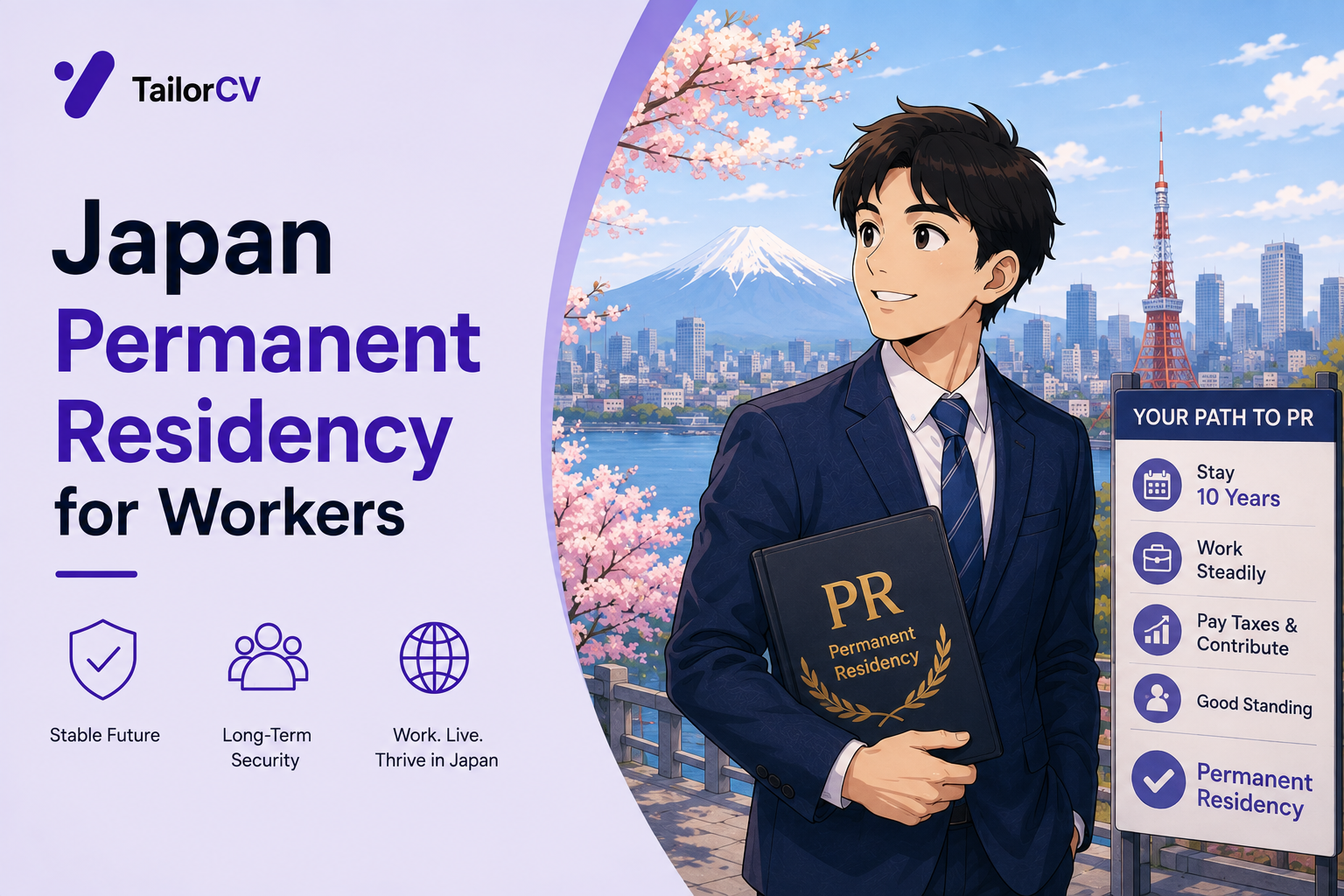
- The conventional route to permanent residence requires a substantial continuous period of residence in Japan.
- A points-based highly skilled professional system offers a considerably shorter path for those who qualify.
- Points come from education, professional history, salary, age and Japanese language ability among other factors.
- Tax and social insurance compliance throughout your stay is examined, which makes early record-keeping matter.
- Permanent residence is distinct from naturalisation, which is a separate process with different consequences.
The two routes
| Route | Residence required | What qualifies you |
|---|---|---|
| Conventional | 10 years continuous residence, generally including 5+ years on a working-status visa | A stable livelihood and a record of meeting your obligations throughout |
| Highly skilled professional — 70 points | 3 years | Scoring 70 on the 高度人材 (kōdo jinzai) points table |
| Highly skilled professional — 80 points | 1 year | Scoring 80 on the same table |
The points table scores academic qualifications, professional career, annual salary, age, research achievements and Japanese language ability, among other factors. Most new graduates entering strong technical or specialist roles are closer to these thresholds than they'd assume — worth actually running the numbers on the official points calculator early rather than assuming the 10-year route is your only option.
Why this matters for graduates. Someone entering on the standard working status who later qualifies under the points system can reach permanent residence considerably sooner than the conventional timeline allows. Worth understanding early, because several of the point categories are things you can deliberately influence.
What the points assessment rewards
Academic qualifications. Higher degrees score more, and a master's or doctorate is a meaningful advantage.
Professional career. Years of relevant experience.
Annual salary. Higher compensation scores more, and it interacts with age — the same salary is worth more at a younger age.
Age. Younger applicants score better, which can favour people who move to Japan early in a career.
Japanese language ability. Certified proficiency contributes points, which is one of several reasons the JLPT levels matter beyond simply getting hired.
Research achievements where applicable — publications, patents, grants.
Graduation from a Japanese university carries additional points, a genuine advantage for international students who studied there.
The practical read: if permanent residence is a long-term goal, the things that improve your position are largely the things that improve your career anyway — a higher qualification, better language ability, a stronger salary.
What is actually assessed
Continuous residence. Extended absences can affect the assessment, so long periods abroad are worth understanding before taking them.
Valid status throughout. Gaps or irregularities in your immigration history are examined.
Independent livelihood. Stable employment and sufficient income.
Tax and social insurance compliance. Residence tax, income tax, pension and health insurance contributions, paid on time, throughout your stay. This is genuinely assessed and late or unpaid contributions cause real problems.
Good conduct. No significant legal issues.
A guarantor, typically someone resident in Japan.
Which makes record-keeping matter from day one. Tax certificates, proof of contributions and employment history are exactly the documents that are difficult to reconstruct years later — the same documentation discipline that pays off throughout an international career.
Permanent residence versus naturalisation
Permanent residence allows you to live and work in Japan indefinitely without status renewal and without restriction on the type of work, while retaining your existing nationality.
Naturalisation means acquiring Japanese citizenship — a separate process, handled by a different authority, with different requirements. Japan does not generally permit dual nationality for adults, which is a significant consideration.
Most foreign workers pursue permanent residence, since it provides the practical freedoms without the nationality question.
Planning around it
Work out where you stand early. The points assessment can be approximated for yourself, and knowing whether you are near a threshold changes decisions about study, language and employer choice.
Language ability compounds. It affects points, widens which employers are open to you, and improves daily life — the clearest example of an investment paying in several directions at once.
Employer and salary matter. The employer types that pay more and offer stable progression put you in a better position, worth weighing alongside everything else when choosing a first job.
Stay compliant. Pay taxes and contributions on time, keep the certificates, avoid gaps in status.
Verify current requirements officially. Rules change and thresholds are revised; the Japanese immigration authority is the authoritative source rather than any article.
What genuinely strengthens an application over time
A stable employment history, ideally with demonstrated career progression at a genuine, established employer, reflects positively, similar to the same holistic assessment approach used in other countries' longer-term residency systems, this is one reason choosing a stable employer thoughtfully at the outset has consequences beyond the immediate job itself.
Continuous, genuine residence over a meaningful period is generally a real requirement, though the specific length can vary depending on your particular category and circumstances, worth verifying current specific criteria directly rather than relying on a general assumption.
Japanese language ability, and genuine integration into the local community and workplace, are recognised factors within a holistic assessment.
Practical steps to build toward this over time
- Keep organised documentation of your employment history, including your work visa status and renewals, throughout your career, exactly the same record-keeping discipline that matters for any long-term status process, reconstructing this later is considerably harder than maintaining it as you go.
- Understand that this is a genuine long-term consideration, worth factoring into decisions about employer stability and career trajectory from your first job, rather than a decision to think about only after many years.
- Verify current specific eligibility criteria directly with the relevant Japanese immigration authority before making significant career decisions based on where you expect to stand, this is exactly the kind of process where policy is reviewed periodically and outdated general information is a genuine risk.
Understanding this as a genuine long-term project
Treat this as a multi-year undertaking from early in your career, factoring genuine employer and career stability into decisions from your first job, rather than a decision to consider only after several years have already passed, this is the same long-term planning discipline that matters for permanent status in any country.
Reassess your own position periodically against current published criteria, rather than assuming your understanding from several years ago remains accurate, since this is genuinely the kind of policy area reviewed and adjusted over time.
What to do while you wait to become eligible
Use the years before you are eligible to apply deliberately, building the strongest possible profile across employment stability, language ability and community integration, rather than treating this as passive waiting time.
Periodically review current official eligibility criteria, since this is genuinely the kind of policy area that is reviewed and can change, an assumption formed several years ago may no longer accurately reflect current requirements by the time you are actually ready to apply.
Tip: Run the 高度人材 points calculator now, not in year eight. If you score 70 the residence requirement drops from 10 years to 3, and most people who qualify had no idea they were close.
Common Mistakes
- Not knowing the points route exists. Substantially faster for those who qualify.
- Neglecting tax and social insurance compliance. Genuinely assessed and hard to remedy retrospectively.
- Long absences without understanding the effect. Continuity is part of the assessment.
- Confusing permanent residence with citizenship. Different processes, different consequences.
- Not keeping documentation. Certificates are difficult to reconstruct years later.
- Relying on outdated figures. Thresholds are revised; check the official source.
Related Guides
Keep building on this with the related guides in this series:
- English-Speaking Jobs in Japan - Where They Actually Are
- Group Discussions and Aptitude Tests in Japanese Recruiting
- Internships in Japan for International Students
- Japanese Language Requirements for Jobs in Japan
- Teaching in Japan - The JET Programme and the Alternatives
- JLPT N2 and N1 - What They Actually Mean for Employment in Japan
You can also check your resume's ATS score for free, generate a tailored cover letter, or build a portfolio website in minutes.
Frequently Asked Questions
How long do I need to work in Japan before applying for permanent residency?
Generally a meaningful period of continuous residence is required, the specific length can vary by category and circumstances, verify current specific criteria directly with the relevant authority.
Does my specific employer matter for this process?
Indirectly, a stable employment history with genuine career progression reflects positively within a holistic assessment, similar to how employment stability matters for long-term status processes in other countries.
Do I need advanced Japanese ability to qualify?
Language ability and genuine community integration are recognised factors, though the specific weighting is not a single fixed formula, worth building genuine language ability over time regardless.
Where do I get current, accurate information on eligibility?
The relevant Japanese immigration authority publishes current official guidance, worth checking directly rather than relying on general or outdated summaries.
How long does the conventional route take?
A substantial continuous period of residence, measured in years. The points-based route can be considerably shorter for those who qualify.
Does the points system guarantee permanent residence?
It provides preferential treatment including a shortened qualifying period. The application is still assessed on the full criteria including compliance and livelihood.
Does Japanese language ability matter?
Yes — for points directly, and more broadly for which jobs and salaries are available, which feed into the other criteria.
Can I apply while on a student visa?
These routes are for those in working status. Time spent studying may count differently toward residence requirements, so confirm your specific position.
What if I change jobs?
Permitted, and continuity of appropriate status matters. Moving to work that does not qualify under your status has implications worth understanding first.
Is naturalisation an alternative?
It is a separate process resulting in Japanese citizenship, and Japan does not generally permit dual nationality for adults — which most foreign workers weigh heavily.
What is your resume scoring right now?
Scan it against a job description and get your ATS match score in about a minute.
Drop your resume here or choose a file
PDF only. Max 2 MB.
We never share your data or use it to train AI models.

Was this guide useful?
Be the first to rate it.