 TD
TD
Key Takeaways
- A federal resume is 3-5 pages, not one - the one-page rule is the fastest way to be rated ineligible.
- HR staff screen literally against the announcement, so every qualification must be stated explicitly rather than implied.
- The GS scale sets pay by grade and step, so identifying the right grade matters more than negotiating.
- Most roles require US citizenship, and many require a security clearance the employer sponsors.
- The process is slow - months, not weeks - so apply and keep searching rather than waiting.
Federal hiring is the most rule-bound recruitment process in the US, and the rules are the opposite of everything private-sector advice teaches. Candidates who apply with a polished one-page resume are routinely rated ineligible, not because they lack the experience but because they did not state it in the form the system requires.
The upside is that a rule-bound process is a learnable one. There is no hidden network, no referral advantage, and no clever positioning. If you meet the criteria and you document it correctly, you get rated. Most applicants fail on documentation.
This guide covers the resume, the screening, and the timeline.
Before anything, check your current resume parses cleanly with the free ATS score checker.
The federal resume is a different document
Length: 3 to 5 pages. Sometimes more. Federal HR needs enough detail to verify you meet the qualification standard, and brevity works against you. This is the single hardest adjustment for private-sector applicants — see the ideal resume length guide for why the one-page convention exists elsewhere and why it does not apply here.
Required fields most private resumes omit:
- Hours per week for every position — "40 hours/week" — because qualifying experience is calculated in hours
- Month and year start and end dates, not just years
- Supervisor name and contact, and whether they may be contacted
- Salary or grade for each role
- Full employer address
Leaving hours off is the most common reason for an ineligible rating. Without it, HR cannot compute whether you have the required 52 weeks of specialised experience, so they cannot credit it.
Write duties in full. Private-sector advice says cut anything that is not an achievement. Federal HR is matching your text against a written qualification standard, so responsibilities matter as much as results. Include both.
Read the announcement like a checklist
Every USAJOBS announcement contains a Qualifications section stating exactly what is required — usually "one year of specialised experience equivalent to the GS-XX level" followed by a description of that experience.
That paragraph is the marking scheme. HR reads your resume looking for its language.
Mirror the wording. If the announcement says "developing and implementing data governance policies," your resume should contain that phrasing where it is genuinely true of you — not a paraphrase. Federal screening is more literal than commercial ATS, because a human is checking specific criteria rather than a system ranking by relevance. The general method is in how to tailor your resume for every job.
Check "Who May Apply." Many announcements are open only to current federal employees ("status candidates") or to specific groups. Applying to a status-only posting as an outside candidate is wasted effort.
Note the closing date and the cap. Some announcements close early once a set number of applications arrive.
Grades, steps and pay
Federal pay follows the General Schedule — GS-1 through GS-15, each with 10 steps, adjusted by locality.
Roughly:
- GS-5 to GS-7 — entry level, bachelor's degree
- GS-9 to GS-11 — master's degree or several years of experience
- GS-12 to GS-13 — experienced specialist
- GS-14 to GS-15 — senior and supervisory
Applying at the right grade matters more than negotiating, because the grade is set by the announcement rather than by discussion. Applying two grades above your qualifying experience wastes an application; applying below it costs you money for years.
Some announcements are advertised at multiple grades with promotion potential — "GS-9/11/12" means you can enter at 9 and progress without reapplying. Those are worth prioritising.
Citizenship, clearance and veterans' preference
Citizenship. Most competitive-service positions require US citizenship. Some agencies hire non-citizens in limited circumstances, but treat it as the exception. If you need sponsorship, federal work is generally not the route — see how to get a job in the USA as an international candidate for what is.
Security clearance. Many roles require one. You generally cannot obtain a clearance yourself — the hiring agency sponsors it. If you already hold an active clearance, put it near the top of your resume; it is one of the most searchable credentials in this market, as the best resume keywords for US jobs covers.
Veterans' preference. Eligible veterans receive preference points and, in some cases, are placed ahead of non-veterans on the referral list. If you qualify, submit the supporting documentation — omitting it forfeits the advantage.
The process, end to end
- Create a USAJOBS profile and upload your resume. The built-in resume builder produces the required fields automatically, which is a reasonable starting point.
- Apply, answering the occupational questionnaire.
- HR rates you against the qualification standard — eligible or ineligible, then a category or score.
- Referral. Qualified candidates are referred to the hiring manager as a certificate list.
- Interview, often panel-based and structured — see US behavioral interview STAR guide.
- Tentative offer, then background check and any clearance processing.
- Final offer and start date.
Expect months. Two to six is normal, longer with a clearance. Keep applying elsewhere throughout — a federal application is not a reason to pause your search, and the US job search timeline sets realistic expectations for the private-sector track running in parallel.
The occupational questionnaire
A self-assessment where you rate your own expertise on each competency. Two failure modes:
Underrating yourself. Modesty here is actively harmful — the questionnaire produces a score, and a low self-rating can drop you below the referral cut-off before a human sees your resume.
Overrating without evidence. Your resume must substantiate the rating. Claiming expert level on something your resume never mentions is the fastest way to be rated ineligible for inconsistency.
Rate honestly at the top of what your resume can support, then make sure the resume supports it.
Common Mistakes
Submitting a one-page resume. The convention that helps everywhere else fails here — HR needs detail to verify qualifying experience, and brevity reads as insufficient evidence rather than as discipline.
Omitting hours per week. Qualifying experience is computed in hours, so without this HR cannot credit your time and will rate you ineligible regardless of how strong the role was.
Paraphrasing the announcement instead of mirroring it. Screening is literal here, and a synonym HR is not looking for simply does not register as a match.
Applying to status-only announcements. "Who May Apply" restricts many postings to current federal employees, and an outside application is discarded without review.
Underrating yourself on the questionnaire. It produces a numeric score used for referral, so unnecessary modesty removes you from consideration before anyone reads your resume.
Claiming expertise the resume does not support. Inconsistency between questionnaire and resume is checked directly and is treated as a disqualifier.
Waiting on a federal application. The timeline runs to months, so pausing your wider search costs you opportunities for a process that may not convert.
Ignoring promotion-potential announcements. A GS-9/11/12 posting lets you progress without reapplying, which is worth more than a slightly higher entry grade elsewhere.
Frequently Asked Questions
How long should a federal resume be?
Three to five pages is normal, sometimes longer for senior roles. Detail is required for HR to verify qualifying experience, so the private-sector one-page rule does not apply.
Do I need to be a US citizen?
For most competitive-service positions, yes. Some agencies hire non-citizens in limited circumstances, but plan around citizenship being required.
What is specialised experience?
Experience directly related to the position at a level equivalent to the next lower grade, usually one year of it. The announcement defines it precisely — that definition is what HR screens against.
Can I get a security clearance myself?
No. The hiring agency sponsors it. Holding an active clearance already is a significant advantage and belongs prominently on your resume.
How long does federal hiring take?
Commonly two to six months, longer where a clearance is involved. Continue applying elsewhere throughout.
Does the USAJOBS resume builder help?
Yes, particularly for a first application — it prompts for the required fields like hours per week and supervisor details that applicants otherwise omit.
What is veterans' preference?
An advantage in rating and referral for eligible veterans. It requires supporting documentation to be submitted with the application; without it, the preference is not applied.
Make sure your resume parses before you adapt it for federal. Check your ATS score free.
Make This Practical
Read the Qualifications section of a real announcement and treat it as your marking scheme. Copy its language into a document, then write your experience underneath each requirement in the announcement's own words wherever it is genuinely true of you.
Then rebuild the resume with the fields federal HR requires — hours per week, month and year dates, supervisor contact, salary or grade for every position — and let it run to three to five pages. Include duties as well as achievements.
Finally, apply at the right grade, complete the questionnaire honestly at the top of what your resume supports, submit veterans' documentation if eligible, and keep your private-sector search running using the US job search timeline and the free ATS score checker.
What is your resume scoring right now?
Scan it against a job description and get your ATS match score in about a minute.
Drop your resume here or choose a file
PDF only. Max 2 MB.
We never share your data or use it to train AI models.

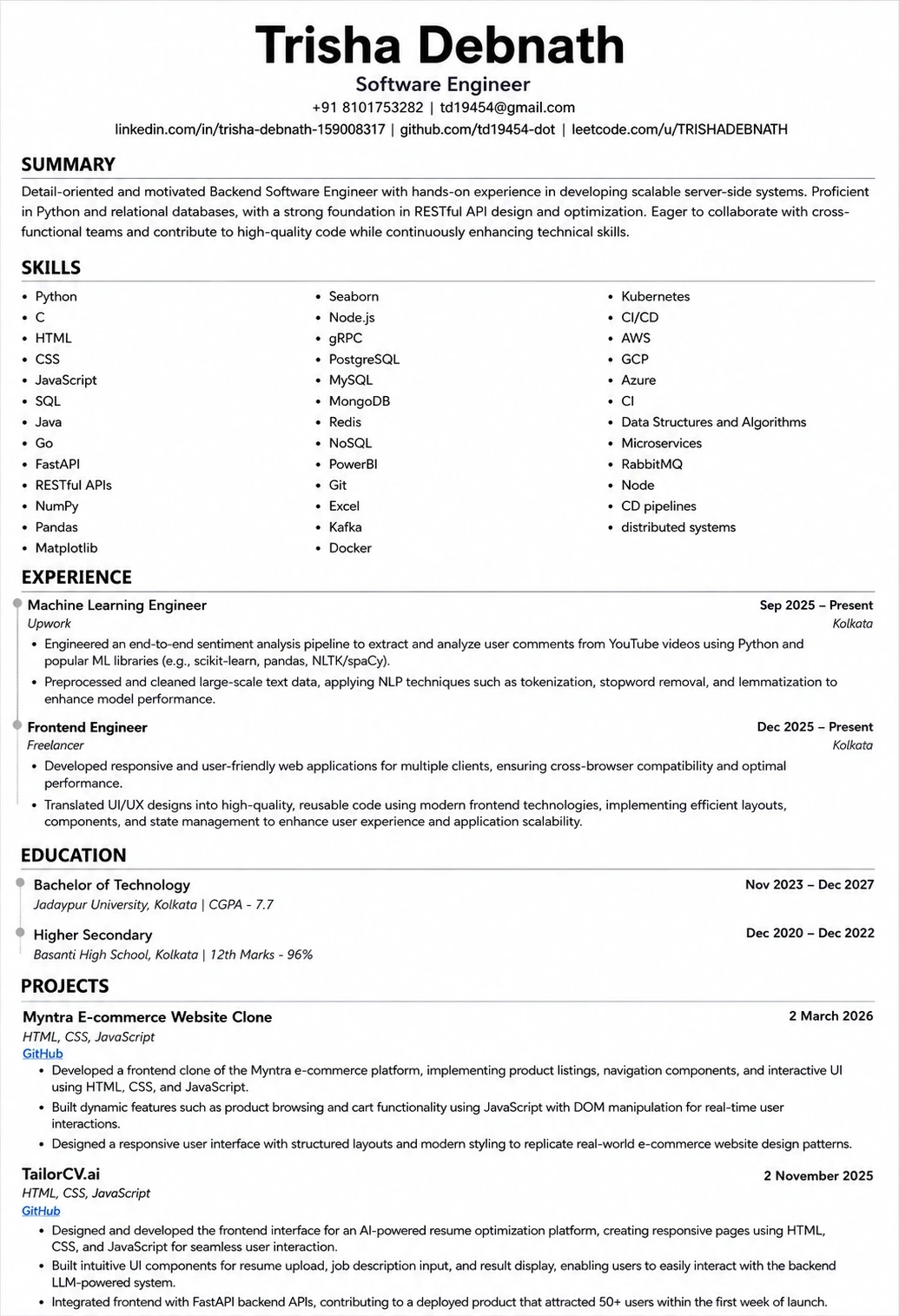
Templates that keep this structure intact
This template is ATS-tested — start from it and the formatting rules in this guide are already handled.
Was this guide useful?
Be the first to rate it.