 SS
SS

Key Takeaways
- A US job search commonly runs three to six months from first application to start date, and longer at senior level.
- The interview loop itself is four to eight weeks per company, which is why sequential applications waste months.
- Running five to eight processes in parallel is the single biggest lever on total time, and it also produces competing offers.
- Background checks and notice period add two to six weeks after you accept, which people forget to plan for.
- December and late August are genuinely slower; hiring picks up in January and September.
The most common mistake in a US job search is not a bad resume — it is a bad model of how long everything takes. People apply to three companies, wait, hear nothing for a month, and conclude something is wrong with their application when the process is simply running at its normal speed.
Knowing the real timings changes your behaviour in two useful ways: you apply in parallel rather than in sequence, and you stop reading silence as rejection.
This guide covers each stage and where the time actually goes.
Before you start, make sure the document behind every application works — run it through the free ATS score checker.
The full picture
For a mid-level professional role:
| Stage | Typical duration |
|---|---|
| Preparation — resume, LinkedIn, target list | 1-2 weeks |
| Applying and waiting for first responses | 1-3 weeks |
| Interview loop, per company | 4-8 weeks |
| Offer and negotiation | 3-7 days |
| Background check | 1-3 weeks |
| Notice period | 2 weeks (US standard) |
| Total | 3-6 months |
Senior and executive roles run longer — six to nine months is unremarkable. Entry level can be faster, particularly through structured graduate programmes.
Where the time actually goes
Application to first response: 1-3 weeks
Most applications never get a reply at all. That is not a signal about you — popular postings collect hundreds of applications, and many are never reviewed by a human.
What compresses this: referrals. A referred application is routed differently and actually gets read, which is why the US networking and referral guide matters more than application volume.
Rule of thumb: if you have heard nothing in three weeks, treat it as closed and move on. Do not keep the slot open in your head.
The interview loop: 4-8 weeks
This is the longest stage and the least compressible, because it depends on other people's calendars.
A typical sequence — recruiter screen, technical or functional screen, then an onsite loop of four to six sessions, then a debrief — has scheduling gaps between every stage. A single interviewer on holiday adds a week. The structure is covered in the US tech interview process guide.
What compresses this: being flexible on scheduling, and replying to recruiters within hours rather than days. You control very little else here.
Offer to start: 3-6 weeks
People consistently forget this stage.
Negotiation — take a day or two rather than accepting on the call, as US salary negotiation sets out.
Background check — one to three weeks, longer if it includes employment verification going back several years or if you have lived abroad. See the US background check guide.
Notice — two weeks is the US convention, though it is a courtesy rather than a legal requirement in most at-will employment. Longer if you are senior or coming from a market with contractual notice — see notice period negotiation.
Why parallel processes matter so much
This is the whole strategy in one idea.
If each company takes six weeks and you interview sequentially, five companies is thirty weeks. Run the same five in parallel and it is six weeks.
The compounding benefit is that offers arrive close together, which is what gives you leverage. A single offer with no alternative is not a negotiation, it is an acceptance. Two offers in the same fortnight is a genuinely different conversation.
Practical target: five to eight active processes at once, with a steady flow of new applications behind them so the pipeline refills as companies drop out.
The cost: it is a real time commitment during the loop weeks. Plan for it.
Seasonality
US hiring has a rhythm, and fighting it wastes energy.
January to March — the strongest period. New budgets, new headcount, decisions get made.
April to June — steady.
July and August — slows noticeably. Decision-makers take holiday and loops stall waiting for one person.
September to early November — the second strong window.
Mid-November to December — the slowest stretch. Budgets are spent, people are away, and offers get pushed to January.
How to use this: apply through December anyway — competition is lower and your application sits at the top of the pile in January. Just do not read the silence as failure.
Timelines that differ
Federal government — two to six months, sometimes longer with a security clearance. A separate track with its own rules; see the US federal jobs and USAJOBS guide.
Startups — often much faster, one to three weeks, because the decision-makers are in the room.
Large tech — four to eight weeks, sometimes longer with hiring committee review.
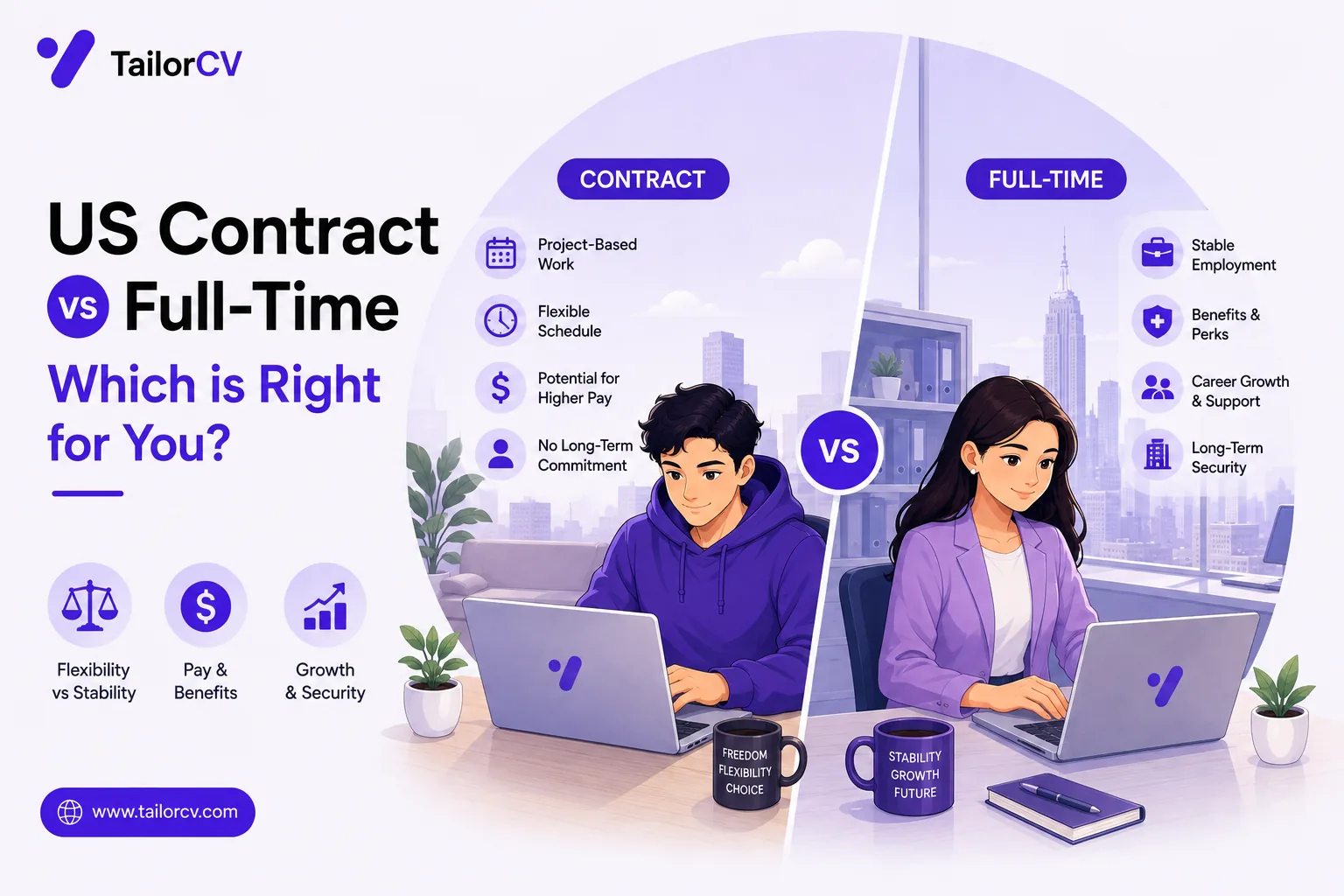
Contract roles — the fastest of all, sometimes days, which is one reason they are worth considering — see W2 vs 1099 explained.
International candidates needing sponsorship — add time for the visa process, and note the H-1B lottery has a fixed annual cycle that can add most of a year. See the H-1B visa job search guide.
Common Mistakes
Applying sequentially. Five companies at six weeks each is thirty weeks in series and six in parallel — this single choice is the biggest determinant of how long your search takes.
Reading silence as personal rejection. Most applications are never reviewed by a human at all, so no reply carries almost no information about your candidacy.
Forgetting the offer-to-start stage. Background check plus notice adds two to six weeks after you accept, and people who budget only to the offer run out of savings at the worst moment.
Pausing the search after a strong interview. Nothing is real until it is a written offer, and processes collapse at final stage for reasons that have nothing to do with you.
Being slow to reply to recruiters. Scheduling latency is where loop time accumulates, and a two-day reply delay at three stages is most of a week.
Stopping in December. Competition is lowest then and your application is first in the January pile, so the slow month is a good time to apply even though it is a bad time to expect offers.
Accepting the first offer without a parallel process. One offer is not a negotiation; the leverage comes from timing others to arrive close together.
Not budgeting for the search. Three to six months without income, or while working full time, is the actual commitment — planning for six weeks guarantees a rushed decision.
Frequently Asked Questions
How long does a US job search take?
Three to six months from first application to start date is typical for mid-level roles. Senior positions commonly run six to nine months; entry level can be faster.
Why have I heard nothing after applying?
Most applications are never read by a human. Popular postings attract hundreds, and volume applying without referrals produces very low response rates — it is not usually a signal about your resume.
How many applications should I have running?
Aim for five to eight active interview processes at once, with new applications flowing behind them. Parallel processes both compress the timeline and create the conditions for competing offers.
How long is the interview loop?
Four to eight weeks per company, driven mostly by scheduling rather than by the number of rounds. Startups are often much faster and large employers slower.
When is the best time to apply?
January to March and September to early November are the strongest windows. December is slowest, though applying then is still worthwhile because competition drops.
How long after accepting until I start?
Two to six weeks — background check, then notice. Plan for this rather than assuming you start the week after you accept.
Should I stop applying once I have a final-round interview?
No. Nothing is certain until a written offer, and having other processes live is what gives you negotiating position if the offer arrives.
Every application starts with the same document. Check your ATS score free.
Make This Practical
Run processes in parallel from the start, targeting five to eight active loops rather than applying to a few and waiting. That one decision compresses a thirty-week sequential search into roughly six weeks and creates the overlapping offers that make negotiation possible.
Then plan for the full timeline rather than the visible part. Budget three to six months, and remember that accepting an offer is followed by one to three weeks of background check and two weeks of notice before any income starts.
Finally, control the parts you can. Reply to recruiters within hours, be flexible on scheduling, pursue referrals rather than relying on the apply button using the US networking and referral guide, keep applying through December, and make sure the resume behind it all clears screening with the free ATS score checker.
What is your resume scoring right now?
Scan it against a job description and get your ATS match score in about a minute.
Drop your resume here or choose a file
PDF only. Max 2 MB.
We never share your data or use it to train AI models.

Was this guide useful?
Be the first to rate it.