 SS
SS
Key Takeaways
- The summary has replaced the objective in almost all cases, because it serves the reader rather than the writer.
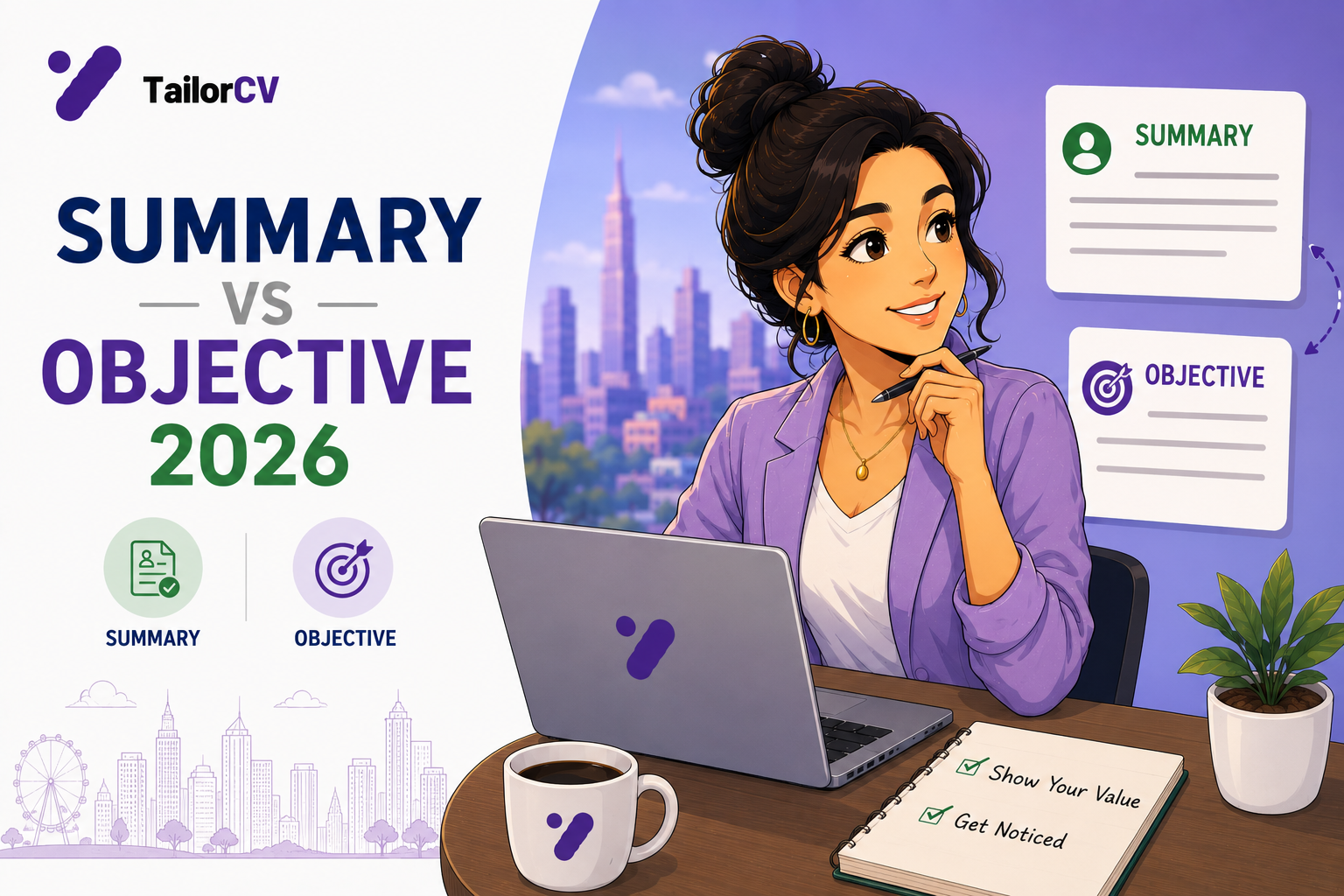
- An objective states what you want; a summary states what you offer.
- A few situations still suit an objective, mainly genuine career changes and first roles.
- Three lines is the working length, and it must be rewritten per role type.
- A generic summary is worse than none, because it wastes the most valuable space on the page.
Why the objective faded
The reasoning behind the shift.
It addresses the wrong reader. An objective describes your goals, while the person reading is assessing whether you solve their problem.
It was almost always generic. Seeking a challenging role in a dynamic organisation described no one and excluded nothing.
It occupied the best space on the page with content that helped nobody decide anything.
The role you are applying to already states the objective. You want this job; that is established by the fact of the application.
And it dated the document. A resume opening with an objective signals a template that has not been revisited in a long time.
The summary inverts all of this by using the same space to state what you bring, which is the question the reader actually has.
What a summary contains
Three lines, doing three jobs.
| Line | Content |
|---|---|
| First | Who you are professionally and at what level |
| Second | The most relevant experience or capability for this role |
| Third | A concrete proof point or the specific value you bring |
Name the role you are applying for, using the posting's title, so the match is immediate.
Include your years or level where it helps rather than where it dates you.
Put one specific thing in it — a number, a named system, a domain — because a summary of pure adjectives is indistinguishable from every other summary.
Avoid the standard filler. Results-driven, detail-oriented and passionate appear on so many resumes that they carry no information at all.
And rewrite it per role type, not per application. One version per kind of job you apply for is usually enough, adjusted lightly each time.
Writing the three lines
A method that produces a usable summary quickly.
Start from the posting. Identify the role's core requirement, because your summary's job is to answer it in the first line.
Write the first line as an identity statement — what you are and at what level — using the title the posting uses rather than your internal one.
Write the second line as your closest relevant capability, choosing the single strongest match rather than listing several.
Write the third line as evidence. A number, a named system, a scale or a domain, which is what separates a summary from a self-description.
Then cut every adjective that survives from the first draft, since almost none of them are earning their space.
Read it against the posting one final time and check that someone comparing the two would see the match immediately.
The whole process takes about ten minutes once you have a version per role type, and it is the highest-return ten minutes in the document.
Summary examples by situation
How the shape changes with circumstance.
Experienced and staying in field. Lead with the level and the specialism, then the strongest capability, then a proof point. This is the simplest case and the most common.
Career changer. Lead with the transferable capability described in the target field's language, then the bridging experience, then evidence that the transition is already underway.
Recent graduate. Lead with the field and the qualification, then the most relevant project or placement, then a concrete outcome from it.
Returning after a break. Lead with the professional identity and level, then the relevant capability, then something current that demonstrates the skills are live.
Contractor moving to permanent. Lead with the breadth of the contract work, then the specialism, then the reason permanent work suits the next stage.
Internal applicant. Lead with your current role and tenure, then the capability the new role needs, then a result from within the organisation that the reader can verify easily.
In every case the structure holds — identity, relevance, evidence — and only the emphasis changes.
Mini checklist
- unchecked: Summary present in the top three lines
- unchecked: Target role named using the posting's title
- unchecked: Level or seniority clear
- unchecked: One concrete specific included
- unchecked: Filler adjectives removed
- unchecked: Length kept to three lines or fewer
- unchecked: Written from the employer's perspective
- unchecked: Version maintained per role type
Scenarios
Scenario 1: You are changing careers
This is the strongest remaining case for objective-like language, but write it as a summary. State the transferable capability first and the direction second, so it opens with what you offer rather than what you want.
Scenario 2: You are applying for your first role
Use a summary built from education, projects and any relevant experience. A graduate with no employment history still has capabilities to state, and an objective adds nothing.
Scenario 3: You are applying within your existing field at your current level
A straightforward summary works. Name the role, the experience and one proof point, then let the rest of the resume carry the detail.
Tip: Write your summary last, after the rest of the resume is tailored. It is a compression of what follows, and writing it first means compressing something that does not exist yet.
Do's and Don'ts
Do
- Write a summary rather than an objective
- Name the target role explicitly
- Include one concrete specific
- Keep it to three lines
- Rewrite it per role type
- Write it after tailoring the rest
Don't
- Open with what you are seeking
- Use filler adjectives
- Keep one summary for a year
- Write five lines of prose
- Repeat your entire resume in miniature
- Leave the space empty
Common Mistakes
- Using an objective. It answers a question nobody asked.
- Generic adjectives. They occupy the best space on the page with nothing.
- A permanent summary. The clearest marker of an untailored resume.
- Excessive length. Beyond three lines it stops being read.
- No specifics. A summary without one concrete detail is decoration.
- Writing it first. It is a compression of the tailored document.
Related Guides
Keep building on this with the related guides in this series:
- How to Write a Resume Summary
- How Recruiters Read Your Resume
- Why the Same Resume for Different Jobs Fails
- Weak Resume Bullets and How to Fix Them
- Resume Update Checklist Before Applying
You can also check your resume's ATS score for free, generate a tailored cover letter, or build a portfolio website in minutes.
Frequently Asked Questions
Should I use a summary or an objective?
A summary, in almost every case. An objective states what you want, while a summary states what you offer, which is the question the reader actually has.
When is an objective still appropriate?
Rarely, and even for career changes it is better written as a summary that leads with transferable capability rather than with your intention.
How long should a summary be?
Three lines or fewer. Beyond that it stops being read, which defeats the purpose of occupying the most valuable space on the page.
What should the summary contain?
Who you are professionally, the most relevant capability for this role, and one concrete proof point. Name the target role using the posting's own title.
How often should I rewrite it?
Per role type rather than per application. Maintain one version for each kind of job you apply to and adjust it lightly for individual postings.
Is no summary better than a generic one?
Close to it. A generic summary wastes the best space on the page, though a specific one is considerably better than leaving that space empty.
How do I write a resume summary quickly?
Start from the posting's core requirement. Write an identity line using their title, a capability line naming your closest match, and an evidence line with something concrete. Then cut every adjective.
Does the summary change for a career change or a graduate?
The structure stays identity, relevance, evidence. A career changer leads with transferable capability in the target field's language; a graduate leads with the field and qualification, then the strongest project.
What is your resume scoring right now?
Scan it against a job description and get your ATS match score in about a minute.
Drop your resume here or choose a file
PDF only. Max 2 MB.
We never share your data or use it to train AI models.

Was this guide useful?
Be the first to rate it.