 SS
SS
Key Takeaways
- Your summary is read first and weighted heavily, which makes it the highest-return edit per application.
- Most people write it once and never change it — the single biggest missed opportunity in tailoring.
- A working formula: role + years + domain + one measurable result, aimed at this posting.
- Three lines maximum. A summary that reads like a full paragraph gets skimmed, not read.
- Generic openers ("results-driven professional") cost you the first line for free — cut them.
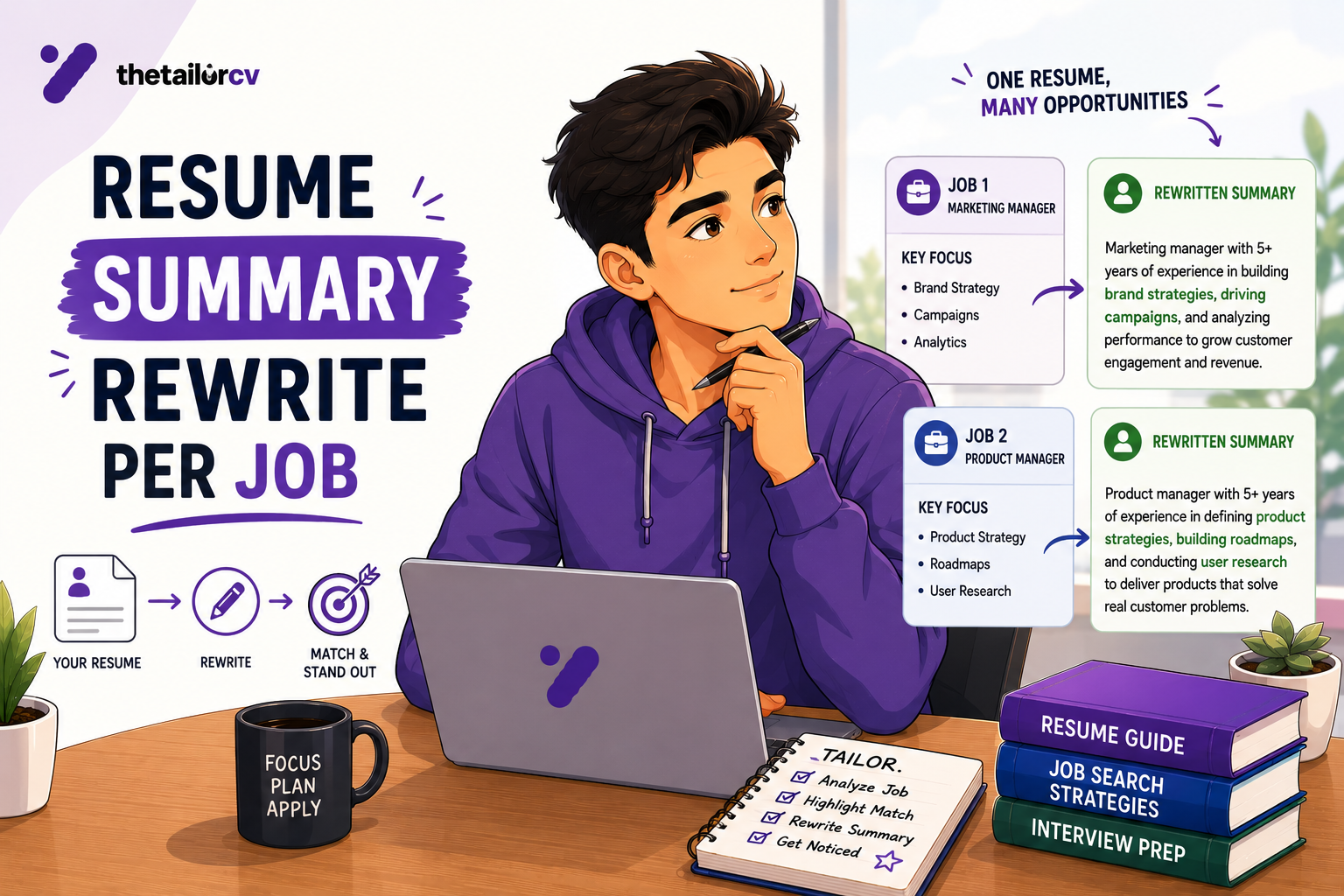
The summary is the first thing read and one of the most heavily weighted pieces of text on your resume, and most people write it exactly once, then leave it untouched across a hundred applications. Rewriting it per posting is a five-minute task that produces outsized return.
Why the Summary Matters More Than Its Length Suggests
Two or three lines is a small fraction of the page, but it is read first by both a human and a matching system, and it sets the frame for everything that follows. A generic opener wastes that position; a targeted one immediately tells the reader "this candidate fits what we asked for."
This is also the section people are least likely to update per application, because rewriting three lines feels less important than the rest of the resume. That instinct is backwards — it is the highest-leverage three lines on the page.
The Formula
Role + years + domain + one measurable result, aimed at the posting.
[Target role] with [X years] in [domain/industry], focused on [2-3 core requirements from the posting]. [One specific, quantified result].
Worked example, for a posting emphasising SQL reporting and stakeholder communication in retail:
Data analyst with 4 years in retail, focused on SQL reporting and stakeholder-facing dashboards. Rebuilt the weekly inventory report, cutting preparation time from 6 hours to 40 minutes.
Every element in that summary is pulled from the posting's actual language, applied to something true.
Before and After, Three Industries
Generic:
Results-driven professional with a proven track record of delivering high-quality work in fast-paced environments.
Software engineering, targeted:
Backend engineer with 5 years building Python and Go services at scale, focused on API reliability and on-call ownership. Reduced P99 latency on the checkout service by 40% through a caching layer redesign.
Healthcare, targeted:
Registered nurse with 3 years in med-surg, specialising in post-operative care and patient education. Reduced 30-day readmission on my unit by 12% through a discharge-checklist protocol I helped design.
Marketing, targeted:
Growth marketer with 4 years in B2B SaaS, focused on lifecycle email and conversion optimisation. Increased trial-to-paid conversion from 8% to 14% through a redesigned onboarding sequence.
Notice the pattern: role, years, domain, then one specific proof point — never an adjective in sight.
What to Cut
Generic openers. "Results-driven," "dynamic," "detail-oriented," "highly motivated" — these describe every applicant equally and say nothing specific. Cut them entirely; the space is better spent on your actual role and domain.
Objective statements about what you want. "Seeking a challenging position that will utilise my skills" tells the reader nothing about you and wastes the position. If you need to state career direction, do it as one clause inside a results-focused sentence, not as the whole summary.
Every skill you have. The summary is not a skills list. Pick the two or three the posting actually cares about; the rest belongs in your skills section.
Long sentences with multiple clauses. Three tight sentences beat one sprawling one. See weak resume bullets for the same discipline applied elsewhere on the page.
The 5-Minute Process
1. Read the posting's first two paragraphs (or the requirements section) and note the two or three things repeated or emphasised most.
2. Write your role and years first. Match the posting's job title where honestly accurate, using the recognisable version of your own title.
3. Name your domain or industry if the posting specifies one. This is frequently omitted and frequently checked.
4. Add one measurable result. Pull from your strongest bullet if you are short on time — see quantifying achievements if you need help finding a number.
5. Read it aloud once. If it sounds like a person describing themselves rather than a list of claims, it is done.
Keeping This Sustainable Across Many Applications
You do not need to write from scratch every time. Keep 2-3 base summary versions for the different types of roles you apply to, and adjust the domain phrase and the result for each specific posting. Most of the formula stays stable; only the specifics targeting that posting change.
If you are applying to genuinely different types of roles — say, both startup and enterprise versions of a similar title — keep separate summaries for each rather than trying to write one that serves both. See why one resume cannot serve every application.
The Line Not to Cross
Every element in your rewritten summary must be true. Naming the posting's domain because you genuinely have that experience is tailoring. Naming a domain you have never worked in because the posting wants it is not — and it sets up an interview question you cannot answer honestly. See improving your score without lying.
Frequently Asked Questions
How long should a resume summary be? Two to three sentences. Longer gets skimmed rather than read.
Should I use "I" in my summary? No — resume summaries are conventionally written without a subject pronoun. "Data analyst with 4 years..." not "I am a data analyst with 4 years..."
Do I need a summary at all? For most roles, yes — it sets context before the reader reaches your experience. Very senior or very technical resumes sometimes skip it in favour of a headline, but a short summary rarely hurts.
Should the summary contain keywords from the job posting? Yes, where they are true of you. This is the single highest-leverage place to use the posting's own language.
How is this different from an objective statement? An objective describes what you want. A summary describes what you offer. Employers care about the second.
Check Whether Your Summary Is Doing Its Job
The fastest way to see if your summary is actually matching what a posting wants is to check it directly.
Scan your resume against the posting and see whether the requirements you tried to name in your summary appear in the missing list. If they do, the wording did not land — usually meaning the term needs to be closer to the posting's exact phrasing.
Free, about a minute. See also how to tailor a resume in 5 minutes and what is a good ATS match score.
What is your resume scoring right now?
Scan it against a job description and get your ATS match score in about a minute.
Drop your resume here or choose a file
PDF only. Max 2 MB.
We never share your data or use it to train AI models.

Templates that keep this structure intact
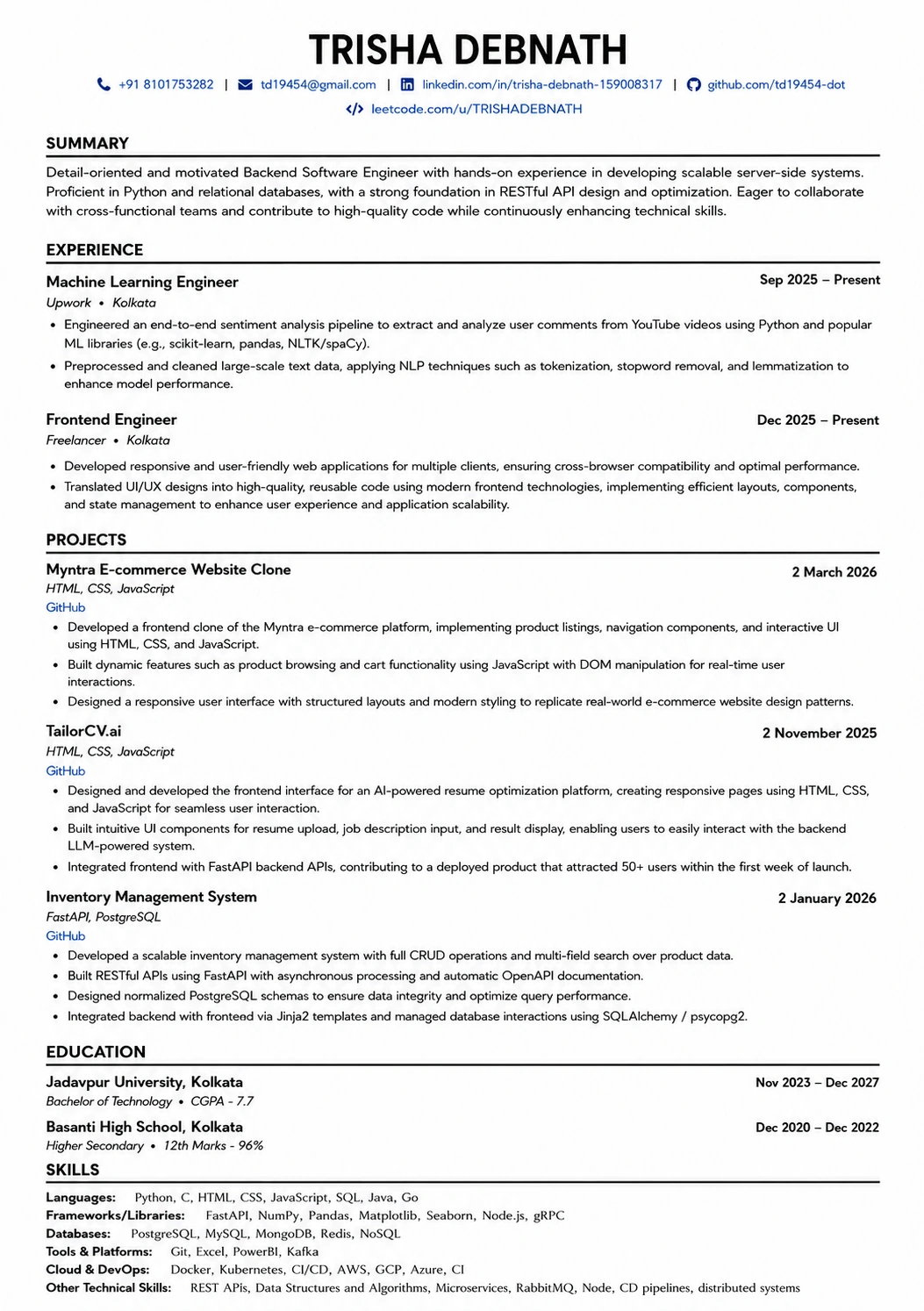
This template is ATS-tested — start from it and the formatting rules in this guide are already handled.
Was this guide useful?
Be the first to rate it.