TD
TD
Key Takeaways
- Malaysian interviews assess skills, fit, and communication — and quietly reward courtesy and punctuality.
- Prepare structured, results-based answers to the common questions using a clear framework (situation → action → result).
- Research the company thoroughly and prepare thoughtful questions to ask them.
- Dress professionally and arrive early; first impressions carry weight.
- Practising out loud — ideally with a realistic mock interview — is the difference between knowing your points and delivering them well.
You've done the hard part — your tailored resume got you shortlisted. Now the interview decides whether you get the offer. In Malaysia, interviews blend professional substance with cultural courtesy: employers assess your skills and fit, but they also notice punctuality, politeness, and how well you communicate across languages and contexts.
This guide gives you everything you need to walk into a Malaysian interview prepared and confident: the most common questions and how to answer them, local etiquette, what to wear, and a preparation routine that consistently turns shortlists into offers.
Before the Interview: Preparation Wins
Most interviews are won or lost before you enter the room.
Research the Company and Role
Know what the company does, its recent news, its products or clients, and how the role fits. Re-read the job description and map your experience to each requirement. This lets you tailor your answers and ask informed questions.
Prepare Your Stories
Most questions can be answered with a short, structured story. Prepare five or six achievement stories that show impact, and practise telling each in under two minutes using a clear structure:
- Situation: the context.
- Action: what you specifically did.
- Result: the measurable outcome.
Generate a personalised set of likely questions with TailorCV interview prep, then rehearse them out loud.
Anticipate the Format
Malaysian employers may use phone/video screens, one or more in-person rounds, panel interviews, and increasingly online assessments (aptitude or technical tests). Ask the recruiter what to expect so nothing surprises you.
Common Malaysian Interview Questions (and How to Answer)
See it in action: a resume-based mock interview
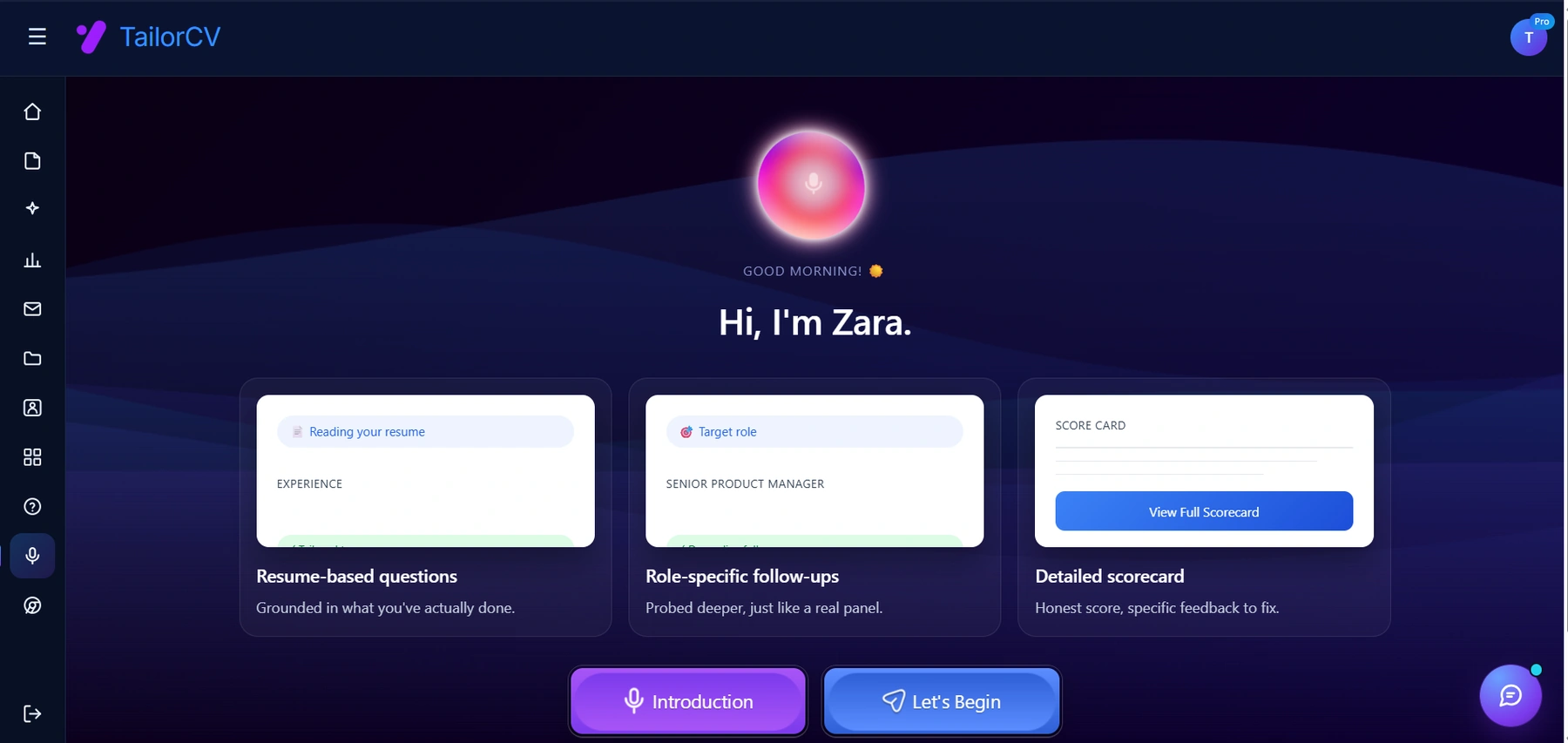
You can rehearse this before the real thing. The interviewer reads your resume first, so the questions come from your actual experience rather than a generic list.
"Tell me about yourself."
A concise 60–90 second professional summary — not your life story. Cover who you are professionally, a key strength or two with evidence, and why you're excited about this role.
I'm a marketing graduate with a year of hands-on experience running social campaigns during my internship, where I grew engagement by 45%. I love turning data into creative that performs, and I'm keen to bring that to a brand-led team like yours.
"Why do you want to work here?"
Show you've researched them. Connect something specific about the company to your goals and values. Avoid generic answers like "it's a good company."
"What are your strengths and weaknesses?"
For strengths, pick two relevant to the role and back them with a quick example. For weaknesses, be honest about a real one and describe how you're actively improving it — never a fake weakness ("I work too hard").
"Tell me about a challenge you faced."
Use the situation–action–result structure. Choose a real challenge, focus on your actions, and end with what you learned or achieved.
"Where do you see yourself in five years?"
Show ambition that aligns with the company. Emphasise growing your skills and taking on more responsibility within the field — not a plan that has you leaving in a year.
"Why should we hire you?"
Summarise your best-fit strengths for this role, tied to their needs. This is your closing pitch — be specific and confident.
"What are your salary expectations?"
Research the market range for the role beforehand and give a researched range rather than a single figure. If pressed early, it's fine to say you're flexible and would like to understand the full role first.
"Do you have any questions for us?"
Always say yes. Ask about the team, success in the role, growth opportunities, or company direction. Thoughtful questions signal genuine interest.
More Questions You Should Prepare For
Beyond the classics above, Malaysian interviewers frequently probe with behavioural and competency questions. Prepare a story for each of these:
"Tell me about a time you worked in a team."
Malaysian workplaces run on collaboration across diverse teams, so this comes up often. Choose an example that shows you contributing, communicating, and helping the group succeed — not just your individual brilliance. Emphasise cooperation and, if relevant, how you bridged different working styles or languages.
"Describe a conflict or disagreement and how you handled it."
Interviewers want maturity, not the absence of conflict. Pick a real, low-drama example, focus on how you listened, stayed respectful, and reached a constructive outcome. Never frame it as you being "right" and someone else being "wrong" — show emotional intelligence.
"Why are you leaving your current job?" / "Why did you leave your last role?"
Stay positive and forward-looking. Frame the move as seeking growth, a new challenge, or better alignment with your goals — never as escaping a bad boss or badmouthing your employer. Even a genuinely difficult situation should be phrased professionally.
"What motivates you?"
Connect your genuine motivators — solving problems, learning, delivering results, helping customers — to the role in front of you. Authenticity plus relevance is the goal.
"Tell me about a time you failed or made a mistake."
Choose a real mistake, take ownership without excessive self-criticism, and focus on what you learned and how you improved afterwards. This question tests self-awareness and resilience.
Role-Specific and Technical Questions
Expect deeper questions tied to the job: a coding exercise or system-design discussion for engineers, a case or numerical question for finance and consulting, a portfolio walkthrough for designers, or a scenario for sales and service roles. Revisit the core concepts of your field, and be ready to think aloud — interviewers often care more about your reasoning than a single "right" answer.
Interview Formats You May Encounter
Malaysian hiring processes vary, and knowing the format helps you prepare:
- Phone or video screen: an early, shorter conversation (often with HR or a recruiter) to confirm basics — your background, interest, availability, and salary range. Be concise and enthusiastic.
- One-on-one interview: the standard format, usually with the hiring manager, focused on your fit and ability.
- Panel interview: several interviewers at once (common at GLCs, MNCs, and for senior roles). Make eye contact with whoever asked the question, but include the whole panel in your answer. Note names if you can and address people respectfully.
- Assessment centre / group interview: used in graduate schemes, involving group exercises, case studies, and presentations. Assessors watch how you collaborate and communicate under pressure — contribute clearly, bring quieter members in, and don't dominate.
- Final round with senior leadership: often more about culture fit, values, and long-term potential than technical detail. Show maturity, genuine interest in the company's direction, and thoughtful questions.
Ask the recruiter in advance how many rounds to expect and what each involves — it's a reasonable question and it lets you prepare precisely.
Salary Negotiation in Malaysia
Money is where many strong candidates leave value on the table. A few principles for the Malaysian market:
- Research first. Know the realistic range for your role, industry, experience level, and location before any number is discussed. KL and Selangor typically pay more than smaller states, reflecting living costs.
- Let them go first where possible. If asked early for a number, it's fine to give a researched range and add that you'd like to understand the full role and package before finalising.
- Consider the whole package, not just base pay: EPF contributions, bonuses, allowances, medical coverage, leave, and growth opportunities all matter.
- Negotiate respectfully and once. When you receive an offer, it's reasonable to counter politely with a justified figure based on your research and value. Stay warm and collaborative — Malaysian business culture rewards courtesy.
- Get the final offer in writing before resigning from any current role.
For fresh graduates, remember that your first job's learning, title, and trajectory often matter more than a small pay difference — but you should still know your market and never undersell yourself.
Handling Difficult or Inappropriate Questions
Occasionally you may face questions that are awkward or that stray into personal territory (marital status, plans to have children, religion, race). You are not obliged to answer personal questions that aren't relevant to the job. Respond gracefully — for example, gently redirecting to your professional suitability: "I prefer to focus on how I can contribute to this role, where I believe my experience in X is a strong fit." Stay calm and professional; how you handle the moment can itself leave a good impression.
For genuinely tough but fair questions — about a gap, a short stint, or a weakness — answer honestly, briefly, and with a forward focus, just as you would in a cover letter.
Fresh Graduate vs. Experienced Candidate
Your emphasis should shift with your experience level:
- Fresh graduates are assessed on potential, attitude, and job-readiness. Lean on internships, final-year projects, co-curricular leadership, and eagerness to learn. Show you understand the role and have prepared seriously — that maturity stands out among peers.
- Experienced candidates are assessed on track record and impact. Lead with quantified achievements, ownership, and how you've grown. For senior roles, weave in leadership, strategy, and how you develop others.
Match your stories to what your level is expected to demonstrate.
Managing Nerves and Body Language
Even well-prepared candidates get nervous. A few practical ways to stay composed:
- Prepare thoroughly — nothing calms nerves like knowing your material and having rehearsed out loud.
- Arrive early so you're settled, not rushing.
- Breathe and slow down. It's fine to take a moment before answering; a considered pause beats a rushed ramble.
- Sit upright, make appropriate eye contact, and smile — open body language signals confidence and warmth.
- Treat it as a conversation, not an interrogation. You're also assessing whether the role fits you.
If you blank on a question, it's perfectly acceptable to ask for a moment to think, or to ask the interviewer to rephrase.
Malaysian Interview Etiquette
- Punctuality is essential. Arrive 10–15 minutes early; account for KL traffic.
- Greet respectfully. A polite greeting and a professional handshake (offered, and read the other person's cue) set the tone. Use titles and surnames unless invited otherwise.
- Be courteous and humble. Confidence is good; arrogance is not. Malaysian workplaces value respect and teamwork.
- Mind your language mix. English is standard for most professional interviews; some may include Bahasa Malaysia. Speak clearly and adapt to the interviewer.
- Body language. Sit upright, make appropriate eye contact, and avoid checking your phone.
- Follow up. A brief thank-you message afterwards is still uncommon and quietly memorable.
What to Wear
- Corporate/finance/MNC: formal business attire — a suit or smart shirt and trousers; conservative and neat.
- Tech/startups: smart casual is often fine, but err slightly formal for a first interview.
- General rule: dress one notch above the company's daily dress code. Clean, well-fitted, and modest always works.
Handling Online Assessments and Video Interviews
- Assessments: practise aptitude and technical tests in advance; read instructions carefully and manage your time.
- Video interviews: test your camera, mic, and connection beforehand; choose a quiet, well-lit space with a tidy background; dress as you would in person; and look at the camera, not the screen.
The STAR Method in Depth
Most behavioural questions ("Tell me about a time you…") are best answered with the STAR structure, which keeps you focused and ensures you finish with impact:
- Situation: briefly set the context — where, when, and what the challenge was. One or two sentences.
- Task: clarify your specific responsibility or goal in that situation.
- Action: the heart of your answer — what you personally did, step by step. Use "I," not just "we," and highlight the skills the role wants.
- Result: the outcome, quantified wherever possible ("cut processing time by 30%," "won the client," "hit 120% of target"). End on the positive impact and, if useful, what you learned.
Prepare five or six STAR stories covering common themes — leadership, teamwork, conflict, a challenge overcome, a mistake, and a proud achievement — and you'll have a flexible bank of material for almost any behavioural question. Rehearse each until you can tell it in under two minutes without rambling. Generate a personalised set of likely questions with interview prep and practise your STAR answers out loud.
Smart Questions to Ask the Interviewer
"Do you have any questions for us?" is not a formality — it's a genuine chance to show interest and judgement. Always have three or four thoughtful questions ready. Strong options include:
- What does success look like in this role in the first six to twelve months?
- What are the biggest challenges the team is facing right now?
- How would you describe the team culture and management style?
- What are the opportunities for growth and development here?
- What are the next steps in the process?
Avoid leading with questions purely about salary, leave, or working hours in an early interview — those are better raised once there's mutual interest or at the offer stage. Tailor at least one question to something specific about the company, which signals you've done your research.
Preparing for Second and Final Rounds
Malaysian employers, especially larger ones, often run multiple rounds. Each has a different emphasis, and adjusting your preparation matters:
- First round (often HR or a recruiter): confirms your background, motivation, communication, and salary expectations. Be concise, positive, and enthusiastic.
- Second round (usually the hiring manager): goes deeper on your skills and how you'd perform in the role. Bring detailed, role-specific examples and be ready for technical or case questions.
- Final round (sometimes senior leadership): frequently about culture fit, values, and long-term potential. Show maturity, genuine interest in the company's direction, and thoughtful questions.
Between rounds, reflect on what came up and refine your answers. If you're asked back, it's a strong signal — prepare accordingly rather than assuming the job is won.
Practise Like It's Real
Reading answers is not the same as delivering them under pressure. The most effective preparation is a realistic rehearsal. The TailorCV AI mock interview asks questions based on your resume and the role, then gives feedback on your answers — so you walk in having already practised. Pair it with interview prep to generate the exact questions you're likely to face.
After the Interview
- Send a short thank-you within a day, referencing something specific from the conversation.
- Reflect on what went well and what you'd improve for next time.
- Follow up politely if you haven't heard back within the timeframe they gave.
Phone and Video Interviews: A Closer Look
More Malaysian hiring now starts remotely, and these formats have their own etiquette:
Phone screens are usually short calls with HR or a recruiter to confirm your background, interest, availability, and salary range. Take the call somewhere quiet, keep your resume and the job description in front of you, smile as you speak (it carries in your voice), and be concise and enthusiastic. Treat it as seriously as an in-person round — it decides whether you advance.
Video interviews require a little setup that pays off:
- Test your technology beforehand — camera, microphone, and internet connection.
- Choose a quiet, well-lit space with a tidy, neutral background.
- Dress fully and professionally, as you would in person.
- Look at the camera, not the screen, to simulate eye contact.
- Minimise distractions — silence your phone and close other apps.
- Have notes nearby (your resume, key points, questions) but don't read from them robotically.
Some employers use one-way recorded video interviews, where you record answers to set questions. Prepare as you would for a live round, do a practice take, and keep your answers structured and within any time limit.
What to Bring and How to Prepare Logistically
For in-person interviews, arrive prepared:
- Several printed copies of your resume (for you and any panel members).
- A notepad and pen for jotting down key points and their answers to your questions.
- Any requested documents — certificates, portfolio, references — neatly organised.
- The interviewer's name and the location details, with your route planned and buffer time for KL traffic.
Small logistical preparation signals professionalism and keeps you calm, so nothing derails you on the day. Rehearse beforehand with the AI mock interview so your delivery is polished when it counts.
Common Interview Mistakes to Avoid
- Not researching the company. It shows immediately and reads as low interest.
- Rambling answers. Structure and brevity beat long, unfocused replies.
- Badmouthing past employers. Always stay professional and positive.
- No questions for them. It signals disengagement.
- Arriving late or flustered. Plan your journey and buffer time.
- Winging it. Under-preparation wastes a hard-won opportunity.
Your Interview Is One Stage of a Strong Application
An interview rarely stands alone — it's the payoff of a well-built application, and it feeds into the next steps. Make sure every part is sharp: the resume that got you here (see how to write a resume for Malaysia jobs and the best resume keywords for Malaysian jobs), a tailored cover letter, and an optimised LinkedIn profile so recruiters keep finding you. If you're targeting the capital, our guide to finding a job in Kuala Lumpur covers its interview-heavy, competitive market, and the complete guide to getting a job in Malaysia ties the whole process together. Preparing your documents and your interview answers together — consistently telling the same strong story — is what converts applications into offers.
Frequently Asked Questions
How should I introduce myself in a Malaysian interview? With a concise 60–90 second professional summary: who you are, a key strength with evidence, and why you're excited about the role — not your full life history.
What should I wear to an interview in Malaysia? Formal business attire for corporate and MNC roles; smart casual (leaning formal) for tech and startups. Dress one notch above the daily dress code.
Are online assessments common in Malaysia? Increasingly, yes — aptitude, personality, or technical tests often accompany the interview process. Practise beforehand and read instructions carefully.
How do I answer salary expectation questions? Research the market range for the role first, then give a researched range rather than a single number. It's fine to ask to understand the full role before committing.
What's the best way to answer "why are you leaving your current job"? Stay positive and forward-looking — frame it as seeking growth, a new challenge, or better alignment with your goals. Never badmouth your current employer, even if the real reason is difficult.
How should I handle a panel interview? Make eye contact with whoever asked the question, but include the whole panel in your answer. Address people respectfully, note names if you can, and stay composed — panels are common at GLCs, MNCs, and for senior roles.
What if I'm asked a personal or inappropriate question? You're not obliged to answer personal questions unrelated to the job. Redirect gracefully to your professional suitability and stay calm — how you handle it can itself leave a good impression.
How do I calm interview nerves? Prepare thoroughly and rehearse out loud, arrive early, breathe and slow down, use open body language, and treat it as a two-way conversation. If you blank, it's fine to pause or ask for the question to be rephrased.
Final Thoughts
A great Malaysian interview combines substance and courtesy: well-structured, results-based answers; genuine research; professional etiquette; and calm confidence. Prepare your stories, anticipate the questions, dress the part, and — above all — practise out loud.
Generate your likely questions with interview prep, rehearse with the AI mock interview, and make sure the resume that got you here is as strong as it can be — see how to get a job in Malaysia and how to write a resume for Malaysia jobs. Walk in prepared, and the offer follows.
Was this guide useful?
Be the first to rate it.