 SS
SS
Key Takeaways
- An internship resolves the employer's two doubts about you — can you do the work, and is the paperwork manageable — before the full-time decision.
- Internship authorisation is usually easier and cheaper than full-time sponsorship, which is why it is the best entry point.
- Applications open roughly a year ahead in every one of these markets, so the decisive application is in your penultimate year.
- Conversion depends on headcount and authorisation policy as much as performance, so ask about both early.
- If you cannot get one, projects, part-time campus work and research are the substitutes — in that order.
Why it is the highest-leverage move
An employer considering an unfamiliar international graduate has two unspoken questions: can this person actually do the work, and how much administrative difficulty comes with them.
An internship answers both. Ten to twelve weeks of observed work removes the first. Having already handled your paperwork once removes the second — and an employer who has done it before does it again far more readily than one being asked for the first time.
That is why the internship, not the graduate application, is usually the decisive one. At many large employers, the intern class is the graduate class — the US conversion dynamic holds broadly across these markets.
Authorisation, by country
Internship authorisation is generally lighter than full-time work authorisation. That is the structural advantage.
United States. CPT covers internships that are part of your curriculum, authorised by your school rather than by USCIS, and it is comparatively fast. One critical trap: twelve months or more of full-time CPT eliminates your OPT eligibility.
Part-time CPT does not. Count carefully before accepting an additional term — the CPT and OPT mechanics are worth understanding before your first internship, not after your third.
Canada. Co-op work permits cover placements that are a required part of your programme. Study permits also permit some off-campus work within limits. The co-op route is a genuine hiring pipeline rather than just experience.
United Kingdom. Student visa conditions permit limited work during term and more during vacations, and placement years are a recognised part of many degrees. The placement year route is well established.
Singapore. Rules differ by whether you study locally or overseas. Local students may undertake attachments forming part of their course; overseas students generally need a training-specific pass, applied for by the employer. Do not assume a Student's Pass permits general employment — the Singapore internship guide covers the distinction.
In every case: confirm with your institution's international office. Rules change, and getting this wrong has consequences beyond losing the role.
Timing
Structured internship programmes at large employers open roughly a year ahead:
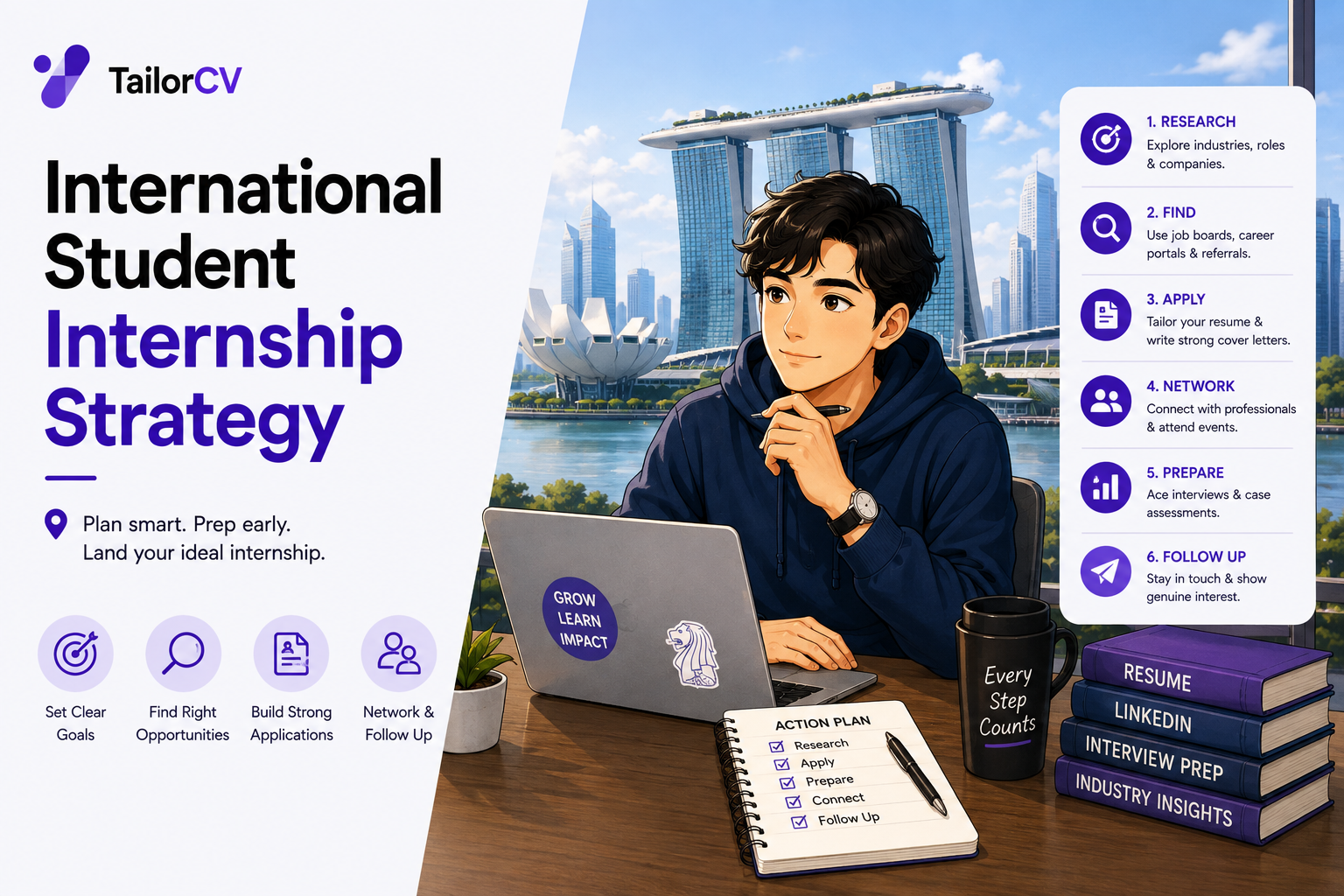
- US: applications from July, peak September, most decided by November
- UK: autumn of the preceding year, with spring weeks running even earlier
- Canada: co-op portals on the academic cycle, several intakes per year
- Singapore: usually the final quarter of the preceding year
The common failure is applying in the spring for that summer. By then the structured programmes closed months earlier and only the on-demand market remains.
For international students the timing pressure is sharper, because any authorisation question slows a hiring process. Being early is worth more to you than to a domestic classmate.
Choosing where to apply
Prioritise employers who have hired international interns before.
Ask directly: "have you supported international students on CPT/co-op previously?" A yes means a process exists.
Larger employers first. More likely to have handled the paperwork, more likely to have an HR function that owns it.
Ask about conversion policy early, not at the exit interview.
"Does the company convert international interns to full-time roles?" is a fair question in a first call. Performance cannot overcome a policy, and finding out in week eleven is too late.
Do not rule out smaller employers entirely — internship authorisation is lighter than full-time sponsorship, so some smaller firms who could never sponsor a graduate can host an intern.
During the internship
The assessment is the same for everyone: communication, ownership, coachability, ramp speed. Managers are judging what you would be like as a colleague for three years.
Two things specific to your situation:
Ask about conversion at the midpoint. "What would you need to see in the second half for a return offer to be realistic?" surfaces problems while you can still fix them, and signals that you want it.
Raise authorisation calmly, once. Confirm what would be needed for a full-time offer and whether the company has done it. Not in week one, and not in the exit interview — around the midpoint, as a logistics question.
Keep your own records: dates, title, responsibilities, outcomes. You will need these for future authorisation applications, and reconstructing them later is unpleasant.
If you cannot get one
Common, and recoverable. In rough order of value:
Projects that exist and run. The strongest substitute, and entirely within your control. Something a hiring manager can open and understand in thirty seconds outperforms another line of coursework — projects that get interviews.
Research with a professor. Real work, a real reference, and frequently authorisation-light because it is on campus.
On-campus employment. Usually permitted with fewer restrictions, and it demonstrates reliability with a local reference.
Remote work for an employer in your home country. Real experience, though it carries less weight than local experience with local references.
Volunteering with a local organisation. Weaker, but it produces references and network in the country where you want to work.
The thing all of these produce that matters most is a local reference — someone in this country who will speak for you.
A two-year plan, by month
"Apply early" is less useful than seeing the actual shape of a plan. This is the calendar for a student on a two-year master's, or the final two years of a bachelor's, targeting a summer internship and then a graduate role.
Year one, September. Two administrative jobs, both boring and both decisive. Book a meeting with the international office and ask one specific question: what work authorisation is available to me, from what date, and what do I need to do to activate it? Write the answer down with dates. Second, find out whether your programme has a required or optional placement component, because that single fact determines which authorisation route you use.
Year one, October to November. Build the artefacts before you need them. One resume in the local format — the US conventions differ from the UK and Singapore ones in ways that matter, and the country-by-country differences are worth reading once. One project that exists, runs, and can be opened by a stranger. A LinkedIn profile that says what you are looking for and when you are available.
Year one, November to January. Applications. This is the window, and most structured programmes in the US, UK and Singapore have opened by now. Volume matters here more than it will at any other point in your career: forty considered applications beats eight perfect ones, because the base rate at this stage is low for everyone and you cannot predict which employer has an authorisation process already in place.
Year one, January to March. Interviews, and simultaneously the second wave of smaller employers who recruit later. Do not stop applying because you are interviewing. The most common self-inflicted wound is pausing applications during a promising process that then ends in week six.
Year one, May to August. The internship. Treat the midpoint conversation as a fixed appointment rather than something you will get around to.
Year two, September to November. Graduate applications, whether or not you have a return offer. A return offer with a deadline is a reason to move faster, not a reason to stop.
The uncomfortable part of this calendar is that the decisive applications happen in your first term, before you feel ready, before your grades are in, and before you know what you want. Everyone is in that position. The students who get placed are not the ones who felt prepared; they are the ones who applied anyway.
Finding employers who have already done this
The single highest-value filter is not company size or prestige. It is whether the employer has hired someone in your situation before, because the first time is a project and the second time is a form.
Four ways to find out, in order of reliability:
Ask alumni from your programme directly. Your university's alumni directory, filtered by employer, gives you names of people who were in your exact position one to three years ago. A short message — "I'm on the same programme you did, I'm applying for internships, did the company handle CPT/co-op for you?" — has a high response rate because the question is specific and easy to answer.
Look at who came to your campus. Employers who recruit at an institution with a large international cohort have generally worked out the paperwork. The career services office knows which employers have hired international students from your programme and will usually tell you if you ask plainly.
Read the application form. Employers who ask the sponsorship question with nuance — separating "do you need sponsorship now" from "will you need it in future" — have usually thought about it. Employers with a single blunt checkbox often have not.
Check the public data where it exists. In the US, employers who file work visa petitions are recorded publicly, and the disclosure data is searchable by company. An employer with a track record of filings is an employer with a process, and this is one of the few genuinely reliable signals available to you.
What none of this tells you is whether this specific team has headcount and appetite. That is what the conversation is for.
The three conversations, scripted
Most of the difficulty here is not knowing what to say. Three moments recur, and having a sentence ready for each removes most of the anxiety.
On the application form. Two checkboxes and no room to explain. Answer both truthfully. Do not attach a document explaining your situation, do not use the "additional information" box to pre-empt a concern nobody has raised yet. The form is a data field.
In the first recruiter call, if they ask. One sentence, three parts: authorised now, for how long, what happens next.
"I'm authorised to work through my programme's curricular training, which my university approves — so for an internship there's nothing the company needs to file. For full-time I'd need sponsorship eventually, and I'm happy to walk through the timing whenever it's useful."
That closes the topic. The long version is covered in how to answer the sponsorship question, and the principle is the same everywhere: brevity signals that it is routine.
At the internship midpoint, with your manager. This is a logistics question, asked calmly, once.
"I'm enjoying this and I'd like to be considered for a return offer. Two things I wanted to understand: what would you need to see in the second half, and does the company convert international interns — is that a route that exists here?"
Asking both together matters. The first shows you want it; the second gets you a factual answer about policy while you still have time to act on it. A manager who says "I don't actually know" is giving you useful information — it means nobody has asked, and it is worth finding out from HR before week eight rather than week eleven.
When your programme has no placement option
A significant number of taught master's programmes have no co-op, no required placement, and no curricular training route. This is the situation students most often read as hopeless, and it usually is not.
Work through it in this order:
Confirm what your status actually permits. Many student visas permit some work without any additional authorisation — on campus, part-time during term, more during vacation. The limits are real and worth knowing precisely. Ask the international office rather than a forum.
Check whether an optional module exists. Some universities offer a credit-bearing project or dissertation-by-placement module specifically to create the curricular link that authorisation requires. It is frequently not advertised, and it is frequently available on request.
Ask whether a summer term registration changes anything. In some systems, remaining registered over the summer alters what you are permitted to do. This varies enough that guessing is unsafe.
If none of that works, build the substitute deliberately. Research with a professor is the strongest option because it produces both real work and a local reference, and it is usually on-campus and therefore authorisation-light. A campus job is weaker but still produces a reference. Remote work for an employer in your home country produces experience without a local reference.
The thing you are actually trying to manufacture is not a line on a resume. It is a person in this country who will vouch for you when an employer calls. Rank your options by whether they produce that.
The money question
Nobody writes about this and it decides a lot of internships.
Structured internships at large employers in the US, UK and Singapore are generally paid, sometimes well. Smaller employers, startups, non-profits and research positions vary enormously, from competitive to nothing.
Three things to work out before accepting:
Whether unpaid is even permitted for you. In some jurisdictions unpaid work has its own authorisation implications, and in others an unpaid position that looks like employment is not lawful regardless of your status. Check before accepting rather than after.
The real cost of relocating for the summer. An internship in an expensive city on a modest stipend can be net negative once housing is counted, particularly if you are also paying rent on an empty room near your university. Some employers provide housing or a relocation allowance; the ones that do not will not mention it, and asking is normal.
What the experience is worth to you beyond the pay. A poorly paid internship at an employer who will convert you is worth more than a well paid one at an employer who cannot. This is one of the few genuinely correct answers to "should I take the lower offer", and it depends entirely on the conversion and authorisation answers you got in week one.
Keep records from day one
This sounds like filing advice. It is actually one of the more consequential habits available to you, because future work authorisation applications, and sometimes permanent residence applications years later, ask for details you will not be able to reconstruct.
What to keep, in one folder, from your first day:
- The offer letter and any amendment, with dates and job title exactly as written
- Your supervisor's full name, title and work email, updated if they leave — people move and become unreachable
- A one-paragraph description of what you actually did, written in the final week while it is fresh
- Any authorisation document issued for the placement, and the dates on it
- Payslips or the stipend agreement, even for a small amount
Two years later, an immigration form will ask for the exact start and end dates of a role you half remember, and the company's HR system will have deleted the record. The folder takes ten minutes to maintain and removes an entire category of future problem.
If the internship is going badly
It happens, and it is more recoverable than it feels in week five.
Distinguish "I am struggling" from "this is not working". New people are slow and confused for a month. That is not failure. Genuine trouble looks like: no work assigned for a week, a manager who avoids meetings with you, or repeated feedback about the same thing.
Ask for the feedback directly, early. "Is my pace where you would expect at this point?" is a question most managers answer honestly, and it converts vague anxiety into something actionable.
If there is no work, say so. Interns frequently sit idle because their manager got busy, and then blame themselves. "I have capacity — is there something I can pick up?" solves it more often than not.
If the conversion is clearly not happening, use the remaining weeks differently.
Build the relationships, get the reference, finish something you can describe in an interview. An internship that does not convert still produces the local reference that changes your graduate applications, and that was always the larger prize.
Common Mistakes
- Applying in the spring for that summer. Structured programmes closed months before.
- Accumulating twelve months of full-time CPT. It destroys OPT eligibility, and students discover it after the fact.
- Assuming your student status permits any work. It frequently does not, and the consequences are serious.
- Not asking about conversion policy until the end. Policy beats performance, and it is knowable in week one.
- Only applying to employers who sponsor full-time. Internship authorisation is lighter; the pools are different.
- Treating the internship as separate from the graduate search. For many employers it is the graduate search.
Frequently Asked Questions
Is an internship really that important?
For international students, yes — more so than for domestic classmates, because it removes the two doubts employers have about hiring you.
Can I intern at a company that will not sponsor me full-time?
Often yes, since internship authorisation is lighter. It is still worth knowing before you start, so you can plan the conversion question realistically.
When should I apply?
Roughly a year ahead. In practice, your penultimate year for a summer placement.
Does an unpaid internship count?
It can count as experience, and in some jurisdictions unpaid work has authorisation implications of its own. Check before accepting, and document it either way.
What if my programme has no co-op or curricular internship option?
Ask your international office what authorisation routes exist for you specifically. Options usually exist; they differ by programme.
How many internships should I do?
One strong one beats three shallow ones — with the important caveat in the US that full-time CPT accumulation can cost you OPT eligibility.
What if I only find an internship for my final summer?
Take it. A final-summer internship rarely converts in time to be your graduate job, but it produces the local reference and the local experience that make your graduate applications materially stronger, and some employers do convert late.
Should I apply to employers who explicitly say they do not sponsor?
For internships, sometimes yes — internship authorisation is often lighter than full-time sponsorship, and a blanket "we do not sponsor" statement on a graduate posting does not always apply to interns. Ask rather than assuming, but do not build your strategy on the exceptions.
Is a remote internship worth doing?
It is worth more than nothing and less than local experience. The gap is the local reference and the demonstrated familiarity with how work happens in that country. If a remote position is your only option, take it and invest separately in building local contacts.
How do I explain a home-country internship on a local resume?
Describe the work and the scale, not the employer's reputation, because a hiring manager will not recognise the name. "Analyst intern at a 400-person logistics firm, built the reporting used by the operations team" travels; the company name alone does not.
Find out where a fresher resume stands
Score yours against a real posting - no account, no cost.
Drop your resume here or choose a file
PDF only. Max 2 MB.
We never share your data or use it to train AI models.

Was this guide useful?
Be the first to rate it.