 SS
SS
Key Takeaways
- The pool of graduates returning to China after studying abroad has grown substantially, meaningfully narrowing the automatic advantage a foreign degree once carried.
- Employers increasingly evaluate specific evidence and demonstrated skill over the credential of having studied overseas alone.
- Timing your return and job search against the domestic recruiting calendar is essential, and a mismatch is one of the most common and avoidable mistakes returning graduates make.
- Your domestic network, likely weakened by years abroad, needs deliberate rebuilding rather than an assumption that connections will simply be there when needed.
- What genuinely transfers from studying abroad is specific and worth articulating clearly, rather than assuming the degree speaks for itself.
Why the advantage has narrowed
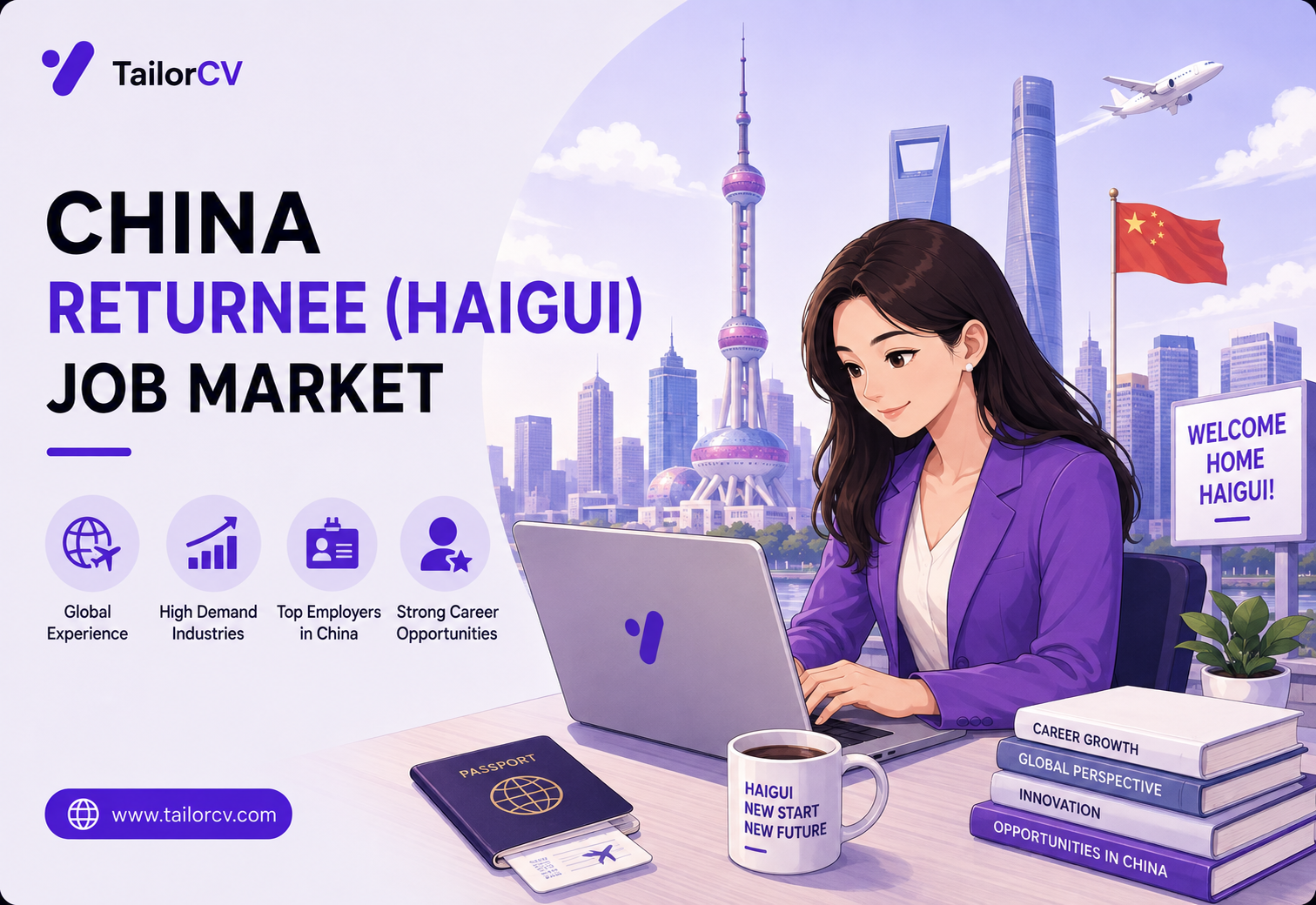
海归 (haigui, literally "sea turtle," a homophone-based nickname for returning overseas graduates) once carried a more automatic premium in the domestic Chinese job market than it generally does today, this is a genuine and significant shift worth understanding honestly before building a job search around outdated assumptions. The term itself is worth knowing — it's how this candidate pool is referred to constantly in Chinese recruiting conversations, job platform filters, and informal discussion, and recognizing it helps you understand how employers are actually categorising and comparing you against other returning candidates.
The pool of graduates returning after studying abroad has grown substantially over recent years, which has meant employers see far more of this profile than in the past, and have correspondingly developed more differentiated, evidence-based ways of evaluating it rather than treating "studied abroad" as a single undifferentiated positive signal.
This does not mean a foreign degree carries no value, it means the value now depends considerably more on the specifics, the institution's actual standing, the relevance of the field of study, and critically, what you can demonstrate you actually did and learned, rather than the fact of having studied abroad alone.
Government and city-level talent programmes still exist specifically to attract high-calibre returnees, and are worth researching if your background is genuinely strong — national and provincial "talent introduction" schemes (historically including programmes referred to under names like the Thousand Talents Plan for more senior researchers, alongside numerous city-specific graduate talent subsidy schemes) offer benefits ranging from cash subsidies to expedited hukou settlement for qualifying returnees. These are generally aimed at a narrower, more accomplished slice of the returnee pool than the general graduate market, but worth checking your eligibility directly rather than assuming they don't apply to you.
What employers now actually evaluate
Specific, demonstrable skills and experience carry more weight than the general credential, a concrete project, relevant internship experience, or a demonstrable skill gained abroad speaks considerably more clearly to an employer than the institution's name alone, similar to the broader principle that evidence outperforms credential in most graduate hiring globally.
Field relevance to the target role matters more than general institutional prestige. A degree closely aligned with your target industry, from a solidly regarded but less globally famous institution, frequently outperforms a prestigious but less relevant degree in the eyes of an employer assessing fit for a specific role.
Language ability, both Mandarin for domestic professional communication and English or another language relevant to the role, is assessed directly rather than assumed from your study history.
Understanding of the current domestic market and industry context matters, and is sometimes genuinely weaker in a returning graduate who has been away for several years, this is worth actively addressing rather than assuming your time abroad alone demonstrates sufficient current market awareness.
Timing your return properly
This is one of the most common and entirely avoidable mistakes returning graduates make. Domestic recruiting runs on the structured national two-season cycle, and a mismatch between your own graduation and return timeline and this calendar can mean missing the primary hiring windows entirely.
Applying before you physically return, if your programme and timeline allow it, is frequently the right approach, exactly as applying before an international move is generally the right approach anywhere, waiting until you have already returned to begin the search often means missing the season that has already opened.
Interview remotely where employers permit it, this is increasingly normal and accepted, and clearly stating your return date in applications removes ambiguity for the employer.
Rebuilding your domestic network
Years spent abroad genuinely weaken domestic professional and personal networks, contacts move, change roles, and simply lose day-to-day connection, this is not a personal failing, it is a predictable consequence of distance and time, and it is worth addressing deliberately rather than assuming your pre-departure network remains as strong and current as it was.
Reconnect with domestic contacts before you need something from them, a genuine, no-agenda message reopening a relationship months before you need a specific favour or introduction lands considerably better than a cold request the week you return.
Your alumni network from the institution you studied at abroad, specifically those who have also returned to China, is a genuinely useful and underused resource, people who have navigated the exact same transition recently have directly relevant, current knowledge that a domestic-only contact does not.
Salary expectations, recalibrated
Your intuition about compensation, calibrated to the country where you studied, is very likely miscalibrated for the domestic market you are returning to, this is worth actively correcting through research rather than carrying forward an expectation formed in a different economic context, exactly the same recalibration challenge that affects any returning graduate globally.
Research current, realistic domestic salary figures for your specific target sector and city directly, the graduate salary guide sets out how to build a realistic figure, rather than assuming your foreign degree commands a substantial automatic premium.
Preparing your specific evidence properly before applying
Translate your specific accomplishments abroad into terms a domestic employer can immediately evaluate, rather than assuming the institution's international reputation alone carries the necessary weight, exactly the same translation discipline that helps any candidate whose credentials come from an unfamiliar system, a specific project, a specific outcome, a specific skill demonstrated concretely, all outperform a general assertion about having studied at a well-regarded foreign institution.
Where possible, build or maintain some connection to the domestic market while you are still abroad, a remote internship, a research collaboration with a domestic organisation, or active participation in relevant professional communities, any of these produce genuine evidence of current market engagement that a purely academic record abroad does not.
Handling the interview stage as a returning candidate specifically
Be prepared to address directly and confidently why you are choosing to return now, and why to this specific market rather than continuing your career where you studied, a genuine, considered answer here matters, employers are aware this is a real decision point for returning candidates and a thoughtful response is well received.
Demonstrate current, specific awareness of the domestic market and industry context during interviews, rather than relying on knowledge that may have been current when you left several years earlier, this is precisely the gap covered in the section on rebuilding market awareness, and it is directly tested through the kinds of questions interviewers ask.
Tip: Apply from abroad before you return, not after. Domestic recruiting runs on fixed seasons, and returning graduates routinely land home just after the window they needed has closed.
Common Mistakes
- Assuming the degree still carries a premium. Assuming the foreign degree alone carries the same premium it may once have carried in the domestic market. The pool of returning graduates has grown, narrowing this advantage.
- Waiting until you land to apply. Waiting until physically returning to China to begin the domestic job search. Frequently means missing the primary recruiting season.
- Not actively rebuilding a weakened domestic network. Not actively rebuilding a weakened domestic network before it is urgently needed.
- Imported salary expectations. Carrying forward salary expectations calibrated to a different country's economic context.
- Assuming time abroad proves market awareness. Assuming general time abroad automatically demonstrates current understanding of the domestic market. Worth actively addressing rather than assuming.
- Leaning on the institution's name. Not articulating specifically what skills and experience you actually gained. Relying instead on the institution's name alone.
Related Guides
Keep building on this with the related guides in this series:
- China Campus Interview Questions - What Is Actually Asked
- China Campus Recruiting - How the Autumn and Spring Cycles Work
- Teaching English in China - A Realistic Guide for Graduates
- The Points System for Foreign Graduate Work Permits in China
- Graduate Salary Expectations in China - A Realistic Guide
- HSK Levels and What They Actually Mean for Employment in China
You can also check your resume's ATS score for free, generate a tailored cover letter, or build a portfolio website in minutes.
Frequently Asked Questions
Is a foreign degree still valuable in the Chinese job market?
Yes, genuinely, though the automatic premium it once carried has narrowed as the pool of returning graduates has grown, specific demonstrable skills and experience now matter considerably more alongside the credential itself.
What does "haigui" mean, and should I use the term myself?
海归 (haigui) is the common term for returning overseas graduates, a homophone-based nickname meaning "sea turtle." You'll see it used constantly in job platform filters and recruiting conversations — worth recognising even if you don't need to use it actively yourself.
When should I start my domestic job search if I am studying abroad?
Before you physically return if your timeline allows, applying early against the national recruiting calendar rather than waiting until you are already back.
Will my network from before I left still be useful?
Likely weakened by time and distance, worth actively reconnecting well before you need something specific, rather than assuming it remains as strong as when you left.
How should I think about salary expectations?
Recalibrate deliberately using current domestic figures for your specific sector and city, rather than carrying forward expectations formed in a different country's economic context.
Does the reputation of my foreign institution matter more than the field I studied?
Field relevance to your target role generally matters more to an employer assessing fit for a specific position than general institutional prestige alone.
What should I emphasise in applications and interviews?
Specific, demonstrable skills and experience gained abroad, current understanding of the domestic market, and language ability, rather than relying on the fact of having studied abroad as sufficient on its own.
What is your resume scoring right now?
Scan it against a job description and get your ATS match score in about a minute.
Drop your resume here or choose a file
PDF only. Max 2 MB.
We never share your data or use it to train AI models.

Was this guide useful?
Be the first to rate it.