 SS
SS
Key Takeaways
- The HSK is the standardised Chinese proficiency test most widely recognised by employers, universities and, in some cases, immigration authorities as a benchmark of Mandarin ability.
- Different levels correspond to genuinely different practical capability, and matching your actual level honestly to a target role's realistic requirement prevents wasted effort in both directions.
- Higher levels, generally from the upper-intermediate range and above, are typically what most professional roles at domestic employers realistically require.
- A stated HSK level on your resume is a credible, verifiable data point that employers can rely on more confidently than a self-described general fluency claim.
- The test measures reading, listening and writing ability specifically, which does not always map directly to spoken fluency, worth understanding this distinction honestly.
What the levels actually represent
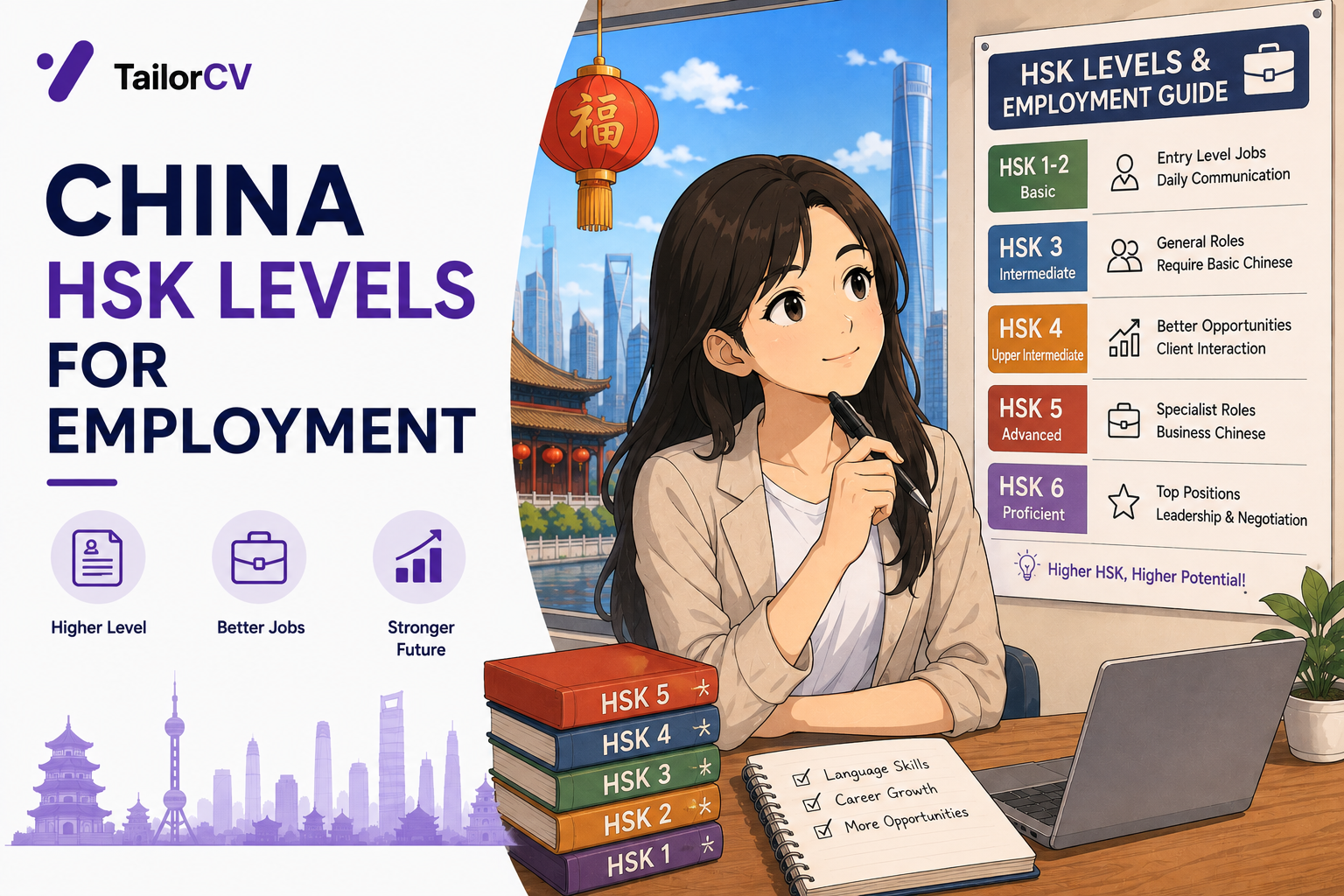
The HSK is structured as six numbered levels under the long-standing standard scale, each representing a defined and tested level of vocabulary knowledge and comprehension ability:
| Level | Vocabulary (approx.) | What it represents | Realistic for professional work? |
|---|---|---|---|
| HSK 1-2 | 150-300 words | Basic beginner competency | No |
| HSK 3 | ~600 words | Functional daily-life ability | Not usually |
| HSK 4 | ~1,200 words | Comfortable handling of everyday professional topics | Realistic floor for functional professional work |
| HSK 5 | ~2,500 words | Complex material, nuanced conversation | Yes, for most professional roles |
| HSK 6 | 5,000+ words | Near-native academic and professional fluency | Required for formal writing, negotiation, high-level communication |
A newer nine-level "HSK 3.0" standard has also been introduced, restructuring the scale into three bands (Elementary, Intermediate, Advanced); check which version a specific employer or programme references, since the two aren't numbered the same way.
The test specifically assesses reading, listening and, at the appropriate levels, writing ability, it does not directly test spoken fluency in the way a conversational interview would, which means someone can hold a strong certified level and still have a speaking ability that lags behind, or occasionally the reverse, worth being honest about this distinction when presenting your ability to an employer.
Lower levels represent basic survival-level ability, useful for daily life and simple interactions but generally insufficient for professional work in a Mandarin-primary environment, regardless of how confident it might feel in casual conversation.
Middle levels represent genuinely functional, conversational ability, adequate for many social and some basic workplace situations, though still often below what a demanding professional role at a domestic employer would realistically require.
Upper levels represent the range most professional roles genuinely need, comfortable handling of complex material, professional documents and nuanced conversation, this is the realistic target for anyone seriously pursuing a career at a domestic Chinese employer or in a Mandarin-primary role.
The highest level represents genuinely advanced, near-native academic and professional fluency, relevant for the most demanding roles, particularly those involving formal writing, negotiation or high-level professional communication in Mandarin.
Matching your level to realistic job requirements
For most professional roles at domestic Chinese employers, HSK 4-5 is generally the realistic baseline expectation, roles below this bar do exist but represent a smaller share of the professional market.
For roles specifically requiring formal writing or high-level negotiation in Mandarin, HSK 6 is frequently a genuine and stated requirement.
For teaching English positions and some specific technical or research roles at multinational companies, a lower or even no certified level may be genuinely sufficient, since the role itself does not primarily operate in Mandarin, worth confirming this specifically against the broader language requirements picture for your target role type.
Honestly assessing where you currently stand against a specific target role's realistic requirement, rather than against a generic sense of "good Mandarin", is the practical exercise that actually matters here.
Presenting your level on applications
State your certified level clearly and specifically on your resume, following the format conventions covered in the resume format guide, a certified level is a far more credible and verifiable data point to an employer than a general self-description of fluency.
If your certified level lags behind your actual spoken ability, or the reverse, address this honestly in an interview if asked, rather than letting either the certificate or a vague claim stand alone as the whole picture, employers who rely on this test as a screening threshold appreciate a candidate who can speak to the gap accurately.
If you do not yet hold a certification but believe your ability meets a target level, consider sitting the test before applying, particularly for roles where a specific level is stated as a requirement, since an unverified claim is a materially weaker credential than a certified one in a market where this test is the widely recognised standard benchmark.
Building toward a target level
Formal coursework, combined with sustained immersion where possible, produces faster and more durable progress than either alone, studying or working in China directly accelerates this considerably beyond what classroom study alone typically achieves.
Target the specific level relevant to your career goal deliberately, rather than studying generally and hoping proficiency naturally arrives at the right point, know which level your realistic target roles actually require and structure your study toward it specifically.
Retesting to demonstrate progress is normal and expected, a certificate showing a lower level from several years ago, alongside genuine current higher ability, is worth updating through a retest before it becomes a liability in an application.
Preparing for the examination itself
Structured test preparation materials specifically for this examination are widely available and organised by level, worth using level-appropriate materials specifically targeting your realistic next milestone, rather than generic study materials not aligned with the test's specific format and structure.
Practise under genuine timed conditions as you approach your target examination date, the format and pacing of the actual test differ meaningfully from open-ended general study, and building comfort with the specific timed format meaningfully improves actual performance beyond what general ability alone would predict.
Balancing test preparation against genuine communicative ability
Do not let examination-specific preparation become disconnected from genuinely useful communicative ability, some learners over-focus narrowly on test-taking technique at the expense of the broader practical fluency that will actually matter once you are working, worth balancing structured test preparation with genuine, varied language use, including conversation practice and exposure to authentic, non-test material.
Tip: Check whether a posting means the classic HSK 1-6 scale or the newer nine-level HSK 3.0 standard before you book a test. The two are not numbered equivalently, and preparing for the wrong one is an expensive mistake.
Common Mistakes
- Assuming any HSK level will do. Assuming any HSK certification, regardless of level, is sufficient for a professional role at a domestic employer. Most professional roles realistically require an upper-intermediate level or above.
- Relying on a self-described general fluency claim. A certified level is a more credible, verifiable data point to an employer.
- Confusing certification with speaking. Confusing a strong certified reading and listening level with equally strong spoken fluency. The test does not directly assess spoken ability in the way an interview would.
- Not retesting to reflect genuine current ability. Lower-level certificate no longer represents your real level.
- Studying without a target level. Studying generally without targeting the specific level your realistic target roles actually require.
- Assuming every role needs HSK 6. Assuming every role requires the highest certified level when many professional roles realistically require somewhat less.
Related Guides
Keep building on this with the related guides in this series:
- China Campus Interview Questions - What Is Actually Asked
- China Campus Recruiting - How the Autumn and Spring Cycles Work
- Teaching English in China - A Realistic Guide for Graduates
- The Points System for Foreign Graduate Work Permits in China
- Graduate Salary Expectations in China - A Realistic Guide
- Hukou and City Settlement for Graduates in China - What It Means
You can also check your resume's ATS score for free, generate a tailored cover letter, or build a portfolio website in minutes.
Frequently Asked Questions
What level do I need for a typical professional job in China?
HSK 4-5 is generally the realistic baseline for most professional roles at domestic employers, with HSK 6 expected for roles involving formal writing or high-level negotiation, though this varies by role and industry.
What's the difference between the old HSK scale and "HSK 3.0"?
The long-standing scale runs HSK 1 through 6; the newer HSK 3.0 standard restructures this into nine levels across three bands. The two aren't numbered equivalently, so check which version a specific employer or programme is actually referencing before assuming your certified level translates directly.
Does the test measure speaking ability?
It specifically tests reading, listening and, at appropriate levels, writing ability, not spoken fluency directly, worth being aware of this distinction and prepared to speak to your actual conversational ability separately if asked.
Should I list my level even if it is relatively low?
Yes, honestly and specifically, alongside context about your actual working ability if it differs meaningfully from the certified level, this is more useful to an employer than omitting language ability from your application entirely.
How long does it take to reach an upper-intermediate or advanced level?
Genuinely a multi-year undertaking for most learners starting from a low base, meaningfully accelerated by studying or working in China directly.
Is a certified level always required, or is genuine fluency without certification acceptable?
Genuine fluency is what ultimately matters for the actual job, though a certified level is a more credible and immediately verifiable signal to an employer in initial screening, particularly at larger organisations.
Do I need the highest level for every role?
No, requirements vary considerably by role and function, some roles realistically require somewhat less, worth matching your target level to your specific target role's genuine requirement rather than assuming maximum is always necessary.
What is your resume scoring right now?
Scan it against a job description and get your ATS match score in about a minute.
Drop your resume here or choose a file
PDF only. Max 2 MB.
We never share your data or use it to train AI models.

Was this guide useful?
Be the first to rate it.