 SS
SS
Key Takeaways
- China runs a formal two-season graduate recruiting cycle, a large autumn season and a smaller spring one, distinct from the single-season model common in the US and UK.
- The autumn season is the primary hiring event for most large employers, opening months before most students expect and closing quickly.
- The spring season serves a genuinely different applicant pool, students who missed autumn, those with newly finished results, and remaining vacancies.
- Large employers publish detailed multi-stage processes, and application volume is enormous relative to the roles available.
- For international students and returnees, understanding both seasons and applying to both meaningfully improves your odds.
The two seasons
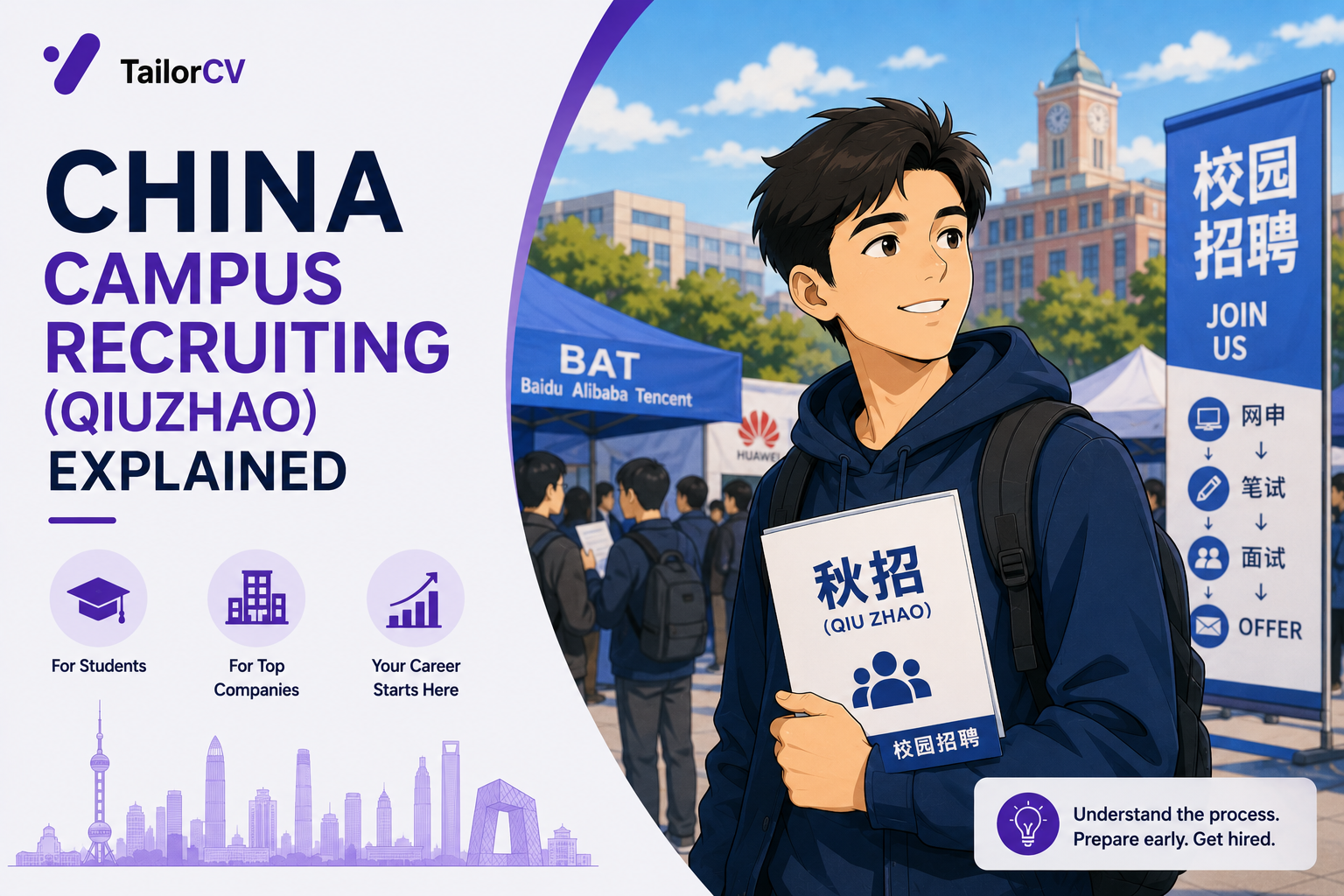
Autumn recruiting — 秋招 (qiūzhāo) — is the primary and largest hiring season, running from late summer through the autumn, aimed at students graduating the following summer. This is where most large employers, particularly major technology firms, state-owned enterprises and multinationals, fill the bulk of their graduate headcount. Knowing the term "qiuzhao" matters practically: it's how the season is referenced on every job platform, in every piece of Chinese-language recruiting advice, and in casual conversation with other job-hunters — search for it directly rather than a generic English translation.
Spring recruiting — 春招 (chūnzhāo) — is a genuinely separate, smaller season, running in the first few months of the calendar year, aimed partly at students who missed or were unsuccessful in qiuzhao, partly at remaining vacancies, and partly at a slightly different pool of graduating students whose final results are only available by that point.
Why both matter. Treating spring as simply a lesser repeat of autumn misunderstands it, some employers genuinely prefer spring candidates for specific roles, and the applicant volume is typically lower, which changes the odds for a candidate applying then rather than waiting an entire additional year for the next autumn cycle.
The scale is enormous relative to most Western markets. Application volumes for major employers routinely run into the hundreds of thousands nationally, which shapes the entire process, heavy automated screening, multiple rounds, and a premium on applying early within each season's window. This scale is worth internalising honestly before your first application — a process built to handle this volume rewards clean, specific, well-matched applications considerably more than a smaller-scale market would, since there's simply less room for a generic document to get a second look.
What the process looks like
Applications open online, typically through the employer's own career site or a small number of dominant recruiting platforms — 前程无忧 (51job), 智联招聘 (Zhaopin), and Boss直聘 (Boss Zhipin) are among the largest general platforms carrying graduate postings alongside company-specific channels — and close on a defined schedule within the season.
Automated screening is heavy, given the volume. A resume that does not clearly match the stated requirements, in the language the posting uses, is unlikely to survive the initial pass, the same underlying dynamic as any large-scale application system, operating at greater scale.
Written tests follow, commonly covering logical reasoning, numerical ability, general knowledge and sometimes role-specific technical content, administered online under time pressure.
Multiple interview rounds typically follow, moving from an initial screen through to a panel or senior interview, with the number of rounds varying by employer and role level.
Group interviews and group discussions appear more commonly in Chinese graduate recruiting than in many Western markets, assessing how you interact and contribute within a group rather than solely on individual answers, worth practising specifically since the format is genuinely different from a one-to-one interview.
Offers can come with defined response deadlines, and large employers manage this at scale, so understanding your own timeline and other applications in progress matters.
Timing, and why it catches people out
Autumn applications frequently open before a student's final year has properly started, and international students in particular, accustomed to a single autumn cycle culminating months later, sometimes discover the window has already opened, and in some cases already closing, before they have begun preparing.
Large employers often complete a substantial share of their annual graduate hiring through autumn alone, which means missing this window is a genuinely significant loss of opportunity, not a minor one.
Building preparation into the summer before your final year, rather than starting in September, is the single most useful timing adjustment available, mirroring the same principle that applies to structured graduate recruiting everywhere.
For international students and returnees
Both major employer categories, multinationals and major domestic firms, run structured recruiting through these same two seasons, though multinationals sometimes run parallel or slightly offset schedules for specific programmes.
Chinese language ability materially affects which channel is realistic for you, covered separately, and worth assessing honestly before committing time to applications that assume native fluency.
Returnees, students who studied abroad and are seeking to work in China, form a distinct and substantial applicant category with their own dynamics, worth reading if this describes your situation.
Applying to both seasons, where your graduation timing allows, genuinely improves your odds, rather than concentrating everything into one attempt.
What each stage of the process actually assesses
- The initial application screen, given the sheer volume, is heavily automated and matches your submitted document against the specific language of the posting, exactly the same underlying mechanism that operates at scale in any large graduate recruitment system, a document that does not extract cleanly or does not use the vocabulary the posting itself uses is filtered before any human ever reviews it, regardless of the genuine strength of your underlying background.
- Written tests, where used, generally assess general aptitude and sometimes role-specific knowledge under real time pressure, this stage is genuinely trainable through dedicated practice, worth investing real preparation time here since it represents one of the more directly improvable stages of the whole process.
- Interview rounds increase in seniority and specificity as you progress, early rounds often assess general fit and basic competency, later rounds probe considerably more deeply into your specific motivations, your understanding of the company and role, and in many cases your actual technical or functional capability for the position.
Preparing a target list across both seasons
Build your target employer list well before either recruiting season opens, rather than reacting to postings as they appear, given the scale and speed at which large employers move through their applicant pools, having your list, your tailored application materials, and your research ready in advance meaningfully improves your odds against a process that rewards early, well-prepared applicants.
Track exactly where you stand with each employer across both the autumn and, where relevant, spring seasons, the volume of parallel applications many candidates manage within this system makes basic organisational discipline genuinely important, losing track of a specific employer's stage or deadline is an entirely avoidable and needlessly costly mistake.
Revisit your list between the two seasons, adding employers you missed in autumn and removing those where the outcome is already clear, treating spring as a genuinely separate, deliberate campaign rather than an afterthought produces meaningfully better results than simply reapplying to the same autumn list without adjustment.
Tip: Search using the Chinese terms — 秋招 for autumn and 春招 for spring — rather than English translations. Every platform, deadline list and student discussion uses those words, and searching in English surfaces almost none of it.
Common Mistakes
- Assuming one recruiting season. Assuming a single annual recruiting season, as in many Western markets. China runs two distinct structured seasons with different characteristics.
- Starting prep in the autumn term. Starting preparation in the autumn term itself. Applications frequently open before the term has properly begun.
- Treating spring as a lesser autumn. Treating spring as a lesser repeat of autumn. A genuinely different pool and, for some roles, a genuinely different opportunity.
- A generic resume at scale. Submitting a generic resume against automated screening at scale. Language matching the posting matters more here than almost anywhere.
- Underestimating group interview formats. Underestimating group interview formats a genuinely different skill from individual interviewing, worth practising specifically.
- Applying to only one season. A meaningful improvement in odds is available by running both.
Related Guides
Keep building on this with the related guides in this series:
- China Campus Interview Questions - What Is Actually Asked
- Teaching English in China - A Realistic Guide for Graduates
- The Points System for Foreign Graduate Work Permits in China
- Graduate Salary Expectations in China - A Realistic Guide
- HSK Levels and What They Actually Mean for Employment in China
- Hukou and City Settlement for Graduates in China - What It Means
- Campus Placement Email Etiquette 2026 - Templates That Get Replies
- Campus Placement Puzzles Guide 2026 - The Logic Questions and How to Solve Them
You can also check your resume's ATS score for free, generate a tailored cover letter, or build a portfolio website in minutes.
Frequently Asked Questions
When does autumn recruiting actually start?
Typically late summer, often earlier than students accustomed to a single Western autumn cycle expect, with applications for many large employers opening well before the academic term begins.
What do "qiuzhao" and "chunzhao" actually mean?
秋招 (qiūzhāo) is autumn recruiting, the larger primary season; 春招 (chūnzhāo) is spring recruiting, the smaller secondary season. Both terms are worth knowing since they're how the seasons are referenced everywhere in Chinese-language job platforms and recruiting discussion.
Is spring recruiting worth pursuing if I missed autumn?
Yes, genuinely. It serves a real and somewhat different applicant pool and is not simply a diminished version of the earlier season.
Do international students go through the same process?
Largely yes, through the same two-season structure, though language requirements and specific employer categories create real differences worth understanding separately.
How many interview rounds should I expect?
Varies by employer and level, commonly several, moving from an initial screen through to a senior or panel round, with group interview formats appearing more often than in many Western markets.
Should I apply to both multinationals and domestic firms?
If your language ability and interests support it, yes, they often run on similar or overlapping timelines and represent genuinely different working environments worth comparing directly.
How important is applying early within a season?
Very. Volume is enormous and early applications are reviewed against a smaller pool before the peak submission period, a meaningful practical advantage.
What is your resume scoring right now?
Scan it against a job description and get your ATS match score in about a minute.
Drop your resume here or choose a file
PDF only. Max 2 MB.
We never share your data or use it to train AI models.

Was this guide useful?
Be the first to rate it.