SS
SS
Key Takeaways
- Employment-based permanent residence is a multi-stage process initiated and largely controlled by your employer.
- The main graduate-relevant categories are distinguished by the qualification and experience the role requires.
- Country of birth, not citizenship, determines whether you face a substantial backlog — and for some countries the wait is measured in many years.
- An employer willing to sponsor a work visa is not necessarily willing to sponsor permanent residence, and these are separate commitments.
- Asking about the employer's policy at offer stage is a normal question and it changes which offers are worth taking.
Why this matters before your first job
Most international graduates focus entirely on the H-1B lottery and think about permanent residence years later. That ordering is understandable and it costs people time, because the decisions that shape this are made at your first or second job.
The process is long. Multiple stages, each taking months, and for some applicants a queue afterwards that runs for years.
Your employer controls it. They decide whether to start, when to start, and they bear the cost and the administrative burden.
Which means the question "does this employer sponsor permanent residence, and at what point?" belongs in your offer conversation, not in a conversation you have in year four. Some employers begin the process in an employee's first year; others wait several years; others do not do it at all while happily renewing a work visa indefinitely.
The stages, in outline
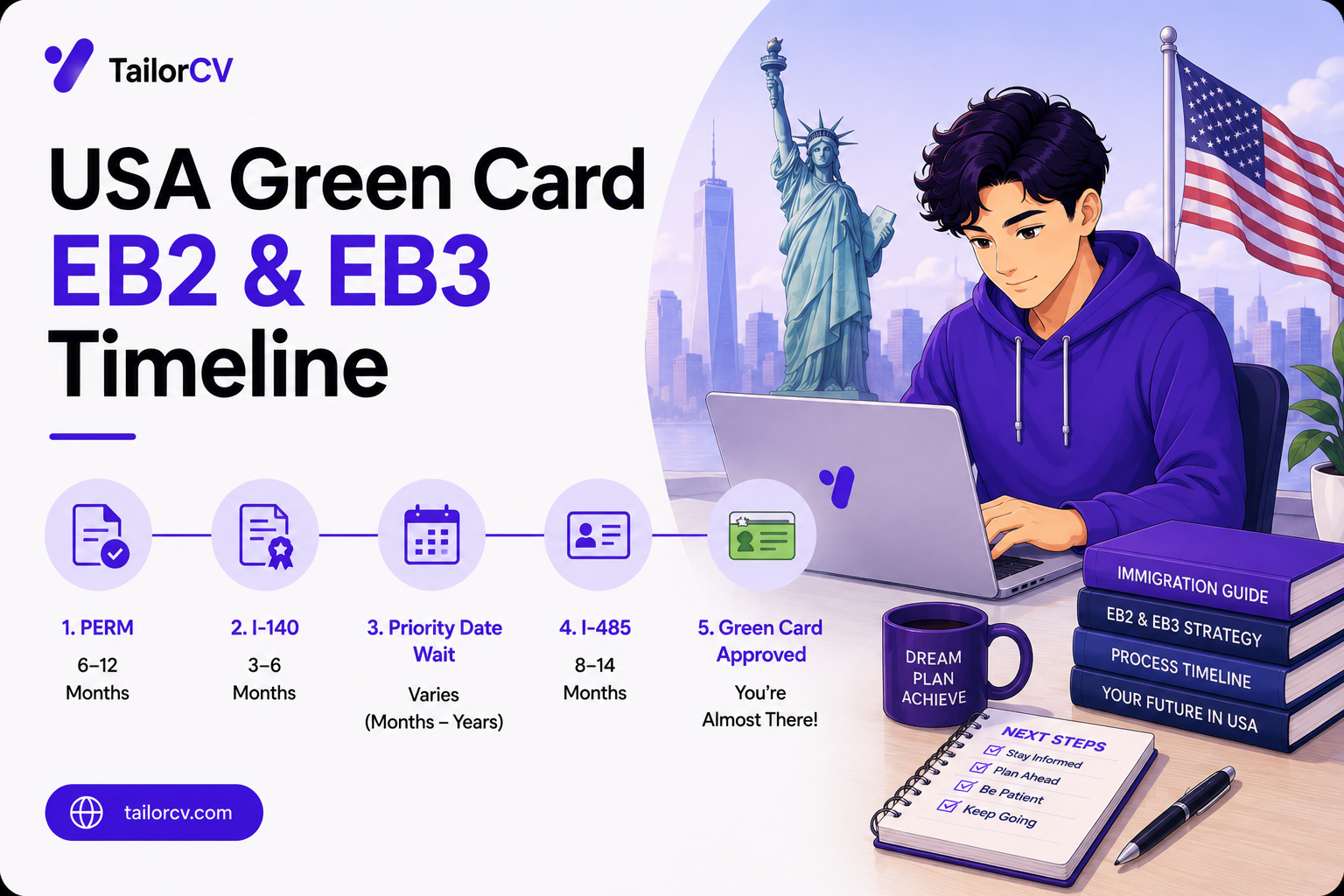
A labour market test — called PERM (Program Electronic Review Management), the Department of Labor's labor certification process. For most employment-based categories, the employer must first test the US labour market for the role through a defined, documented recruitment process, demonstrating that no qualified, willing US worker is available. This stage has its own requirements and timelines, generally takes many months even when uncontested, and is done by the employer's immigration counsel.
An immigrant petition. The employer petitions on your behalf, establishing that the role qualifies under the relevant category and that you meet its requirements.
Waiting for a visa number, if your category and country of birth are backlogged. This is the stage that can take years, and it is entirely outside anyone's control.
Adjustment of status or consular processing, the final stage where permanent residence is actually granted, depending on whether you're already inside the US or applying from abroad.
Throughout, you generally need to maintain valid non-immigrant status, which is why the work visa and the permanent residence process run in parallel rather than sequentially.
The categories that matter for graduates
EB-2 — the category requiring an advanced degree or exceptional ability. Typically relevant where the position requires a master's degree or higher, or a bachelor's plus substantial progressive experience.
EB-3 — the category for skilled workers and professionals. Typically relevant for positions requiring a bachelor's degree, or skilled roles requiring defined experience.
The practical difference for you. The category depends on what the role requires, not simply on what you hold. A master's graduate in a role that only requires a bachelor's is generally sponsored in the category matching the role.
Why the category matters enormously. The backlogs differ between categories, sometimes by many years, for applicants from the most affected countries.
The National Interest Waiver (NIW) is the named route that skips PERM entirely — available within the EB-2 category for individuals whose work is judged to be of substantial merit and national importance, assessed on evidence you accumulate over years rather than on employer sponsorship. It's related in spirit to the O-1 criteria but distinct in mechanics: an NIW petition can, in some cases, be filed by the individual rather than requiring an employer to initiate it at all, which is precisely why it's worth knowing the name and researching whether your own field and evidence base could support one, well before you'd otherwise start the employer-driven process.
The country-of-birth issue
This is the single largest variable and it is entirely outside your control.
Allocation is by country of birth, not by citizenship, and not by where you studied or currently live. Someone born in a heavily-demanded country faces the queue for that country regardless of what passport they hold.
Per-country limits mean high-demand countries develop substantial backlogs. In practice, this affects applicants born in India most severely, with China also facing a substantial, though generally shorter, backlog — a structural consequence of a small number of countries producing a very large share of employment-based applicants against a fixed per-country ceiling. For applicants born in these two countries specifically, the wait between petition approval and permanent residence in the EB-2 or EB-3 categories can run into many years, in some cases longer than a decade.
For applicants born in most other countries, the wait is far shorter, often close to the processing time of the stages themselves rather than a separate multi-year queue on top of them.
The State Department's monthly Visa Bulletin is the actual document that tracks this — it publishes the priority dates currently being processed for each category and country combination, and it's the single source worth checking directly (rather than a general estimate) to see where a specific case actually stands relative to the current queue.
What this means practically. Two colleagues doing identical work, sponsored on the same day by the same employer, can face waits differing by a decade purely because of where they were born. This is not a reflection on either of them and it is a structural feature of the system.
Which is why understanding your own position early, based on your specific country of birth, matters far more here than in most other planning decisions you'll make about your career. If you face a long backlog, it changes the calculation on almost everything — whether to stay, whether to prioritise employers who start the process immediately, whether to consider other countries where the graduate route leads somewhere on a predictable timeline.
Questions to ask an employer
"Does the company sponsor employment-based permanent residence?" A straightforward yes or no, and a surprising number of employers who sponsor work visas do not.
"At what point in someone's tenure does the process typically start?" The range is wide — some begin in the first year, others after several years, and the difference is significant if you face a backlog.
"Who bears the cost?" Employers generally cover the required costs of certain stages; practices on others vary.
"Has the company done this recently, and for people in roles like mine?" A track record means a process exists.
"What happens if I change roles internally?" A material change in the job can affect a pending case.
These are all normal offer-stage questions. Asking them signals planning rather than presumption, and the answers materially change which offer is better for you.
Tip: Ask at offer stage whether the employer sponsors permanent residence and when they typically start. Many employers who happily sponsor an H-1B never file a green card at all.
Common Mistakes
- Assuming a visa means a green card. Assuming work visa sponsorship implies permanent residence sponsorship. They are separate decisions and separate commitments.
- Not asking at offer stage. Not asking at offer stage the answer changes which job is actually better for your situation.
- Not knowing your country-of-birth position. It is the largest variable and it is knowable in advance.
- Assuming the category follows your degree. It generally follows what the role requires.
- Changing jobs at the wrong moment. Some transitions are straightforward and some jeopardise a pending case.
- Relying on general timelines from forums. Backlogs move, categories differ, and the specifics of your case matter.
Related Guides
Keep building on this with the related guides in this series:
- MBA Internship Recruiting Timeline in the US
- 401(k) and Benefits Explained for New Graduates
- US Background Checks - What Employers Actually See
- Cap-Exempt H-1B Employers - The Route Around the Lottery
- Community College Transfer Students - Building a Career Strategy That Works
- US Data Science New Grad Hiring - The Roles, the Loop and the Preparation
You can also check your resume's ATS score for free, generate a tailored cover letter, or build a portfolio website in minutes.
Frequently Asked Questions
Can I sponsor myself?
Certain limited routes exist for individuals whose work meets specific standards of merit or ability. The main employment-based routes require an employer.
Does my country of birth really matter more than my citizenship?
Yes. Allocation is by country of birth, which is why two people with the same passport can face very different waits.
Can I change employers during the process?
Sometimes, with real complexity, and it depends on the stage and the similarity of the new role. This is a situation for specific legal advice rather than general guidance.
Should I choose an employer based on their green card policy?
If you intend to stay long term, it is a legitimate and significant factor — arguably more significant than a modest salary difference, particularly if you face a long backlog.
How long does the whole thing take?
Months to years for the employer-controlled stages, plus a queue that for some countries and categories runs for many years.
Where do I get reliable information?
USCIS publishes the authoritative process guidance, and the State Department's monthly Visa Bulletin shows where the queues currently stand for each category and country. For your own case, an immigration attorney reviewing your specific facts is worth the cost — general guidance, including this article, can tell you the structure of the system, not where your individual case sits within it.
Is India's backlog really that much worse than other countries'?
Yes, structurally so — India and, to a lesser extent, China are the two countries most affected by the per-country limits, a direct consequence of the volume of applicants born there against a fixed ceiling that applies equally regardless of a country's population or the number of qualified applicants it produces.
What is your resume scoring right now?
Scan it against a job description and get your ATS match score in about a minute.
Drop your resume here or choose a file
PDF only. Max 2 MB.
We never share your data or use it to train AI models.

Was this guide useful?
Be the first to rate it.