 SS
SS
Key Takeaways
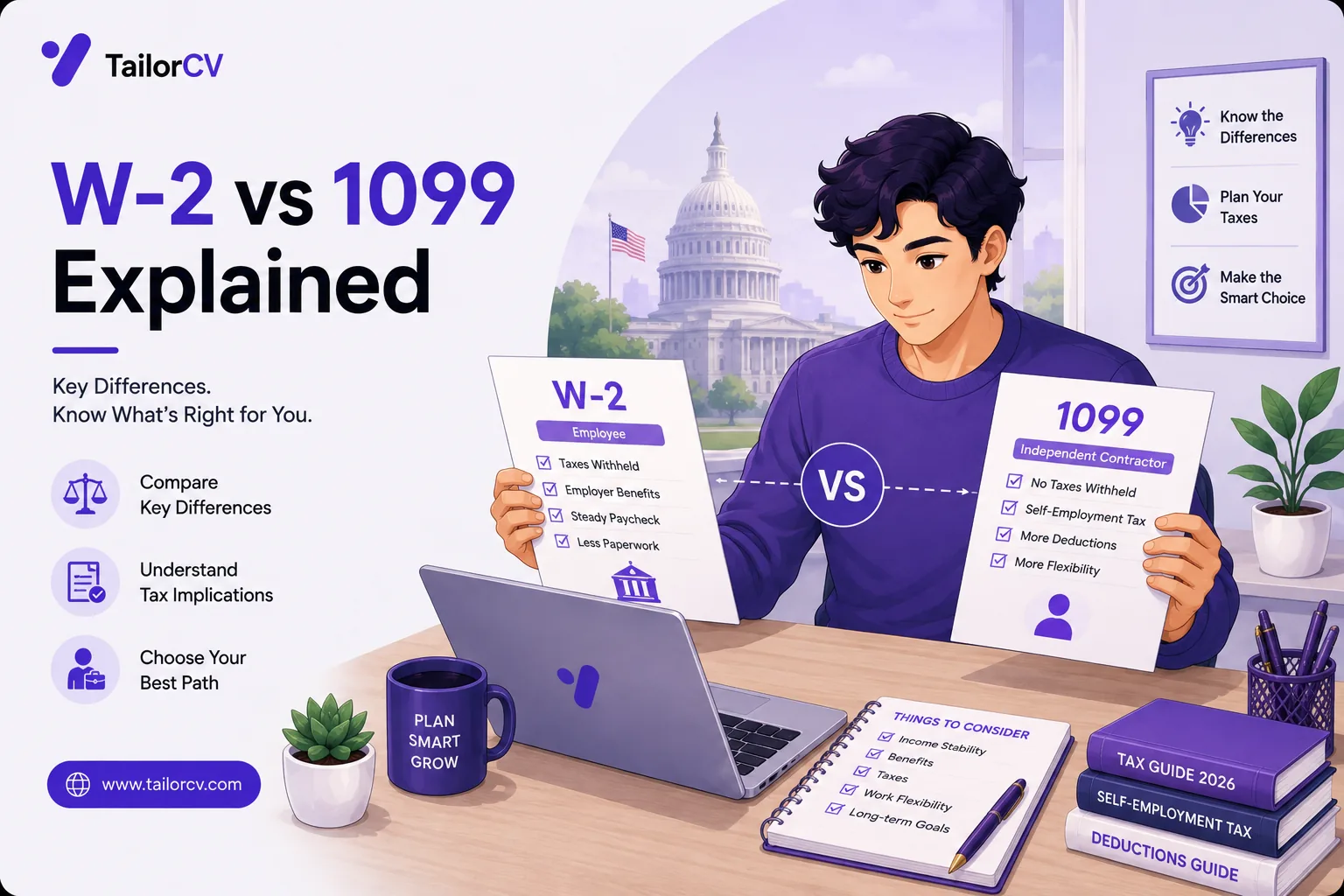
- W2 means you are an employee — the employer withholds taxes and pays half your payroll tax; 1099 means you are self-employed and pay all of it.
- A 1099 rate needs to be meaningfully higher than a W2 salary just to break even, because you absorb self-employment tax, health insurance, and unpaid time off.
- Health insurance is the single biggest hidden cost, since the US ties coverage to employment.
- 1099 contractors get no unemployment insurance, no employer retirement match, and no paid leave.
- Misclassification is real — if the work looks like employment, calling it 1099 does not make it contracting.
"Do you want W2 or 1099?" sounds like an administrative question and is actually a compensation question. The same headline number means very different take-home depending on the answer, and candidates who treat a 1099 rate as equivalent to a salary routinely end up worse off than the job they left.
This guide covers what each arrangement actually means, what it costs, and how to work out the rate you need.
If you are still searching, start with the document doing the work — the free ATS score checker.
The three arrangements
W2 — employee. The classic arrangement. Your employer withholds income tax from each paycheck, pays half your Social Security and Medicare contributions, and typically offers health insurance, retirement matching, and paid time off. You receive a W2 form at year end.
1099 — independent contractor. You are self-employed. Nothing is withheld; you receive the full invoiced amount and are responsible for your own taxes, including both halves of Social Security and Medicare — the self-employment tax. No benefits of any kind. You receive a 1099 form.
Corp-to-corp (C2C). You form your own business entity — commonly an LLC or S-corp — and it contracts with the client company. More administration, potentially better tax treatment depending on your situation, and often the arrangement staffing agencies prefer for higher-rate roles.
W2 through an agency is a fourth common option: you are a W2 employee of the staffing agency rather than of the client. You get some benefits and withholding, but the role itself is a contract.
What 1099 actually costs you
This is where people miscalculate. A 1099 rate is not comparable to a salary — several employer-paid costs move onto you.
Self-employment tax. As an employee, you and your employer each pay half of Social Security and Medicare. As a contractor you pay both halves. That is roughly an extra 7.65% of your income, on top of income tax. There is a partial deduction, but the cash still leaves.
Health insurance. The big one. Employer plans are typically subsidised substantially; buying comparable individual coverage on the marketplace costs far more, and family coverage is dramatically more. This alone can be the difference that makes a higher 1099 rate a pay cut.
No paid time off. Two weeks of holiday and a week of illness is roughly three weeks — about 6% of the year — where a contractor earns nothing.
No retirement match. An employer 401(k) match is straightforward compensation. As a contractor you can still save through a SEP-IRA or solo 401(k), but nobody is matching it.
No unemployment insurance. If the contract ends, there is generally no unemployment benefit. This matters more than people expect, because contracts end abruptly.
Administrative cost. Quarterly estimated tax payments, bookkeeping, possibly an accountant, possibly business insurance.
Working out the rate you need
A rough method, not tax advice — the real number depends on your state, your filing status, and your deductions, and it is worth an accountant's hour before you commit.
Start from your target W2 equivalent and build up:
- Base salary you want to match
- Add ~7.65% for the employer half of payroll tax you now carry
- Add your health insurance cost for the year — get an actual marketplace quote, do not estimate
- Add unpaid time off — roughly 6% if you want three weeks
- Add the retirement match you are giving up
- Divide by billable hours — 2,080 hours in a year minus your unpaid time off, so roughly 1,960
The result is frequently 25-35% above the equivalent salary. If a recruiter offers a 1099 rate that is only slightly above the W2 salary for the same work, it is a pay cut.
On the upside: genuine business expenses may be deductible in a way employee expenses are not, and C2C arrangements can offer additional structuring options. Both are situation-specific and worth professional advice.
Misclassification
Worth knowing because it affects you, not just the employer.
Whether you are an employee or a contractor is determined by the nature of the work, not by what the contract calls it. Broadly, if the company controls how, when and where you work, provides your equipment, and you work set hours alongside employees doing the same job, that looks like employment regardless of the paperwork.
Companies sometimes classify workers as 1099 to avoid payroll tax and benefits obligations. If you are misclassified, you carry costs you should not be carrying, and you lack protections you should have. The IRS and state agencies both have processes for challenging classification.
This is not a reason to refuse all contract work — legitimate contracting is common and often well paid. It is a reason to notice when a "contract" role is functionally a job.
When each makes sense
W2 suits you if: you want stable income, you need employer health insurance (particularly with a family), you value unemployment protection, or you would rather not run quarterly tax admin.
1099 or C2C suits you if: the rate genuinely clears the break-even calculation, you have health coverage another way — a spouse's plan, for instance — you want multiple clients, or you want the flexibility and can absorb the gaps.
Contract-to-hire is a common middle path: a contract period with the possibility of converting to permanent. It is a real route into companies that are cautious about headcount, and it moves faster than permanent hiring — see the US job search timeline.
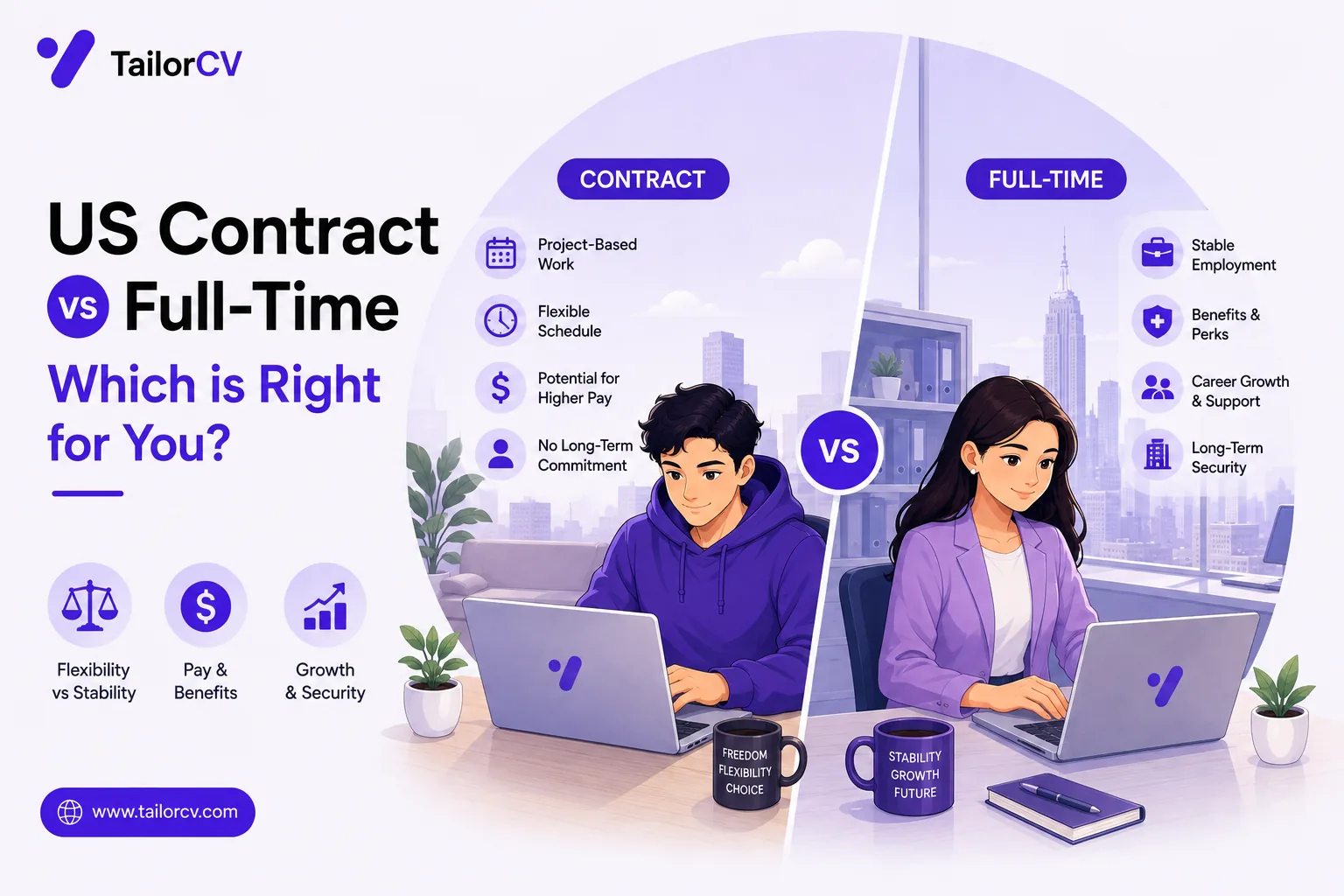
The wider question of whether contract or permanent fits your stage is covered in contract vs full-time in the US.
Common Mistakes
Comparing a 1099 rate directly to a salary. They are not equivalent — the contractor absorbs payroll tax, health insurance, unpaid leave, and the retirement match, which commonly amounts to 25-35% before you break even.
Estimating health insurance instead of quoting it. It is usually the single largest cost in the calculation and it varies enormously by state, age, and family size, so a guess can swing the decision entirely.
Forgetting quarterly estimated taxes. Nothing is withheld from a 1099 payment, so the money arrives looking like income and the tax bill arrives later with penalties for underpayment.
Ignoring the gap between contracts. Contracts end abruptly and there is generally no unemployment benefit, so the rate needs to cover unpaid stretches as well as unpaid holiday.
Not budgeting for time off at all. Three weeks of holiday and illness is about 6% of annual income that simply does not exist as a contractor.
Accepting misclassification quietly. If the company controls your hours, equipment, and how you work, the arrangement may be employment regardless of what the contract says — and the costs of that fall on you.
Skipping the accountant. One hour of professional advice before signing a C2C or 1099 arrangement is cheap relative to a year of getting the structure wrong.
Assuming C2C is automatically better. It adds real administration and only pays off in some situations, so it is worth modelling rather than assuming.
Frequently Asked Questions
What is the difference between W2 and 1099?
W2 means you are an employee — taxes are withheld and the employer pays half your payroll tax and usually provides benefits. 1099 means you are self-employed, receive the gross amount, and pay all taxes and costs yourself.
How much higher should a 1099 rate be?
Commonly 25-35% above the equivalent W2 salary, though the exact figure depends on your health insurance cost, state, and how much time off you want. Work it out rather than using a rule of thumb.
Do 1099 contractors get unemployment benefits?
Generally no. This is one of the more significant protections you give up, and it matters because contracts frequently end without notice.
What is corp-to-corp?
You form a business entity that contracts with the client. It adds administration and can offer tax advantages depending on your situation — worth an accountant's opinion before committing.
Can a company classify me as 1099 to avoid taxes?
Classification depends on the nature of the work, not the label. If the company controls how and when you work, it may be employment regardless of the contract, and there are formal routes to challenge it.
Is contract work bad for my resume?
No — contracting is normal in the US, particularly in technology and specialist fields. Label the roles clearly as contract so the pattern reads as intentional rather than as short tenures.
What is contract-to-hire?
A contract period with the possibility of converting to permanent employment. It moves faster than permanent hiring and is a genuine route into companies cautious about adding headcount.
Whichever arrangement you take, the application starts the same way. Check your ATS score free.
Make This Practical
Do the arithmetic before answering "W2 or 1099". Start from the salary you want, add roughly 7.65% for the employer payroll tax you now carry, add a real marketplace quote for health insurance, add about 6% for unpaid time off, add the retirement match you are losing, then divide by around 1,960 billable hours.
Then check whether the offer clears that number. If a 1099 rate is only marginally above the W2 salary for identical work, it is a pay cut wearing a bigger number.
Finally, get an accountant's hour before signing anything corp-to-corp, set aside money for quarterly estimated taxes from your first invoice, and label contract roles clearly on your resume so the pattern reads as deliberate. The wider stage-of-career question is in contract vs full-time in the US.
What is your resume scoring right now?
Scan it against a job description and get your ATS match score in about a minute.
Drop your resume here or choose a file
PDF only. Max 2 MB.
We never share your data or use it to train AI models.

Was this guide useful?
Be the first to rate it.