TD
TD
Key Takeaways
- Negotiation is expected in the US, and the first offer is rarely the employer's maximum.
- Several states and cities require employers to disclose pay ranges, which turns guessing into positioning.
- Total compensation is the metric - base, bonus, and equity - and equity is often where the real flexibility sits.
- Many jurisdictions now prohibit employers from asking your salary history, so you usually do not have to answer.
- Your level, decided during interviews, affects compensation more than any negotiation afterwards.
American negotiation culture is more direct than most of the world's, and candidates from markets where discussing money is uncomfortable consistently leave value behind - sometimes a great deal of it, compounding over years.
The core facts are straightforward. Employers expect a counter. Recruiters typically have approved ranges with room in them. And an offer is the moment of maximum leverage you will ever have with that employer, because they have already decided they want you and would rather not restart.
This guide covers researching the range, handling the expectations question, and negotiating the whole package.
Before there is an offer to negotiate, your resume has to work - run it through the free ATS score checker.
Research Before You Are Asked
Negotiating without data is guessing, and guessing low is the default failure.
Pay transparency laws. Several US states and cities require employers to include salary ranges in job postings, and some require disclosure on request. This is the most reliable data available - look at postings for the same title in the same market even at other companies, since the ranges are public.
Compensation aggregation sites. Several track self-reported total compensation by company, level, and location, and are particularly detailed for technology roles. Treat them as directional rather than exact.
Levelling matters more than the site. At most large employers, compensation is banded by level. Knowing that a company's L4 and L5 bands differ substantially tells you more than any single reported figure - and it explains why your interview performance affects pay more than negotiation does.
Location adjusts everything. The same role in San Francisco, Austin, and Raleigh can differ substantially, and cost of living offsets much of it. Compare what remains, not the headline.
Ask the recruiter directly. "What's the approved range for this level?" is a normal question in the US and recruiters frequently answer it.
The Expectations Question
It arrives early, usually in the recruiter screen.
Try to defer once:
I'd like to understand the role and level better first. Do you have an approved range for this position?
This works often, particularly where pay transparency rules apply. Whoever names a number first anchors the discussion, and you would rather it were them.
If pressed, give a researched range:
Based on what I've seen for this level in this market, I'm targeting total compensation in the $X to $Y range, though it depends on the mix of base, bonus, and equity.
Two rules:
Put your target near the bottom of the range. Employers hear the lower number. If you want $180k, say $180-200k, not $160-200k.
Talk in total compensation, not base alone. It gives more room to construct a package.
On salary history
Many US states and cities prohibit employers from asking about your salary history, precisely because it perpetuates existing pay gaps.
Even where it is legal, you generally do not have to answer. Redirect:
I'd rather focus on the value of this role and the market rate for it than what I was paid previously.
This is a normal, well-understood answer. If you are currently underpaid, disclosing it anchors your new offer to your old one.
More framing in the salary expectation answer guide.
Negotiating the Offer
Once you have an offer, your leverage is at its peak.
Do not accept on the call. Thank them warmly, express genuine enthusiasm, and ask for the details in writing plus a few days to review. Nobody withdraws an offer over this.
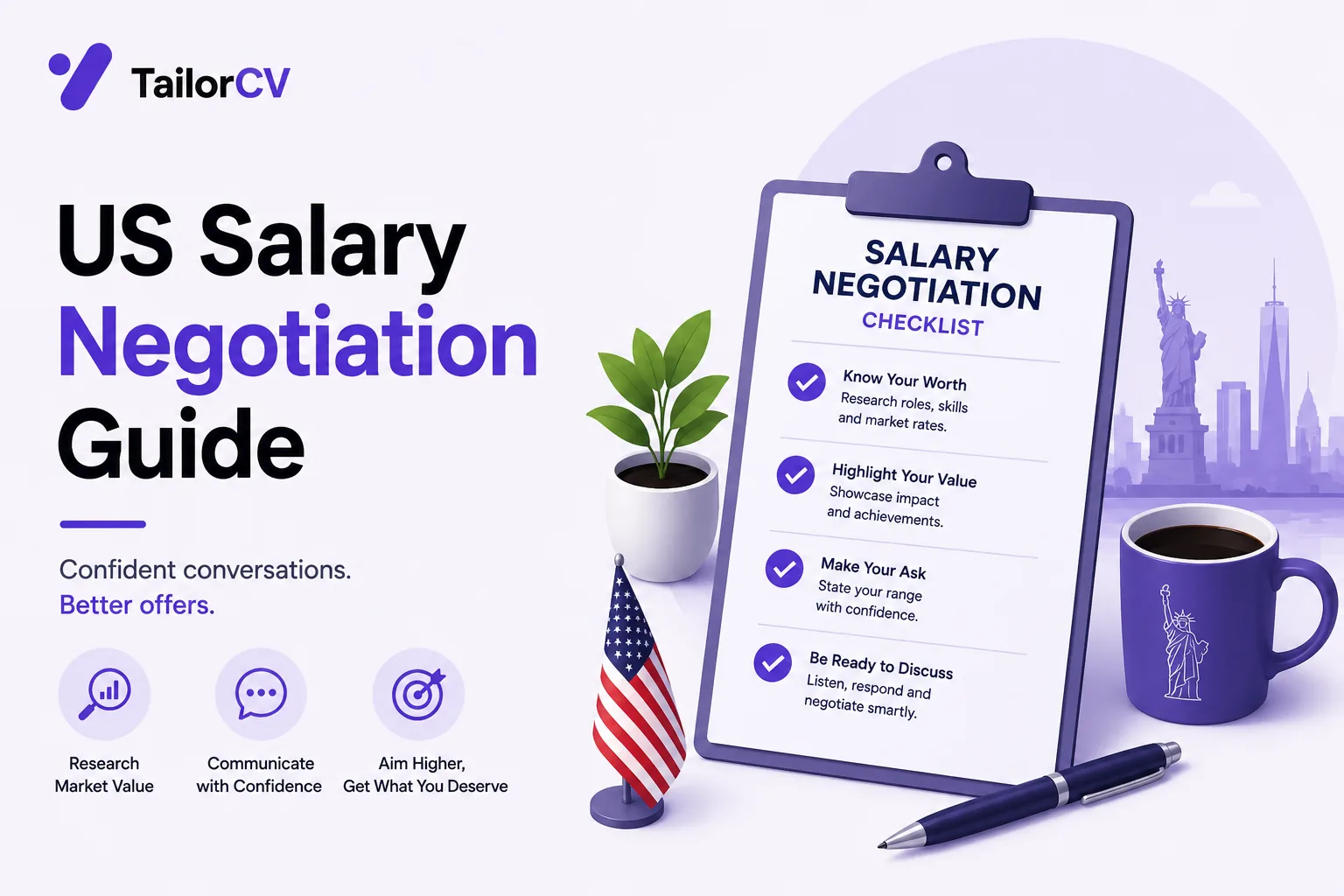
Then make a clear, justified ask:
Thank you - I'm genuinely excited about this and I want to make it work. Based on my research for this level in this market, and the [specific experience] I'd be bringing, I was hoping for total compensation closer to $X. Is there flexibility there?
What makes an ask work:
Justify with market and value, not need. Rent and personal circumstances are not arguments. Market rate and what you bring are.
Be specific about the number. "Could you do better?" invites a token increase. A specific figure gives them something to approve.
Stay warm. The people negotiating with you are your future colleagues. Enthusiastic and firm beats adversarial.
Ask more than once if there is movement, but not endlessly. Two rounds is normal in the US; five is not.
Get everything in writing before resigning your current role.
Negotiate the Whole Package
Base salary is often the least flexible component, particularly within banded structures. These frequently are not:
Equity. Often where the largest flexibility sits, particularly at technology companies. Understand what you are being offered - RSUs versus options, the vesting schedule, any cliff, and what the shares are actually worth today. An extra equity grant is frequently easier for a company to approve than an equivalent base increase.
Signing bonus. The single easiest thing to negotiate, because it is one-time and does not affect internal pay bands. If base is genuinely fixed, ask here.
Annual bonus target. Ask what it is based on and what it has historically paid, not just the maximum percentage.
Level. If you believe you were levelled below your experience, this is worth raising - it affects compensation for your entire tenure, not just year one. It is also harder to change after starting.
Start date. Free to grant, and useful if you need time between roles.
Remote or hybrid arrangement. Worth real money in commuting cost and time, and frequently negotiable.
Relocation assistance, if you are moving.
Professional development budget, conference attendance, and education support.
PTO, though this is often fixed by policy. Note that the US has no statutory minimum paid vacation, so this varies enormously between employers and is worth comparing carefully.
Visa and immigration support, if relevant. Who pays the legal fees is a legitimate question - see the H-1B visa job search guide.
Using Competing Offers
The strongest position in US negotiation, and it requires care.
Run processes in parallel so offers arrive close together. This is standard practice and a major reason not to interview sequentially - see the US tech interview process guide.
Be honest. Do not invent an offer. It is checkable often enough, and being caught ends the process.
Frame it collaboratively, not as a threat:
I have another offer at $X, but I'd genuinely prefer to join your team. Is there anything you can do to close the gap?
If you have no competing offer, market data still works. You do not need leverage to negotiate; you need justification.
Common Mistakes
Accepting on the spot. Costs money for no reason.
Naming a number first when you could avoid it. Anchoring is real.
Building your range around your minimum. They hear the bottom.
Negotiating base only. Equity and signing bonus are frequently more flexible.
Justifying with personal need. Market and value are the arguments.
Disclosing salary history unnecessarily. Often illegal for them to ask, and it anchors you low.
Ignoring level. It affects your pay for years and is harder to change later.
Inventing competing offers. A serious risk for a small gain.
Negotiating adversarially. These are your future colleagues.
Resigning before the offer is in writing. Never.
Comparing base across cities. Cost of living changes the picture substantially.
Frequently Asked Questions
Is it normal to negotiate salary in the US?
Yes, and it is expected. Recruiters typically work within approved ranges that have room in them, and the first offer is rarely the maximum. Not negotiating is the anomaly.
How much should I ask for above the offer?
It depends entirely on where the offer sits relative to market data for that level and location. Research first and make an ask you can justify - a figure grounded in market data lands far better than a percentage from an advice article.
Do I have to tell them my current salary?
Many US states and cities prohibit employers from asking. Even where legal, you can decline and redirect to the market rate for the role. If you are underpaid, disclosing it anchors your offer low.
What if they say the salary is fixed?
Move to the rest of the package - signing bonus is the easiest to move, followed by equity, start date, remote arrangement, and professional development budget. If the level itself seems wrong, raise that.
Can I negotiate as an international candidate needing sponsorship?
Yes. Sponsorship does not mean accepting less - and for H-1B, the employer must pay at least the prevailing wage for the role and location, which sets a floor. Also ask who covers the legal fees.
Will negotiating cause them to withdraw the offer?
Very rarely, when done professionally. Employers expect a counter. What damages a negotiation is being adversarial, endlessly haggling, or misrepresenting a competing offer.
Should I tell them about competing offers?
If they are real, yes - framed collaboratively rather than as an ultimatum. Never invent one.
Get to the offer stage first. Check your ATS score free.
Make This Practical
Research before the first recruiter call, because the expectations question arrives early and an improvised answer costs you. Use pay transparency postings for your title and market, compensation aggregation sites for level bands, and ask the recruiter directly what range is approved.
Then protect the anchor. Try once to get them to state a range, give total compensation rather than base if pressed, put your target near the bottom of any range you name, and decline to disclose salary history - which many jurisdictions bar them from asking about anyway.
Finally, negotiate the whole package once the offer arrives. Never accept on the call, make one specific ask justified by market rate and what you bring, and if base is fixed move to signing bonus, equity, level, start date, and remote arrangement. Run processes in parallel so offers land together, get everything in writing before resigning, and prepare the interviews that decide your level using the US tech interview process guide.
What is your resume scoring right now?
Scan it against a job description and get your ATS match score in about a minute.
Drop your resume here or choose a file
PDF only. Max 2 MB.
We never share your data or use it to train AI models.

Was this guide useful?
Be the first to rate it.