 TD
TD
Key Takeaways
- Contract roles hire faster and pay a higher headline rate, but the rate has to absorb benefits, unpaid time off, and gaps between contracts.
- Contracting is strongest when you have scarce skills, want variety, or need to break into a company that is cautious about headcount.
- Full-time is strongest early career, when you need visa sponsorship, or when you have dependents relying on your health coverage.
- Contract-to-hire is a genuine middle path and is often how companies test candidates they cannot yet justify hiring.
- On a resume, contract roles are fine — label them explicitly so short tenures read as intentional rather than as job-hopping.
The question usually arrives as a fork: a permanent offer and a contract offer, with the contract rate looking dramatically better on an hourly basis. Whether it is better depends on things the number does not show.
This guide covers the real trade-offs, who each suits, and how contracting affects your career over time rather than just this month.
Whichever you pursue, the resume is the same starting point — check it with the free ATS score checker.
What actually differs
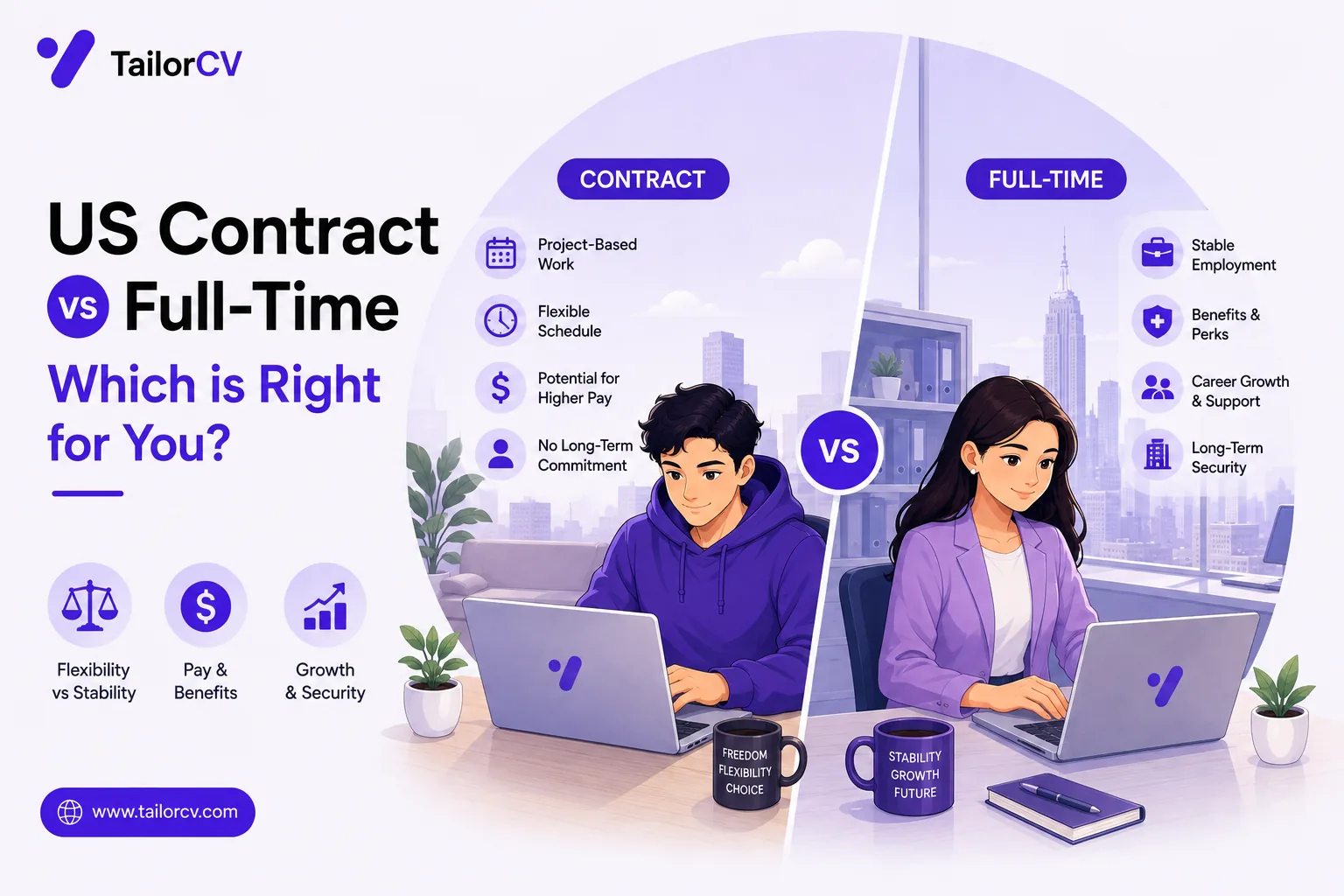
| What differs | Full-time (W2) | Contract |
|---|---|---|
| Hiring speed | 4-8 weeks | Days to 2 weeks |
| Headline pay | Salary | Higher hourly rate |
| Health insurance | Usually employer-subsidised | Yours to arrange, or via agency |
| Paid time off | Typically 10-20 days | Usually none |
| Retirement match | Common | Rare |
| Unemployment benefit | Yes | Generally not on 1099 |
| Job security | At-will, but stable in practice | Contract end date |
| Visa sponsorship | Possible | Rare |
| Variety of work | One employer | Multiple clients over time |
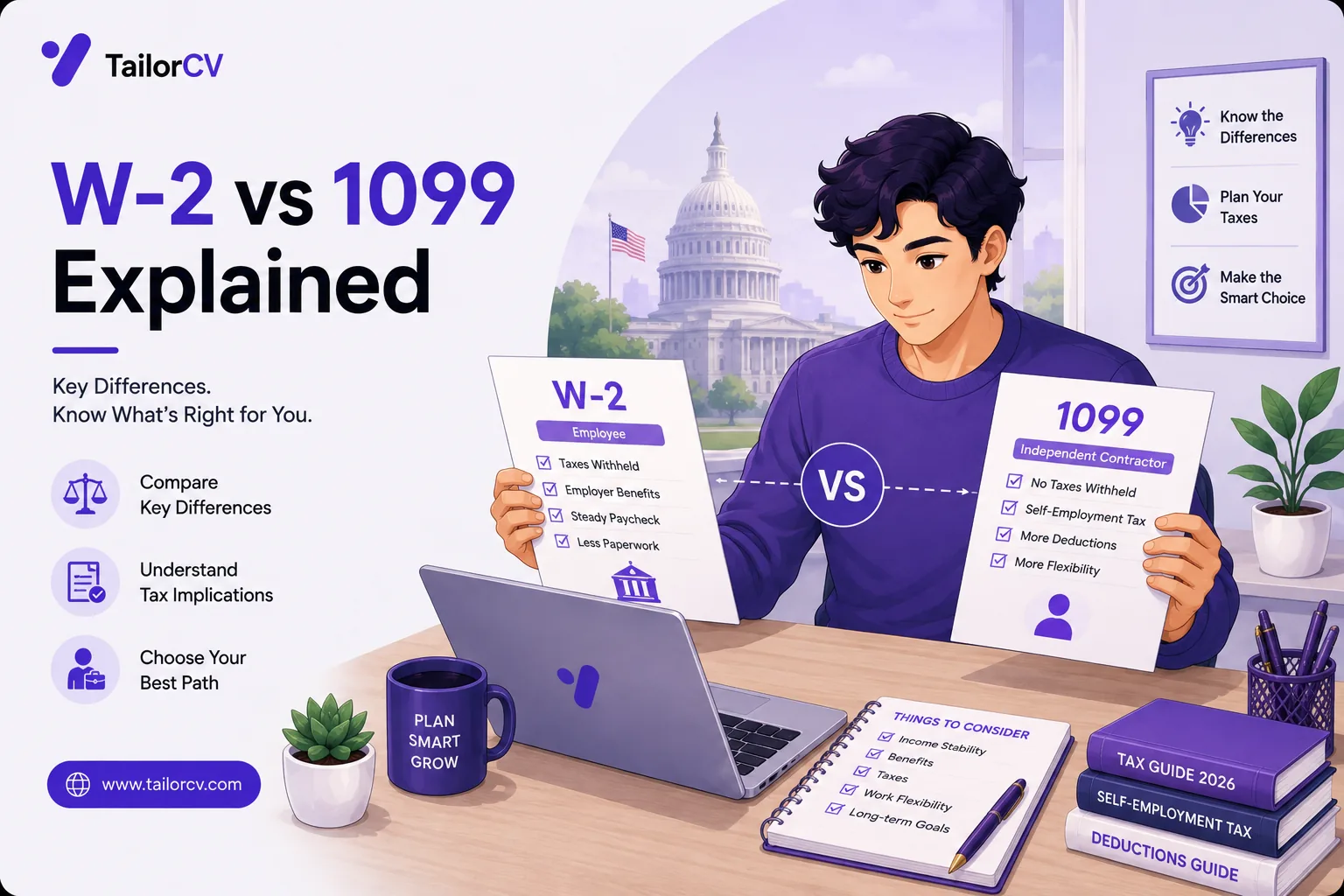
The tax and benefit mechanics behind that table — W2, 1099, corp-to-corp, and how to compute a break-even rate — are covered in W2 vs 1099 explained.
When contracting is the right call
Your skills are scarce. Specialist skills command a premium in contract markets that permanent salary bands often cannot match. If companies struggle to hire what you do, contracting captures more of that value.
You want to break into a specific company. Headcount approval is slow and political; contract budget is frequently easier to release. Plenty of people join a target company on contract and convert later — the manager already knows your work by then.
You want variety, or you are exploring. Several clients across a couple of years teaches you more about which environments suit you than three years in one.
You need speed. Contract hiring can be days rather than months, which matters if you are between roles. See the US job search timeline.
You have coverage elsewhere. A spouse's health plan removes the single largest cost of contracting and changes the arithmetic substantially.
You are late career and want flexibility. Contracting suits people who want to work selectively rather than continuously.
When full-time is the right call
Early career. You need mentorship, structured feedback, and the visible progression of promotions. Contract work is often deliberately narrow — you are hired to do a defined thing, not to be developed.
You need visa sponsorship. Contract roles rarely sponsor. If your status depends on employment, permanent is generally the route — see how to get a job in the USA as an international candidate.
Dependents rely on your health insurance. Family coverage bought individually is expensive enough to erase a substantial rate premium.
You want equity. Contractors do not receive RSUs or options. At a company whose upside is in equity, that is the majority of the compensation.
You value predictability. Contracts end. Some people find the rolling uncertainty genuinely draining, and that is a legitimate reason to choose stability.
You want to be promoted. Contractors are rarely inside the promotion process, however good the work.
Contract-to-hire
Worth treating as its own category rather than a compromise.
A defined contract period — commonly three to six months — with the stated possibility of converting to permanent. Companies use it when they want someone now and cannot yet justify a permanent requisition, or when they want to reduce hiring risk.
Ask before accepting:
- What does conversion actually depend on? Performance, or headcount approval that may never arrive?
- How often has it converted before? If the honest answer is "rarely", treat it as a fixed-term contract and price it accordingly.
- What is the salary on conversion? Frequently below your contract rate, because benefits resume. Know the number in advance rather than discovering it at the end.
- Who employs you during the contract — the client, or an agency?
The conversion dynamics mirror internship conversion, and the same behaviours matter: reliability, communication, finishing what you start. Converting an internship into an offer transfers almost directly.
Contracting on your resume
A real concern, and mostly a solvable one.
Label every contract role explicitly. "Senior Data Engineer (contract, 8 months)" tells the reader the tenure was by design. Unlabelled, three eight-month roles look like someone who cannot hold a job.
Name the client where you can. "via [Agency] at [Client]" is clearer than the agency name alone, which reveals nothing about the work.
Group long contracting stretches. If you contracted for four years across six clients, a single heading — "Independent Consultant, 2022-2026" — with clients listed beneath reads far better than six separate entries.
Keep the achievement discipline. Contract work is often more measurable than permanent work, because you were hired for a specific outcome. Use it — see how to quantify achievements on your resume.
Expect the question. "Why contract?" is asked, and "the rate was better" is a weaker answer than "I wanted exposure to several data platforms quickly, and I got it." Have the intentional version ready.
Common Mistakes
Comparing the hourly rate to a salary directly. The rate must absorb payroll tax, health insurance, unpaid time off, and gaps — commonly 25-35% before you break even, as W2 vs 1099 sets out.
Assuming contract-to-hire will convert. Ask what conversion depends on and how often it has happened; if the answer is vague, price the role as a fixed-term contract.
Not knowing the conversion salary in advance. It is frequently below the contract rate because benefits resume, and discovering that at month five is a bad time to negotiate.
Taking a contract while needing visa sponsorship. Contract roles rarely sponsor, and the arrangement can complicate status in ways that are expensive to unwind.
Leaving contract roles unlabelled on a resume. Short tenures read as instability unless the reader can see they were fixed-term by design.
Contracting too early in a career. Contract roles are scoped narrowly and rarely come with mentorship, which is the thing that compounds most in your first few years.
Ignoring the gap between contracts. Two unpaid months a year is a real cost that the headline rate has to cover.
Forgetting equity. At companies where the upside is in stock, a contractor is opting out of most of the compensation.
Frequently Asked Questions
Does contract work look bad on a resume?
Not if labelled clearly. Contracting is normal in the US, particularly in technology and specialist fields. Mark each role as contract with its duration so the pattern reads as intentional.
Is contract work less secure?
It has a defined end date, but at-will employment means permanent roles carry less security than people assume. The practical difference is that a contract ending is expected and usually comes without unemployment benefit.
Can I negotiate a contract rate?
Yes, and there is often more flexibility than in salary bands. Know your break-even number before the conversation.
Should I take contract-to-hire?
It can be a genuine route into a company that cannot yet approve headcount. Ask what conversion depends on, how often it has happened, and what the converted salary would be.
Do contractors get benefits?
On 1099, generally not. Through a staffing agency on W2, sometimes limited benefits. Always confirm which arrangement you are actually being offered.
Can I contract while on a visa?
Usually difficult. Most work visas tie you to a sponsoring employer, and contract arrangements rarely fit. Get immigration advice before considering it.
How do I explain contracting in an interview?
With intent. Name what you were getting out of it — exposure, specific skills, a market you wanted to learn — rather than citing the rate. The pattern is fine; sounding accidental is not.
Both routes start with a resume that clears screening. Check your ATS score free.
Make This Practical
Convert the contract rate into a salary equivalent before comparing anything. Subtract payroll tax, a real health insurance quote, unpaid time off, and an allowance for gaps between contracts — then see whether it still beats the permanent offer.
Then match the choice to your situation rather than the number. Early career, needing sponsorship, supporting dependents on your insurance, or wanting equity all point to permanent. Scarce skills, a target company with no headcount, wanting variety, or having coverage elsewhere all point to contract.
Finally, if you contract, protect the resume. Label every role as contract with its duration, name clients where permitted, group long stretches under a single consulting heading, and prepare an intentional answer to "why contract?" using how to quantify achievements on your resume to make each engagement's outcome concrete.
What is your resume scoring right now?
Scan it against a job description and get your ATS match score in about a minute.
Drop your resume here or choose a file
PDF only. Max 2 MB.
We never share your data or use it to train AI models.

Was this guide useful?
Be the first to rate it.