 SS
SS
Key Takeaways
- A US background check verifies employment dates, education, and criminal history — and dates are where most offers unravel.
- Offers are usually "contingent" until the check clears, so do not resign until you have written confirmation.
- Inflating a job title or stretching dates by a few months is the most common self-inflicted failure.
- Under the FCRA you must be told before an adverse decision and given a chance to dispute the report.
- Ban-the-box and salary-history laws vary by state, so what an employer may ask depends on where you are.
The background check is the last stage of a US hire and the one candidates think least about. That is a mistake, because it is where offers get withdrawn — almost never for a criminal record, and very often for a resume that did not survive verification.
The reassuring part: employers are checking whether you told the truth, not looking for reasons to reject you. If your resume is accurate, this stage is administrative.
This guide covers what is actually checked, how long it takes, and what to do if something comes back wrong.
Before it gets this far, make sure the resume is accurate and parses — the free ATS score checker.
What actually gets checked
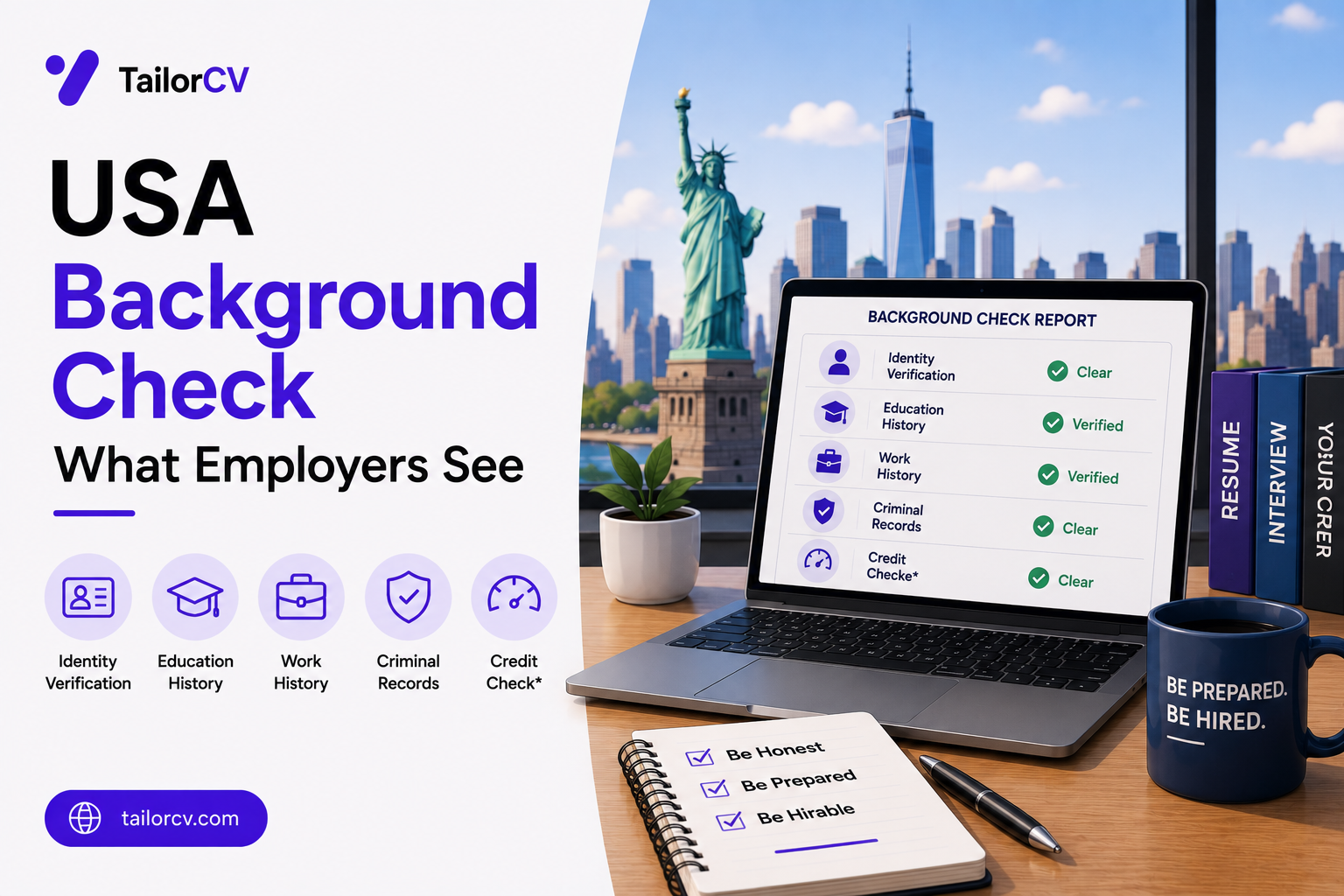
Employment verification. The big one. A screening company contacts each former employer's HR to confirm job title, start date, and end date. Most large employers confirm only those three facts and nothing else — they will not discuss performance.
Education verification. Degree, institution, and graduation date, usually via the registrar or a clearinghouse service.
Criminal history. County, state, and federal records, typically going back seven years. What may be considered varies by state.
Identity and right to work. Social Security number validation, and I-9 verification after you start.
Credit check — only for roles with financial responsibility, and requiring separate consent in many states.
Professional licences — for regulated roles, verified against the state board. See the US state licensure guide.
Drug screening — industry-dependent and declining in prevalence, though still standard in transport, healthcare, and safety-critical work.
Where offers actually fall apart
Almost never a criminal record. Almost always a discrepancy.
Employment dates. You wrote "2021-2023"; HR confirms March 2021 to August 2022. If your resume implied you were there four months longer than you were, that reads as a misrepresentation even when it was sloppiness. Use month and year, and use the real ones.
Job title inflation. You wrote "Senior Data Analyst"; HR confirms "Data Analyst II". This is the single most common problem. If your internal title differed from what the market calls the role, write the real title and bracket the explanation: Data Analyst II (functioning as team lead).
Degree status. Claiming a degree you did not complete is the one that ends offers outright. "Completed 90 credits toward BSc Computer Science" is honest and perfectly acceptable; implying the degree is not.
Gaps papered over. Stretching dates to hide a gap creates a verifiable discrepancy. An honest gap is a much smaller problem than a falsified date — see how to explain an employment gap.
A company that no longer exists. Not your fault and it happens often. Keep old offer letters, pay stubs, or W2s — those usually satisfy the verifier.
Timeline
Typically one to three weeks, and it belongs in your planning as the US job search timeline sets out.
What makes it slower:
- Former employers abroad, or in different time zones
- Companies that have been acquired, merged, or closed
- Universities with slow registrars, or transcripts in another language
- Roles requiring a security clearance, which is a separate and much longer process — see the US federal jobs guide
What you can do: respond to the screening company within hours. A large share of delay is candidates taking days to supply a form.
Your rights under the FCRA
The Fair Credit Reporting Act governs third-party background checks and gives you specific protections.
Consent. They must get your written authorisation before running it.
Pre-adverse action notice. If the report might cost you the job, the employer must give you a copy of it and a summary of your rights before deciding.
A chance to dispute. You can challenge inaccurate information, and the screening company must reinvestigate.
Adverse action notice. If they proceed, they must tell you, name the screening company, and confirm the company did not make the decision.
Errors are common — mismatched names, records belonging to someone else, dates recorded wrongly. If something comes back wrong, dispute it in writing rather than assuming the offer is gone.
State variation is significant. Many states and cities have "ban the box" laws restricting when criminal history may be asked about, and several restrict salary history questions — relevant when negotiating, as US salary negotiation covers.
If you have something in your history
Be strategic, not evasive. If a conviction will appear, consider raising it before the report does — after the offer, before the check. Framing it yourself is better than the employer discovering it.
Know your state's rules. Some limit how far back records may be considered, or bar certain records entirely.
A gap is not a red flag. Employers see them constantly. A falsified date is a red flag.
Common Mistakes
Resigning before the check clears. Offers are contingent until confirmed in writing, and a withdrawn offer after you have resigned leaves you with nothing.
Using year-only dates. "2021-2023" invites a discrepancy against verified months; using real month-and-year removes the ambiguity entirely.
Inflating a job title. This is the most common cause of a failed check — HR confirms the exact title on record, and a market-friendly rewrite reads as misrepresentation.
Claiming an unfinished degree. Verification is straightforward and this is the discrepancy most likely to end an offer outright.
Stretching dates to hide a gap. The gap was a small problem; the falsified date is a large one, and it is trivially verifiable.
Being slow with the screening company's forms. Much of the one-to-three-week timeline is candidates taking days to respond.
Assuming an error means the offer is lost. Report errors are common and the FCRA gives you an explicit right to dispute before any adverse decision.
Not keeping old employment records. When a former employer has closed or been acquired, old offer letters, pay stubs and W2s are what resolve the verification.
Frequently Asked Questions
How long does a US background check take?
One to three weeks typically. Longer with international employers, closed companies, slow registrars, or a security clearance.
What causes people to fail?
Discrepancies far more than criminal records — mismatched employment dates, inflated job titles, and unfinished degrees claimed as completed.
Will they find out I was fired?
Most large employers confirm only title and dates and will not discuss performance or reason for leaving. Smaller employers sometimes say more, so be prepared to explain rather than surprised.
Can an employer check my credit?
Only for roles with financial responsibility, and it generally requires separate consent. Several states restrict it further.
What if the report contains an error?
Dispute it. Under the FCRA you must receive a copy before any adverse decision and the screening company must reinvestigate. Errors, particularly mismatched identities, are common.
Should I disclose a conviction upfront?
Often better to raise it yourself after the offer and before the check, framed in your own words. Check your state's ban-the-box rules for what may be asked and when.
Can I resign once I have the offer letter?
Wait until the offer is confirmed unconditionally in writing, with the background check cleared. "Contingent" means exactly that.
Accuracy starts on the resume itself. Check your ATS score free.
Make This Practical
Audit your resume against what is verifiable before you apply anywhere. Replace year-only dates with real month-and-year, use your exact official job title with any explanation in brackets, and state degree status honestly — including credits completed if you did not finish.
Then protect the transition. Treat every offer as contingent until written confirmation arrives, do not resign before that, and respond to the screening company within hours since candidate delay is most of the timeline.
Finally, know your position if something goes wrong. Keep old offer letters and W2s for employers that have closed, dispute report errors in writing rather than assuming the offer is lost, and check your state's rules on criminal history and salary history questions.
What is your resume scoring right now?
Scan it against a job description and get your ATS match score in about a minute.
Drop your resume here or choose a file
PDF only. Max 2 MB.
We never share your data or use it to train AI models.

Was this guide useful?
Be the first to rate it.