 SS
SS
Key Takeaways
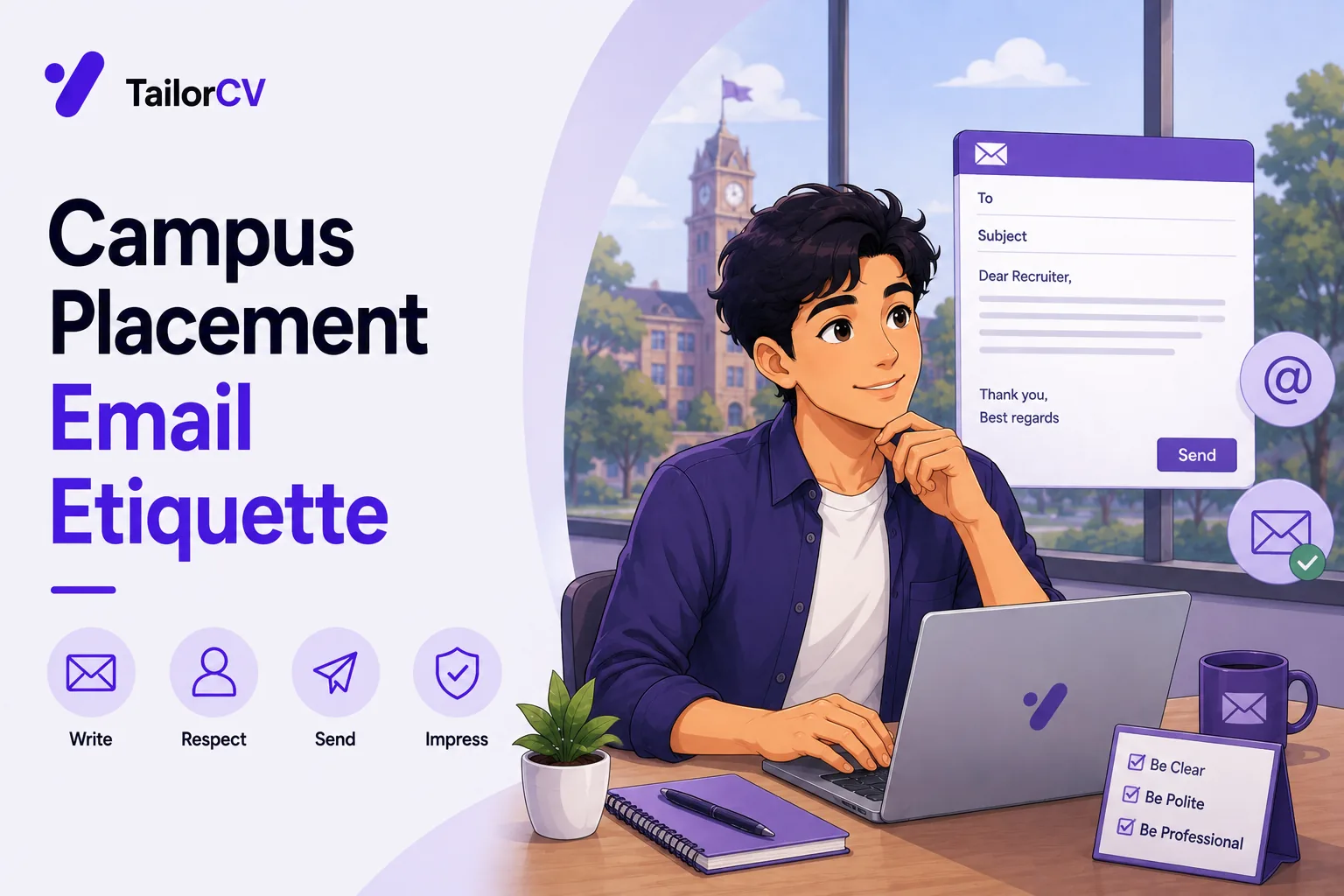
- Your email address, subject line and greeting are judged before anyone reads the message.
- Recruiters read on mobile, so short emails with the ask in the first two lines get replies.
- Follow up once after a reasonable interval, not repeatedly.
- Never send the same email to a group of recruiters in visible CC.
- A thank-you email after an interview is low-cost and remembered more often than students expect.
Placement season involves more email than students expect — to recruiters, to HR after interviews, to alumni asking for referrals, and to your placement cell. The conventions are simple and the failures are predictable.
Getting this right will not win you an offer on its own. Getting it wrong costs replies you would otherwise have received.
This guide covers the rules and the templates.
Before any of it, make sure the resume you attach works — the free ATS score checker.
The basics that get judged first
Your email address. firstname.lastname@ or a close variant. Not cool_dude_2003@ or krishna.rocks@. Create a professional address now and use it for everything placement-related.
Subject line. Specific and informative. Recruiters scan inboxes.
- Good:
Application for [Software Engineer](https://thetailorcv.com/blog/software-engineer-interview-preparation) Role — Ananya Sharma, NIT Trichy - Bad:
Job,Regarding job,Hi sir
Greeting. "Dear Ms Sharma" if you know the name, "Dear Hiring Team" if you do not. Avoid "Respected Sir/Madam" — it is common in Indian student email and reads as dated and impersonal to most recruiters, particularly at product companies and multinationals.
Signature. Name, degree and year, institution, phone, LinkedIn or GitHub. Keep it to four lines.
Attachments. PDF, named properly — Ananya_Sharma_Resume.pdf. Mention the attachment in the body.
The phrases to stop using
These are standard in Indian student email and read badly to recruiters at product companies and multinationals. None of them are wrong in a grammatical sense; they simply mark the sender as inexperienced.
| Instead of | Write |
|---|---|
| Respected Sir/Madam | Dear Ms Rao / Dear Hiring Team |
| I am writing this mail to inform you that | I'm applying for the Backend Developer role |
| Kindly do the needful | Could you let me know whether… |
| Please find attached herewith | My resume is attached |
| I would be highly obliged if you could | I'd welcome the chance to… |
| Awaiting your positive response | Thank you for your time |
| It would be a great honour to work | I'm interested in the role because… |
| Thanking you in anticipation | Thank you |
| Myself Ananya Sharma | I'm Ananya Sharma, a final-year… |
| Sir, I want job | (delete and start again) |
Why this matters more than it should. A recruiter reading forty student emails uses whatever signals are available. Two or three of these phrases in the first line places you in a category before your evidence is read — and the replacements are shorter, which also helps.
Length and structure
Recruiters read on mobile. Under 150 words, with the ask in the first two lines.
Structure:
- Who you are, in one line
- What you want, immediately
- One or two lines of relevant evidence
- A clear closing action
No long introductions. A paragraph about your passion for technology before the ask is the most common student email failure, and most recruiters stop reading before the point arrives.
Templates
Applying directly to a recruiter
Subject: Application for Backend Developer Role — Ananya Sharma, NIT Trichy
Dear Ms Rao,
I'm a final-year Computer Science student at NIT Trichy applying for the Backend Developer role posted on your careers page.
I've spent two years on backend work — most recently building a scheduling system in Django and PostgreSQL that the department library now uses for about forty bookings a week. I also interned at [Company] last summer on their internal reporting tools.
My resume is attached. I'd welcome the chance to discuss the role.
Thank you for your time, Ananya Sharma B.Tech CSE 2026, NIT Trichy +91 XXXXX XXXXX | github.com/ananya
Asking an alumnus for a referral
Keep it small and give them an easy out — the approach in networking messages for referrals.
Subject: NIT Trichy alum — quick question about [Company]
Hi Rahul,
I'm a final-year CSE student at NIT Trichy, and I saw you're a backend engineer at [Company]. I'm applying for their SDE-1 role (req 4471).
I've been working on event-driven systems — my last project handled about 40,000 records a day through a Python ingestion pipeline. If it looks like a reasonable fit, would you be open to referring me? Happy to send my resume either way, and no problem at all if you'd rather not.
Thanks either way, Ananya Sharma B.Tech CSE 2026 | github.com/ananya
Thank-you after an interview
Send within a day. Short.
Subject: Thank you — Backend Developer interview
Dear Mr Kulkarni,
Thank you for your time this morning. I enjoyed the discussion, particularly your point about how the team handles schema migrations without downtime — I hadn't considered the dual-write approach before.
I'm very interested in the role and happy to provide anything further.
Best regards, Ananya Sharma
Referencing something specific is what makes this land. A generic thank-you reads as a template because it is one.
Following up after no response
Once, after a week or the stated timeline.
Subject: Following up — Backend Developer application
Dear Ms Rao,
I applied for the Backend Developer role on 12 August and wanted to check whether there is any update. I remain very interested in the position.
Thank you, Ananya Sharma
Asking to reschedule an interview
Rare, awkward, and handled badly by most students. Give a reason in one clause, offer alternatives, and do not over-apologise.
Subject: Request to reschedule — Backend Developer interview, 14 October
Dear Ms Rao,
I'm scheduled to interview on 14 October at 11am. Unfortunately that clashes with a university examination I cannot move.
Would any of these work instead — 15 October after 2pm, 16 October morning, or 17 October any time? I'm happy to fit around whatever suits the panel.
Apologies for the inconvenience, and thank you for accommodating it.
Ananya Sharma
The three specific slots are the whole trick. "Could we reschedule?" hands the recruiter work; three options they can accept in one word does not. Ask as soon as you know, never the night before, and never for a reason that sounds optional.
Declining an offer
Do it properly — the industry is smaller than it looks.
Dear Ms Rao,
Thank you very much for the offer. After careful consideration I've decided to accept another position that is closer to the backend infrastructure work I want to focus on.
I'm grateful for your time throughout the process and I hope our paths cross again.
Best regards, Ananya Sharma
What not to do
Do not mass-email recruiters in visible CC. Every recipient sees that they are one of thirty, which guarantees no reply.
Do not send the same email to multiple companies without changing the company name. Leaving the wrong name in is a common and fatal error.
Do not use "Respected Sir/Madam". It reads as dated at most modern employers.
Do not attach a resume named resume final final2.pdf.
Do not follow up repeatedly. Once is appropriate; three times is a reason to stop replying.
Do not use informal language or emoji. Placement email is professional correspondence.
Do not write four paragraphs before the ask.
Do not send from a phone without checking formatting. Signature blocks and line breaks frequently break.
Common Mistakes
Using an unprofessional email address. It is judged before the message is read, and creating a new one takes two minutes.
Opening with "Respected Sir/Madam" or "Myself Ananya". It places you in a category before your evidence is read.
Vague subject lines. "Regarding job" gets skipped in an inbox recruiters scan rather than read.
Burying the ask. Recruiters read on mobile, so a paragraph of introduction before the point means the point is never reached.
Mass-emailing with visible CC. Every recipient can see they are one of many, which guarantees silence.
Forgetting to change the company name. A recycled email naming the wrong employer is the most damaging small error in placement correspondence.
Following up more than once. It converts a neutral non-reply into an active decision not to engage.
Asking to reschedule without offering slots. It hands the recruiter work and frequently gets no reply.
Sending a generic thank-you. Referencing something specific from the conversation is what distinguishes it from a template.
Not declining offers properly. The industry is smaller than students assume, and a graceful decline is remembered.
Frequently Asked Questions
What email address should I use?
Firstname.lastname or a close variant. Create a professional address specifically for placement season and use it consistently.
How long should a placement email be?
Under 150 words, with the ask in the first two lines. Recruiters read on mobile and scan rather than read.
Should I use "Respected Sir/Madam"?
Avoid it. It reads as dated and impersonal at most modern employers. Use the person's name if you have it, or "Dear Hiring Team".
What about "kindly do the needful" and "please find attached herewith"?
Both mark you as inexperienced. "Could you let me know whether…" and "My resume is attached" say the same thing in fewer words.
How many times should I follow up?
Once, after a week or the stated timeline. Repeated follow-ups make non-response an active decision.
How do I ask to reschedule an interview?
As early as possible, with a one-clause reason and three specific alternative slots. Offering options rather than asking a question is what gets it accepted.
Is a thank-you email after an interview worth sending?
Yes — it is low-cost and remembered more often than students expect. Reference something specific from the conversation.
Can I email the same message to several companies?
Only with the company name and role changed each time. Leaving the wrong name in is a fatal and common error.
Should I decline an offer by email?
Yes, promptly and graciously. The industry is smaller than it looks and a well-handled decline is remembered.
Make sure the resume you attach clears screening. Check your ATS score free.
Make This Practical
Create a professional email address today if yours is not already one, then go through the phrase table and delete "Respected Sir/Madam", "kindly do the needful" and "please find attached herewith" from whatever draft you are currently sending. Both fixes take minutes and both are judged before your evidence is read.
Then restructure how you write. The ask in the first two lines, the whole message under 150 words, one or two pieces of concrete evidence, and a clear closing action — because recruiters scan on mobile and a paragraph of introduction means the point is never reached.
Finally, save the six templates and adapt them rather than writing from scratch. Change the company name every single time, follow up exactly once, offer three specific slots if you ever need to reschedule, and send a thank-you within a day that references something they actually said.
Does your formatting survive the parser?
Upload your resume and see what an ATS actually reads back.
Drop your resume here or choose a file
PDF only. Max 2 MB.
We never share your data or use it to train AI models.

Was this guide useful?
Be the first to rate it.