 SS
SS
Key Takeaways
- The Bay Area still pays more than anywhere else in tech, and housing still consumes more of it than anywhere else.
- Compensation is dominated by equity, so comparing base salaries alone misreads offers badly.
- AI and infrastructure hiring is concentrated here to a degree no other US market matches.
- Referrals matter more than applications in a market this saturated with candidates.
- Total-compensation-minus-housing is the only comparison that tells you anything useful.
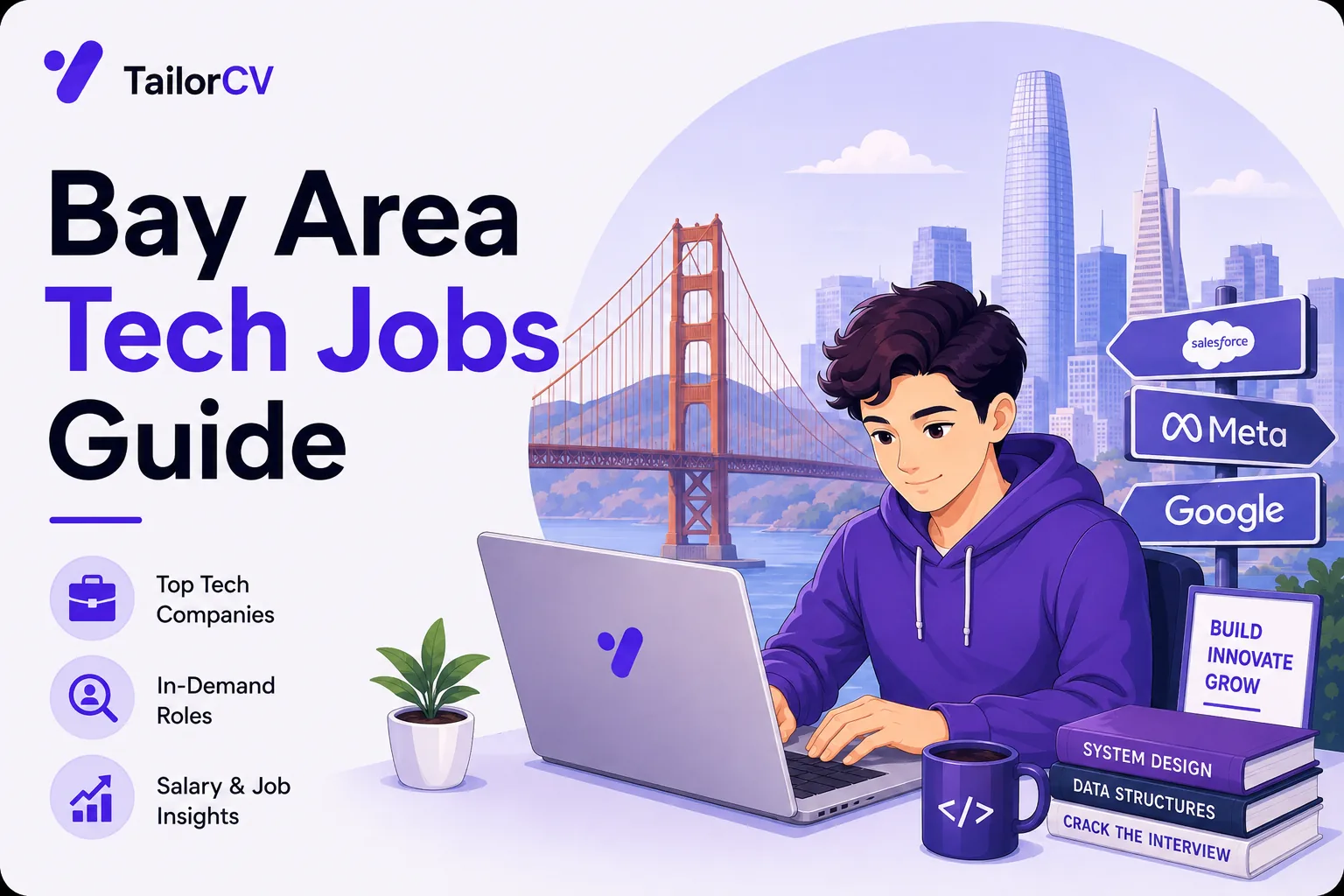
The Bay Area is the densest technology labour market in the world, and the debate about whether it is worth it has been running for a decade. The honest answer depends almost entirely on your stage: early-career engineers gain more from the density of opportunity than they lose to rent, while people supporting a family often find the arithmetic stops working.
This guide covers what hires, how the money is structured, and how to break in.
Before applying anywhere, check your resume parses — the free ATS score checker.
What actually hires
AI and machine learning. The concentration here is genuinely unmatched — foundation model labs, applied AI startups, and AI teams inside every large company. If you work in this area, the Bay Area has more roles than the rest of the US combined.
Infrastructure and developer tools. Cloud, observability, databases, security, CI/CD. A deep market with well-funded companies.
Consumer and social platforms. The large established players, plus a constant supply of new attempts.
Fintech and crypto. Payments, lending, and trading infrastructure.
Enterprise SaaS. The unglamorous majority of the market, and where a great deal of stable, well-paid work actually is.
Biotech and health tech, concentrated more around South San Francisco and the Peninsula.
The geography
San Francisco — startups, AI labs, fintech, consumer. Younger, denser, higher rent per square foot.
South Bay — Palo Alto, Mountain View, Sunnyvale, San Jose — the large established technology companies and hardware. More suburban, more car-dependent.
Peninsula — San Mateo, Redwood City — a middle ground, increasingly popular with companies wanting to split the difference.
East Bay — Oakland, Berkeley — meaningfully cheaper housing, a growing number of offices, and a commute if your job is in the city.
Hybrid is now the dominant pattern, which has quietly made the East Bay far more viable than it was.
Compensation
Specific numbers date quickly, so understand the structure instead.
Total compensation, not salary. Bay Area offers are base plus bonus plus equity, and at established companies equity is frequently 30-50% of the package. Comparing base salaries across offers is close to meaningless — see US salary negotiation.
Levelling drives pay more than negotiation. Your band is set by the level you are hired at, and moving between bands is worth far more than negotiating within one. Which is why system design performance in interviews matters commercially — see the US tech interview process guide.
RSUs versus options. Public company RSUs have a knowable value. Startup options may be worth nothing. The distinction is covered properly in startup vs big tech.
California state income tax is high, which narrows the gap to lower-tax states more than headline numbers suggest.
The cost side
Housing is the whole story. Rent for a one-bedroom in San Francisco or the core Peninsula is among the highest in the world, and buying is out of reach for most people on a single technology salary.
The comparison that matters: total compensation minus housing, adjusted for state tax. Run that against an Austin, Seattle or Raleigh offer before assuming the Bay Area wins. It frequently still does for senior individual contributors at large companies. It frequently does not for mid-level roles at startups.
Also weigh: commute time, whether you need a car, and childcare costs if relevant — all of which are higher here than the salary premium sometimes covers.
Breaking in
Referrals dominate. This is the most candidate-saturated market in the country. A cold application competes with hundreds; a referral gets read. Alumni networks are particularly strong here — see the US networking and referral guide.
Specialise visibly. "Full-stack engineer" is the most common profile in the Bay Area and therefore the least differentiated. A specific specialism — distributed systems, inference optimisation, payments infrastructure — competes against a far smaller pool.
Interview preparation is non-negotiable. The large companies run standardised loops with a real algorithmic bar. Preparation is expected and measurable — see coding interview preparation.
Public work helps disproportionately. Open source contributions, technical writing, and a substantive GitHub profile carry weight in a market where reviewers are drowning in similar resumes — see how to optimise your GitHub profile.
Sponsorship is more available here than most US markets, because the large employers sponsor routinely — see the H-1B visa job search guide.
Common Mistakes
Comparing base salary across cities. Bay Area offers are equity-heavy, so base-only comparison understates them — and ignoring California's state tax overstates them. Both errors need correcting to get a real number.
Relying on applications alone. This is the most saturated candidate market in the US, and cold applications on popular postings frequently reach nobody.
Generic full-stack positioning. It is the single most common profile here, which makes it the least visible — narrowing to a specific specialism competes against a much smaller pool.
Skipping interview preparation. The large employers run standardised loops with a genuine algorithmic bar, and strong engineers fail them regularly for lack of practice rather than lack of ability.
Treating startup options as compensation. Most are worth nothing, so an offer that only looks competitive with equity included is a below-market cash offer.
Underestimating housing. It is the dominant variable in whether the numbers work, and it swamps salary differences between markets more often than people expect.
Ignoring the East Bay. Hybrid working has made Oakland and Berkeley genuinely viable, at materially lower housing cost, and many candidates never consider them.
Negotiating within a level instead of questioning the level. Band placement is worth far more than movement inside a band, and it is harder to change after you start.
Frequently Asked Questions
Is the Bay Area still worth it?
For senior individual contributors at large companies, frequently yes even after housing. For mid-level roles at startups, often not. Run total compensation minus housing and state tax rather than comparing headline numbers.
What pays best?
Established public technology companies and well-funded AI labs, largely because equity is a substantial and knowable part of the package.
Do I need to live in San Francisco?
No. Hybrid working has made the East Bay and outer Peninsula viable, at significantly lower housing cost. Check the office-day expectation before committing to a location.
How competitive is it?
Extremely. It attracts candidates nationally and internationally, which is why referrals and visible specialisation matter more here than in most markets.
Do Bay Area companies sponsor visas?
More than most US markets — large employers sponsor routinely. The H-1B lottery still applies, so plan around its annual cycle.
Is AI hiring really concentrated there?
Yes, more than any other US market. If you work in machine learning or applied AI, the density of opportunity is the single strongest argument for being there.
What about the cost of living beyond rent?
Childcare, commuting and general costs are all above national averages. Factor them in rather than treating rent as the only difference.
Make sure your resume survives a market this crowded. Check your ATS score free.
Make This Practical
Run the real comparison before deciding. Total compensation minus housing, adjusted for California state tax, against equivalent offers elsewhere — that number, not the headline salary, tells you whether the move works.
Then narrow your positioning. Replace generic full-stack framing with a specific specialism, because the common profile is invisible in a market this saturated and a narrow one competes against a handful of candidates rather than hundreds.
Finally, work the channel that actually converts. Pursue referrals through alumni and former colleagues using the US networking and referral guide, prepare properly for standardised loops, build visible public work, and verify your resume parses with the free ATS score checker.
What is your resume scoring right now?
Scan it against a job description and get your ATS match score in about a minute.
Drop your resume here or choose a file
PDF only. Max 2 MB.
We never share your data or use it to train AI models.

Was this guide useful?
Be the first to rate it.