 SS
SS
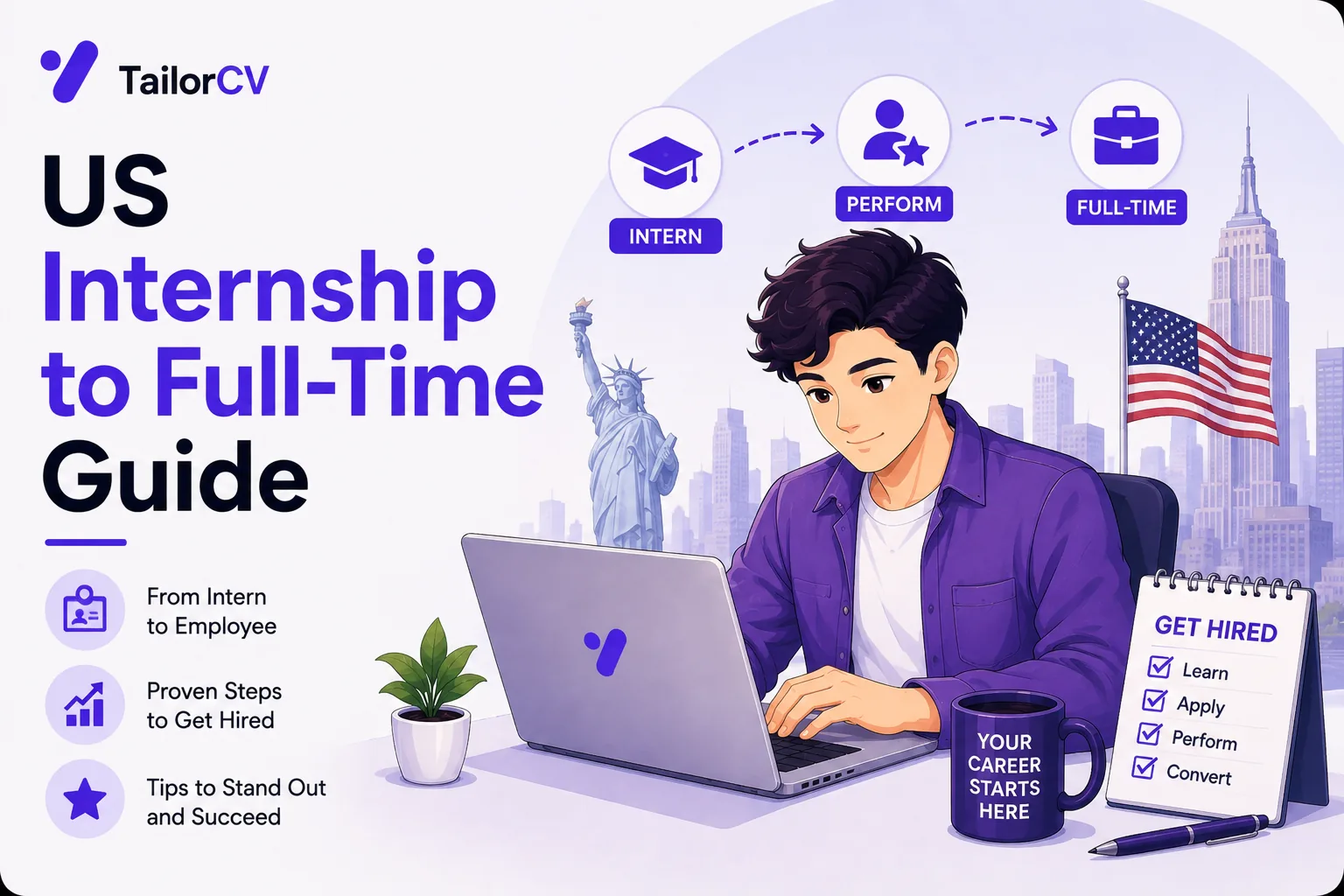
Key Takeaways
- A large share of US graduate hiring happens through internship conversion rather than open new-grad postings.
- Summer internship recruiting runs the autumn before, so the application deadline arrives far earlier than students expect.
- Managers assess reliability and communication at least as much as raw technical output.
- Ask about conversion criteria in week one, not week ten, so you have time to act on the answer.
- No return offer is common and recoverable, but it needs a plan starting immediately.
American graduate hiring is unusual in how much of it flows through internships. Many large employers fill the majority of their entry-level headcount from their own intern class, which means the summer between your penultimate and final year matters more than your final-year job search does.
That has a scheduling consequence students discover too late: applications for that summer open the previous autumn.
This guide covers getting the internship, converting it, and what to do if it does not convert.
Before applying, check your resume parses — the free ATS score checker.
The timing
Autumn, over a year ahead. Applications open for the following summer at most large employers. Some finance and consulting cycles run even earlier — see the US finance jobs guide.
Winter. Online assessments and interviews.
Spring. Offers, and many programmes are full by now.
Summer. The internship, typically ten to twelve weeks.
End of summer or shortly after. Return offer decisions.
Following spring. You graduate and start.
The practical consequence: if you are in your penultimate year and it is October, apply now. If it is March, most large programmes have closed and you should target smaller companies, which hire on a normal timeline.
What managers actually assess
Interns assume they are judged on how much they build. They are judged on whether the team wants them permanently, which is a broader question.
Reliability. Do you deliver what you said, when you said? An intern who consistently ships modest work on time outranks one who occasionally produces something impressive and often goes quiet.
Communication. Do you report progress without being chased, and say when you are stuck? Managers cannot help someone who disappears.
Coachability. Do you take code review or feedback and apply it? Repeating the same corrected mistake is a significant negative signal.
Ownership. Do you finish, including tests, documentation and handover — the parts nobody enjoys?
Fit. Are you someone the team wants in the room?
Technical ability is the assumed baseline. Everyone in the intern class is inexperienced; managers know that. The differentiators are above.
The single most useful question
Ask in your first week:
What would a successful internship look like from your side? And how do return offers work here — what are the criteria?
Very few interns ask, and the answer is the actual assessment rubric. Asking in week one gives you ten weeks to act on it; asking in week ten gives you nothing.
Ask again at the midpoint: "Is there anything I should be doing differently?" Most managers answer honestly when asked directly, and early correction is far cheaper than a surprise at the end.
The behaviours that convert are the same ones covered in the internship to PPO conversion guide, which goes deeper on running the internship itself.
Running the summer well
Set up properly in week one. Environment, access, accounts. Ask for help rather than struggling silently for three days — nobody thinks less of an intern who cannot configure an unfamiliar internal system.
Understand the product before the code. Interns who know what the business does ask better questions and are noticed for it.
Ask when stuck for about an hour. Show what you tried first, which turns a request for help into evidence of effort. Silence for three days is the single most damaging pattern.
Send a short weekly update unprompted. Almost no intern does this, and it is remembered.
Finish things. Three completed small tasks beat one ambitious half-done rewrite.
Meet people beyond your mentor. Conversion conversations involve more people than you expect.
Keep a record of what you built and what it achieved. You need it for the conversion conversation, your resume, and every interview afterwards.
If the offer does not come
It happens frequently, and often for reasons unconnected to you — headcount freezes, budget, no opening on that team.
Ask why, directly and politely. Some managers give genuinely useful answers.
Ask for a referral or recommendation. A manager who valued your work but had no headcount will often refer you elsewhere, and that referral is worth a great deal — see the US networking and referral guide.
Ask to stay in touch. Roles open later, and former interns get contacted months afterwards more often than people expect.
Get a written recommendation before you leave, while the work is fresh.
Start the full-time search immediately in the autumn. New-grad postings open then, and the internship itself is now the strongest thing on your resume regardless of whether it converted.
Common Mistakes
Applying in spring for that summer. Large-employer programmes recruit the previous autumn and are usually full by March, so a spring start means targeting smaller companies instead.
Going silent when stuck. Three lost days plus demonstrated poor judgement is the most damaging pattern an intern can establish.
Asking about conversion in the final week. By then you cannot act on the answer; week one gives you the criteria with time to meet them.
Starting something ambitious and not finishing it. Completion, including tests and documentation, is what managers actually weight.
Treating unglamorous work as beneath you. Documentation and small bug fixes are visible opportunities to demonstrate reliability.
Never sending progress updates. A short weekly note means your manager never wonders what you are doing, and almost no intern does it.
Not recording what you built. Details fade fast, and reconstructing a summer's work in October for interviews is painful.
Leaving without asking for a recommendation. Ask while the work is fresh rather than emailing cold a year later.
Frequently Asked Questions
When do US summer internship applications open?
Typically the previous autumn at large employers, with some finance and consulting cycles running even earlier. Applying in spring for the same summer usually means the programmes have closed.
How common are return offers?
They vary enormously by company and by year, and business conditions affect them as much as performance. What you control is reliability, communication, and finishing what you were given.
When should I ask about conversion?
In week one, framed as what success looks like and what the criteria are. Ask again at the midpoint for feedback while you can still act on it.
What do managers care about most?
Reliability and communication, more than raw output. Technical ability is the assumed baseline for everyone in the intern class.
What if I do not get a return offer?
Ask why, ask for a referral and a written recommendation, and start the full-time search in the autumn. The internship remains the strongest item on your resume either way.
Should I take an unpaid internship?
If the work is real and the alternative is nothing, it still builds experience and a reference. Weigh it against paid alternatives rather than accepting it as the only option.
Can international students intern in the US?
On F-1 status, generally through CPT during the programme. The mechanics and how to present it are in the OPT and CPT resume guide.
Check your resume before applying. Check your ATS score free.
Make This Practical
Fix the timing first. If you are in your penultimate year, applications for next summer open this autumn — check the dates now rather than discovering in March that the programmes closed.
Then ask the conversion question in week one. What does success look like from the manager's side, and what are the return offer criteria? That answer is the rubric, and asking early is the difference between meeting it and hearing it too late.
Finally, run the summer on the things actually assessed. Ask for help after about an hour rather than going quiet, send an unprompted weekly update, finish what you were given including the unglamorous parts, keep a written record of what you built, and ask for a recommendation before you leave regardless of how conversion goes.
Find out where a fresher resume stands
Score yours against a real posting - no account, no cost.
Drop your resume here or choose a file
PDF only. Max 2 MB.
We never share your data or use it to train AI models.

Was this guide useful?
Be the first to rate it.