 SS
SS

Key Takeaways
- Most successful UK career changes are sideways moves through an adjacent role, not a clean jump into an unrelated field.
- Changing sector while keeping your function is far easier than changing both at once.
- A functional CV rarely works — recruiters read chronological CVs and treat gaps in structure as evasion.
- Employer-funded routes — apprenticeships, internal moves, graduate schemes open to career changers — beat self-funded retraining in most cases.
- The interview question that decides it is "why now", and a vague answer costs the offer.
Career change advice usually presents two options: stay where you are, or retrain from scratch and start again at the bottom. Most successful changes are neither. They are a sequence of adjacent moves where each step is only slightly outside what you have already proved.
That is less dramatic and considerably more likely to work.
This guide covers the routes that actually succeed in the UK, how to write the CV, and where retraining is worth paying for.
Before applying anywhere, check your CV parses — the free ATS score checker.
Change one thing, not two
Every role has a function — what you do — and a sector — where you do it.
Changing sector, keeping function. A finance manager in retail moving to a finance manager in healthcare. Comparatively straightforward: your core skill is proven and only the domain is new.
Changing function, keeping sector. An operations manager in a hospital moving into hospital data analysis. Also workable, because your domain knowledge is real and valued.
Changing both. A retail operations manager becoming a healthcare data analyst. Hard, and usually needs an intermediate step.
The practical implication: identify which single variable you are changing. If the honest answer is both, find the intermediate role that changes one, do it for a year or two, then change the other. That is the mechanism behind most career changes that work.
Routes that work in the UK
Internal moves. By far the most underused. Your current employer already knows you are reliable, and moving into a different function internally is dramatically easier than convincing a stranger. Many large organisations actively support it.
Apprenticeships. Not just for school leavers — UK apprenticeships run to degree and master's level and are open to career changers of any age. The employer pays, you earn while training, and the levy funds much of it. This is frequently the single best-value retraining route available and is widely overlooked by professionals — see the UK apprenticeship guide.
Graduate schemes open to career changers. Many UK schemes have no age limit and accept applicants with previous careers. The pay drop is real but the training and progression are structured — see the UK graduate scheme guide.
Contracting into a new area. Employers take less risk on a fixed-term contractor, so a contract can be an entry point where a permanent role would not be — see the UK contracting and IR35 guide.
Public sector. The NHS and Civil Service recruit against published criteria rather than pedigree, which favours candidates whose evidence is real but unconventional — see the NHS jobs guide and the Civil Service application guide.
Professional qualifications — ACA, CIPD, chartered engineering status — where the qualification is the credential the sector actually screens on.
Retraining: when it is worth it
Worth paying for when:
- The qualification is a hard requirement — you cannot practise without it
- It is employer-funded, including apprenticeships and study support
- It comes with a placement or a structured route into work
- It is recognised by the sector rather than by the training provider alone
Rarely worth paying for when:
- It promises a career change on the strength of a certificate alone
- The provider's evidence for outcomes is testimonials rather than data
- The sector actually hires on demonstrable work rather than credentials — which is true of most technology roles, where a portfolio does more than a certificate
Before paying anything, read twenty job adverts for the role you want and check whether the qualification appears in the requirements. If it does not, you are buying confidence rather than employability.
Writing the CV
Keep it chronological. Functional CVs — skills grouped with dates buried — are widely disliked by UK recruiters and agencies, who read them as hiding something. Whatever you are worried they will notice, they notice more when the structure is unusual.
Lead with a targeted personal statement. Three or four lines naming the change explicitly and the evidence behind it:
Operations manager with eight years in retail logistics, now moving into supply chain analytics. Built the demand forecasting model that cut stockouts 22% across 40 stores; completed CIPS Level 4 in 2025.
That names the change, gives proof, and shows commitment in three lines. Silence on the change is worse — it makes the reader work it out themselves.
Translate achievements into the target sector's language. Same work, different framing. "Managed a £2m budget" reads across sectors; "ran the Q4 planogram reset" does not.
Put relevant evidence above chronology where honest. A projects or relevant-experience section before older roles is fine; disguising dates is not.
Address it in the cover letter, which matters more for career changers than for anyone else — see the UK cover letter guide.
The interview question that decides it
"Why now?"
Every career changer gets asked, and a vague answer sinks the application. The interviewer is testing whether this is a considered move or an escape from something.
Weak: "I felt ready for a new challenge."
Strong: "I've been doing the analytics part of my operations role for two years — building the forecasting models — and it's the part I want to do full time. I finished CIPS Level 4 last year and I've been running our reporting since."
The second answer demonstrates the change already started before the application. That is what makes it credible.
Also expect: "What will you find hardest?" Answer honestly with what you are doing about it. Denying any difficulty reads as not having thought it through.
Common Mistakes
Changing function and sector simultaneously. It doubles the leap; find an intermediate role that changes one, then change the other.
Using a functional CV. UK recruiters read it as concealment, and it performs worse than a chronological CV with an honest statement at the top.
Not naming the change on the CV. Leaving the reader to work out what you are doing is worse than stating it plainly with evidence.
Paying for retraining the sector does not screen on. Read twenty adverts first — if the qualification is not in the requirements, you are buying confidence rather than employability.
Overlooking apprenticeships. They run to degree and master's level, have no age limit, and the employer funds them — the best-value retraining route in the UK and rarely considered by professionals.
Ignoring internal moves. Your current employer already trusts you, which is the hardest thing to establish anywhere else.
Answering "why now" vaguely. It is the question that decides career-change applications, and a generic answer reads as escape rather than intent.
Waiting until you are qualified to start. Doing the work in your current role first is what makes the change credible.
Frequently Asked Questions
Is it too late to change career?
No, and UK apprenticeships and most graduate schemes have no upper age limit. What matters is whether you are changing one variable at a time and can evidence the direction.
Will I have to take a pay cut?
Frequently some drop, though changing sector while keeping your function often avoids it entirely. Changing both usually costs more.
Should I use a functional CV?
No. UK recruiters and agencies dislike them and read them as hiding something. Keep it chronological with a targeted statement at the top.
Is a bootcamp or course worth it?
Only if the sector actually screens on that credential. Read twenty job adverts first — in technology particularly, demonstrable work usually counts for more than a certificate.
What are apprenticeships for career changers?
Employer-funded training running up to degree and master's level, open to any age. You earn while training, which makes them the strongest value retraining route in the UK.
How do I explain the change in interviews?
By showing it started before the application — the parts of your current role that already overlap, plus any study completed. "Ready for a new challenge" is the answer that loses.
What if I have no experience in the new field?
Find the intermediate role. Take on the relevant work inside your current job, contract into it, or move sector first while keeping the function you have already proved.
Check your CV before applying. Check your ATS score free.
Make This Practical
Work out whether you are changing your function, your sector, or both. If it is both, find the intermediate role that changes one — that single reframing turns an implausible jump into two achievable steps, and it is the mechanism behind most career changes that actually work.
Then start the change before you apply. Take on the relevant work inside your current role, complete the qualification the sector genuinely screens on, and check that it appears in twenty real job adverts before paying for anything.
Finally, be explicit on paper and prepared in person. Keep the CV chronological with a statement naming the change and the evidence, translate your achievements into the target sector's language, and rehearse an answer to "why now" that points at what you have already been doing rather than at what you are ready for.
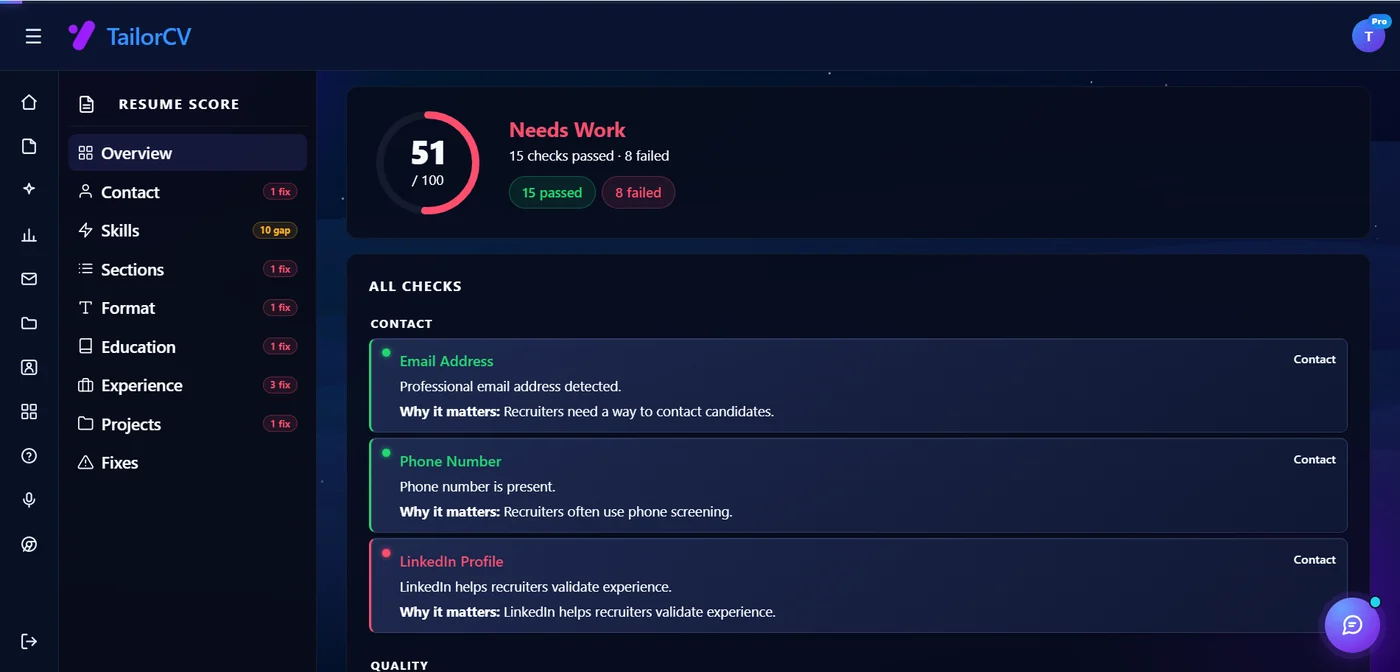
What is your resume scoring right now?
Scan it against a job description and get your ATS match score in about a minute.
Drop your resume here or choose a file
PDF only. Max 2 MB.
We never share your data or use it to train AI models.
Templates that keep this structure intact
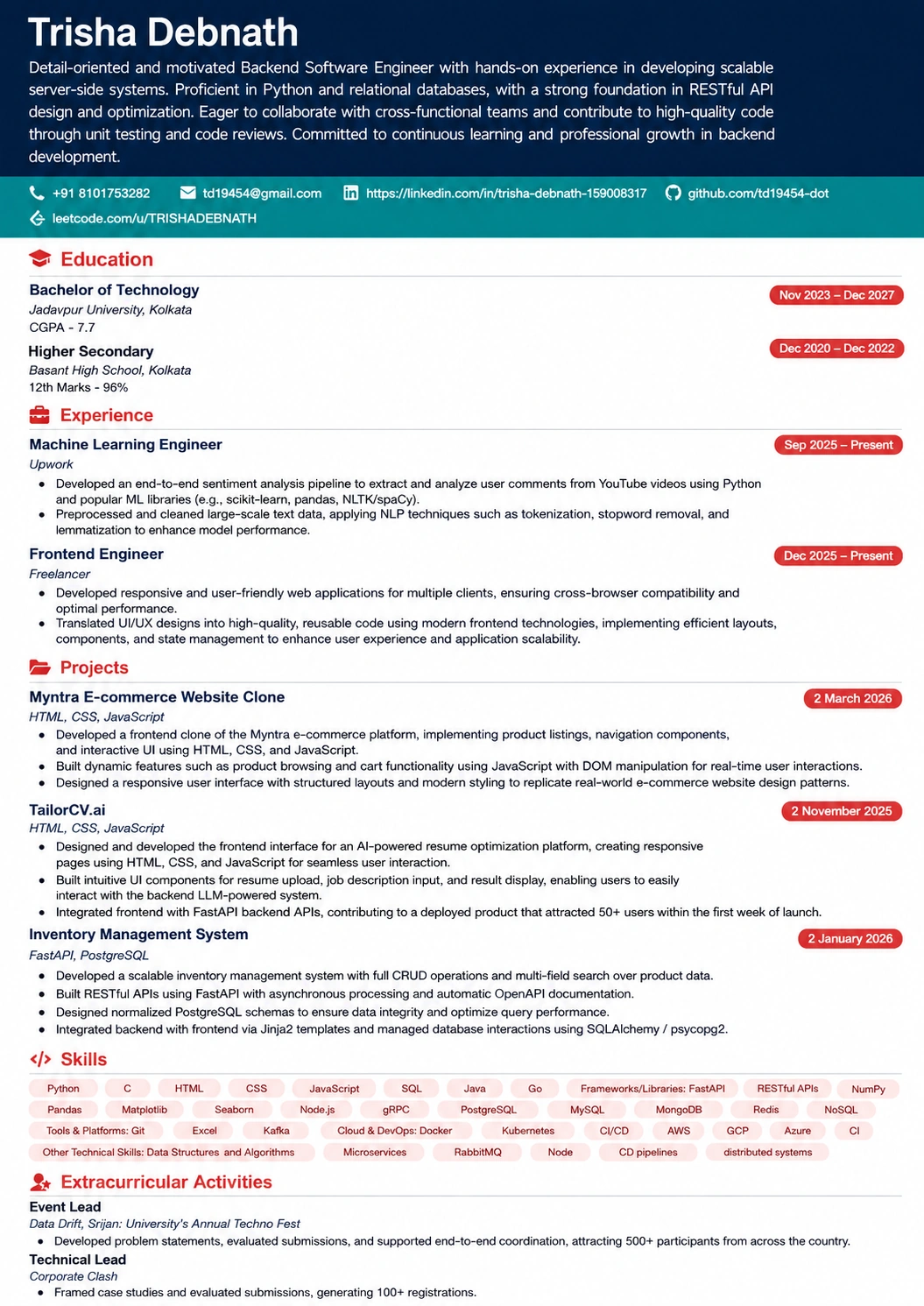
This template is ATS-tested — start from it and the formatting rules in this guide are already handled.
Was this guide useful?
Be the first to rate it.