 SS
SS
Key Takeaways
- Income tax and National Insurance are deducted automatically before you are paid, and your tax code determines how much.
- New employees are sometimes placed on an emergency tax code, which can mean paying more than necessary until it is corrected.
- Workplace pension enrolment is automatic for most eligible employees, and opting out means declining an employer contribution.
- Student loan repayments are deducted automatically once your income crosses the relevant threshold, calculated on the payslip itself.
- Checking your first payslip properly in month one prevents a small error becoming a larger one later.
Reading the payslip itself
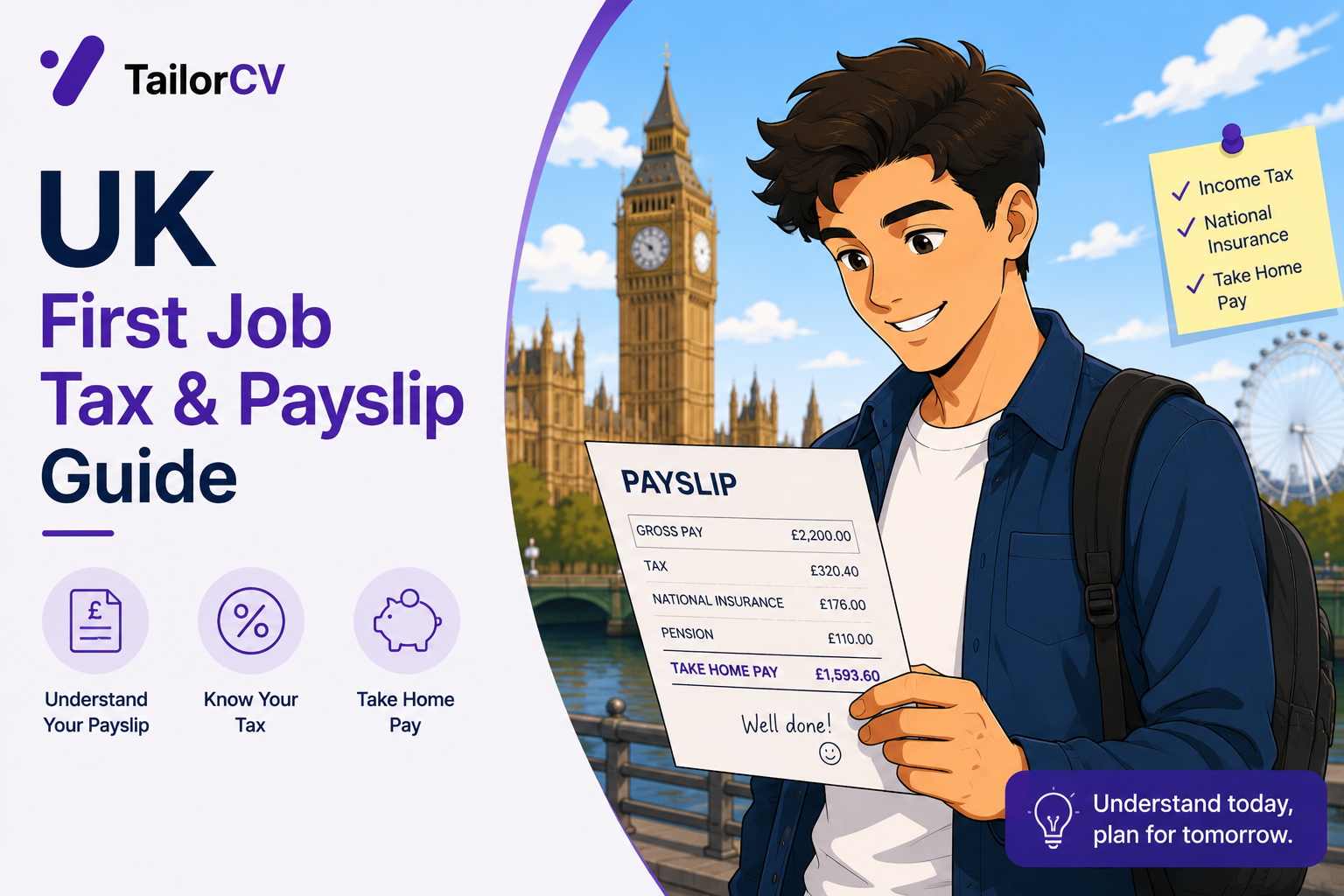
Gross pay is your salary before any deductions, the number on your offer letter.
Income tax is deducted automatically through the payroll system based on your tax code, which determines how much of your income is tax-free before the rest is taxed at the applicable rates.
National Insurance is a separate deduction, funding state benefits and the state pension, calculated on a different basis from income tax.
Pension contributions, both yours and your employer's, appear separately, covered in more detail below.
Student loan repayments, if applicable, are calculated and deducted automatically once your income crosses the relevant repayment threshold.
Net pay is what actually lands in your account, the number that matters for your budget rather than the gross figure on your offer letter.
Tax codes, and the emergency code problem
Your tax code tells your employer how much of your pay is tax-free. A standard code applies to most people with one job and no unusual circumstances.
New employees are sometimes placed on an emergency tax code, particularly if your employer has not yet received your full details from a previous employer or you have not provided a starter checklist. This can mean paying more tax than necessary in your first few payslips.
This is usually corrected automatically once your full details are processed, and any overpayment is refunded through your pay, but it is worth checking rather than assuming it will sort itself out silently.
Check your tax code on your first payslip. If something looks wrong or you are unsure, ask your employer's payroll team directly, a five-minute question in month one prevents months of overpayment.
Workplace pensions, and why opting out costs more than it looks
Automatic enrolment applies to most eligible employees, meaning you are enrolled into a workplace pension scheme by default unless you actively opt out.
Your employer is required to contribute alongside you, at a minimum rate, once you are enrolled. This is genuinely free money in the same sense as a US employer 401k match, declining to be enrolled means declining the employer's contribution as well as your own.
You can opt out, and the case for doing so as a new graduate is generally weak. The employer contribution alone is a return most other financial decisions cannot match, and staying enrolled at the minimum level costs relatively little from your take-home pay.
Check what your specific employer contributes, since some offer higher matching for higher personal contributions, similar in spirit to the matching structures common elsewhere.
Student loan repayments
Repayments are calculated automatically through the payroll system once your income crosses the applicable repayment threshold for your loan plan, and the deduction appears as a separate line on your payslip.
You do not need to do anything to start repaying, it happens automatically based on the information HMRC holds, though it is worth confirming your employer has the correct plan type on file, since an incorrect one can lead to over or under-deduction.
The repayment is calculated as a percentage of income above the threshold, not a fixed amount, so it moves with your salary rather than staying constant.
What to actually check in month one
Your tax code, and whether it looks like a standard code or an emergency one.
That your gross pay matches your contract.
Whether pension enrolment happened, and at what contribution rate.
Which student loan plan you are on, if applicable, and whether deductions have started appropriately.
Whether any one-off items are correct, such as a signing bonus or relocation payment, which sometimes appear on an early payslip with their own tax treatment.
If anything looks wrong, ask payroll directly and promptly. Correcting an error identified in month one is a quick administrative fix. The same error discovered eight months later, after several payslips have compounded it, is a considerably longer process to unwind.
Understanding your specific tax code fully
Your tax code is not a single universal figure, it reflects your specific personal allowance and any adjustments relevant to your particular circumstances, worth understanding what your specific code actually means rather than treating it as an opaque number, official guidance explains how to interpret a given code, and it is worth spending ten minutes on this in your first month.
If you have income from more than one source, including a second job or freelance work alongside your main employment, understand how this affects your overall tax position, since your personal allowance is generally split or allocated across sources in a specific way that is worth understanding rather than assuming.
Scenarios: checking your first payslip
Scenario 1: Your tax code ends in W1, M1 or X
That is an emergency code and you are probably overpaying. It sometimes corrects itself; often it needs a call to HMRC or your payroll team.
Scenario 2: Your gross pay does not match your contract
Raise it in month one. A discrepancy caught immediately is an administrative fix; the same error found in month six has compounded across five payslips.
Scenario 3: No student loan deduction is showing
Check which plan you are on and that payroll has it. Missing deductions build a balance you will owe later rather than money you get to keep.
Tip: Check your tax code on your first payslip. An emergency code (often ending in W1, M1 or X) means you are overpaying, and it does not always correct itself without a call to HMRC.
Common Mistakes
- Not checking the first payslip at all. Not checking the first payslip at all the single easiest way to catch an emergency tax code or a pension enrolment issue early.
- Opting out of the workplace pension. Comparable to walking away from free compensation.
- Ignoring an emergency tax code. Assuming an emergency tax code will sort itself out with no need to check. It usually does, and confirming it is happening costs nothing.
- The wrong student loan plan. Not confirming the correct student loan plan is on file. An incorrect plan type can mean over or under-deduction.
- Ignoring a pay discrepancy. Ignoring a discrepancy between contracted salary and gross pay shown. Worth raising immediately rather than assuming it will be corrected later.
- Sitting on a payroll question. Waiting months to ask payroll a question that takes five minutes to resolve in month one.
Planning around your first full tax year
Understand that your first partial tax year in a new job may not fully reflect your ongoing annual position, particularly if you started partway through the tax year, worth being aware that your situation may adjust somewhat as you move into your first complete year of employment.
Keep basic financial records from the start of your employment, payslips, your employment contract, and any correspondence about tax code changes, this is genuinely useful both for your own understanding and for any future situation where you need to reference your employment and tax history.
Related Guides
Keep building on this with the related guides in this series:
- UK Accountancy Graduate Routes - Qualifications and Employers
- The UK Civil Service Fast Stream - What the Process Involves
- UK Cover Letters for Graduates - When They Matter and What to Write
- The UK CV Format for Students and Graduates
- Degree Classification and UK Employers - How Much It Actually Matters
- UK Graduate Salary Expectations - What to Actually Expect
You can also check your resume's ATS score for free, generate a tailored cover letter, or build a portfolio website in minutes.
Frequently Asked Questions
Why is more tax being taken from my first payslip than I expected?
You may be on an emergency tax code, common for new employees until full details are processed. It is usually corrected automatically with any overpayment refunded, and worth confirming with payroll if it persists.
Should I opt out of the workplace pension to increase my take-home pay?
Generally not advisable as a new graduate. The employer contribution is effectively free additional compensation, and opting out means forfeiting it entirely.
Do I need to apply to start repaying my student loan?
No, repayments begin automatically through payroll once your income crosses the relevant threshold, calculated as a percentage of income above it rather than a fixed sum.
What is the difference between income tax and National Insurance?
Both are automatic deductions and calculated differently, funding different things, income tax funds general government spending, National Insurance funds specific benefits including the state pension.
What should I check on my very first payslip?
Your tax code, that gross pay matches your contract, whether pension enrolment happened and at what rate, and that any student loan plan is correctly recorded.
Who do I ask if something on my payslip looks wrong?
Your employer's payroll or HR team directly, promptly, rather than waiting to see if it resolves on its own.
What is your resume scoring right now?
Scan it against a job description and get your ATS match score in about a minute.
Drop your resume here or choose a file
PDF only. Max 2 MB.
We never share your data or use it to train AI models.

Was this guide useful?
Be the first to rate it.