 SS
SS
Key Takeaways
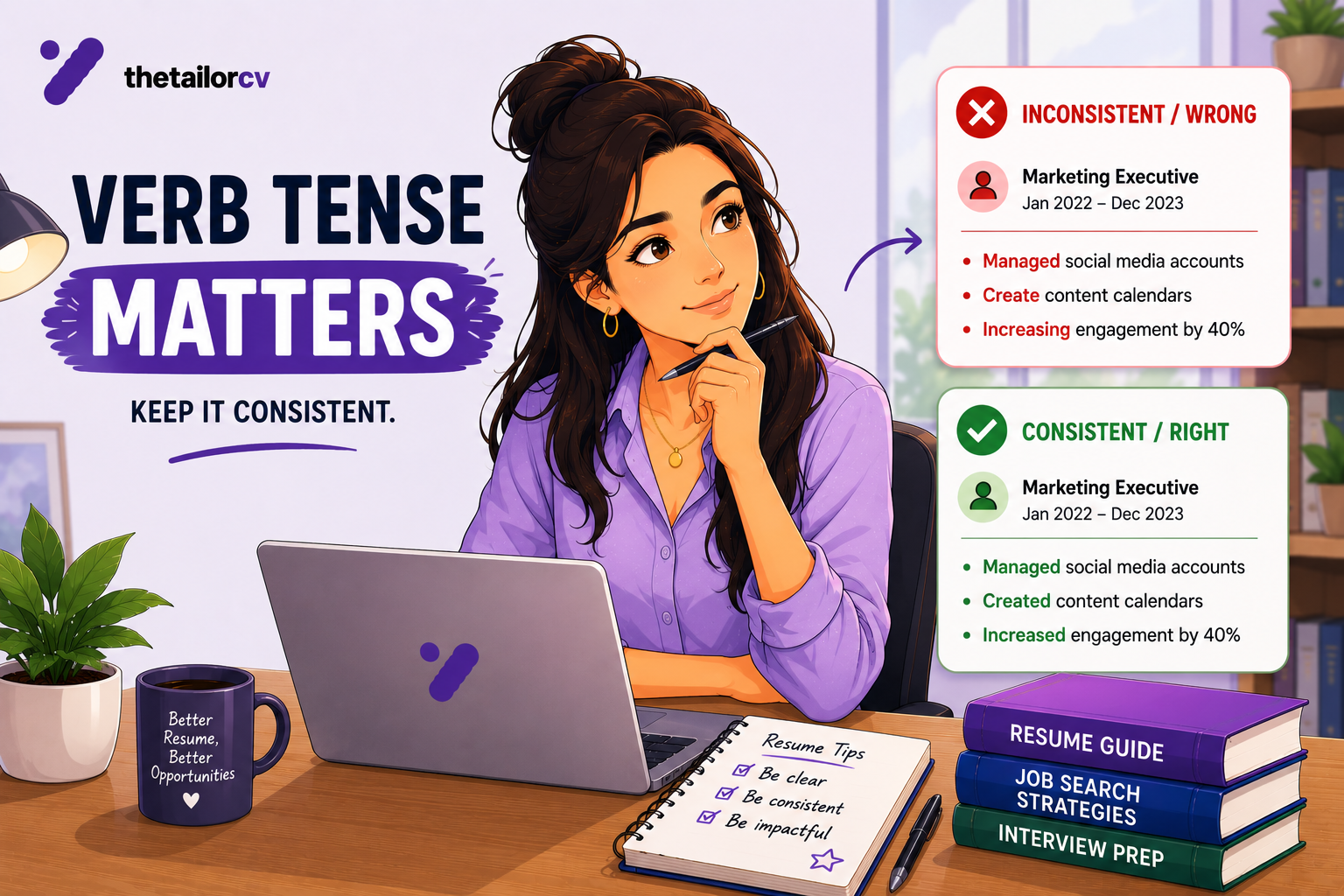
- The rule is simple: present tense for your current role, past tense for everything before it.
- Mixing tenses within the same job entry reads as carelessness, even when the content is strong.
- Bullets under different roles should not share identical verb forms copy-pasted between jobs.
- This does not affect ATS matching directly, but it affects the human read that follows.
- A two-minute audit catches nearly every instance.
Verb tense errors do not break ATS matching, but they are one of the fastest ways to signal carelessness to a human reader — and the human reader is the one who decides whether to call you.
The Rule
Current role: present tense. You are still doing this work.
Manage a team of 6 analysts. Build weekly reporting dashboards. Lead the quarterly planning process.
Every previous role: past tense. You are no longer doing this work.
Managed a team of 4 analysts. Built weekly reporting dashboards. Led the quarterly planning process.
That is the entire rule. Almost every tense error on a resume is a violation of one half of it.
The Two Common Mistakes
Mistake one: present tense on a past role.
Marketing Coordinator, Acme Inc, 2021-2023 - Manage the social media calendar - Coordinate with the design team
This reads as though you are still there, or as a copy-paste error from a template. Fix by converting to past tense throughout that entry.
Mistake two: past tense on your current role.
Marketing Manager, Current Company, 2023-Present - Managed the rebrand launch - Led the Q3 campaign
This one is subtler and just as common — it undersells ongoing work as finished, and it is inconsistent with the "Present" end date sitting right next to it.
Mixed Tense Within One Entry
This is the version that reads worst, because it happens within a single job and looks like the resume was assembled from different drafts:
Marketing Manager, Current Company, 2023-Present - Manage a team of 4 - Led the Q3 campaign - Building the new attribution model
Three different tenses in three bullets under the same still-current job. Fix by making the whole entry consistent — all present tense, since this is the current role.
Why This Matters More Than It Seems
A recruiter reading dozens of resumes an hour is not analysing your grammar deliberately. They are pattern-matching for competence and attention to detail, and a tense inconsistency registers as a small negative signal even when the reader could not articulate why. It sits in the same category as a typo — individually minor, collectively costly when several appear together.
It is also one of the easiest things to get right, which makes getting it wrong stand out more, not less. Unlike a genuinely hard writing problem, this is purely a proofreading pass.
The Two-Minute Audit
1. Find your current role. Confirm every bullet under it uses present tense: manage, build, lead, own, drive, coordinate, oversee.
2. Find every previous role. Confirm every bullet uses past tense: managed, built, led, owned, drove, coordinated, oversaw.
3. Check within each entry for mixing. Read the bullets under one job consecutively. If the tense shifts mid-list, fix it.
4. Check your summary separately. Summaries are conventionally present tense regardless of role — "Data analyst with 4 years..." — since they describe you generally, not a specific past action.
Copy-Paste Between Jobs Is the Usual Cause
Most tense errors come from copying a bullet from one job entry to another while updating the role — the tense from the original context survives the copy. If you build your resume by duplicating an existing bullet and editing it, re-check the tense every time, because it is the detail most likely to be missed in an edit pass focused on content.
A Quick Reference Table
| Situation | Tense |
|---|---|
| Current job bullets | Present |
| Past job bullets | Past |
| Resume summary | Present |
| Skills section | No verb needed — nouns |
| Education | Past (unless currently enrolled) |
| Currently enrolled degree | Present ("Pursuing", "Currently completing") |
Does This Affect ATS Matching?
Not directly. Matching systems generally recognise both "manage" and "managed" as the same underlying skill. This is a human-readability issue, not a keyword-matching one — which is exactly why it is easy to overlook when you are focused on getting your keywords right, and why it deserves its own separate pass. See weak resume bullets for the content side of bullet quality.
Frequently Asked Questions
Should my resume summary be past or present tense? Present. It describes who you are now, not a completed action.
What about a role I am still in but on leave from? Present tense — you are still employed there even if not actively working day to day.
Is it wrong to use present tense for a very recent past role? Yes, if the role has genuinely ended. Use past tense regardless of how recently it ended.
What tense should freelance or ongoing project work use? Present, if the work is ongoing. Past, if a specific project has concluded even if you continue freelancing generally.
Does this matter for a resume submitted through an ATS? It matters for the human read that follows the automated filter, which is why it is worth two minutes even though it will not change your match score.
Fix the Tense, Then Check the Match
A tense audit is a fast, mechanical pass — worth doing right before you submit, alongside checking that the resume actually matches the posting you are applying to.
Scan your resume against the posting to confirm the content itself evidences what the role requires. Tense consistency polishes the read; match quality is what gets you through the filter in the first place.
Free, about a minute. See also weak resume bullets and last-minute application checklist.
What is your resume scoring right now?
Scan it against a job description and get your ATS match score in about a minute.
Drop your resume here or choose a file
PDF only. Max 2 MB.
We never share your data or use it to train AI models.

Templates that keep this structure intact
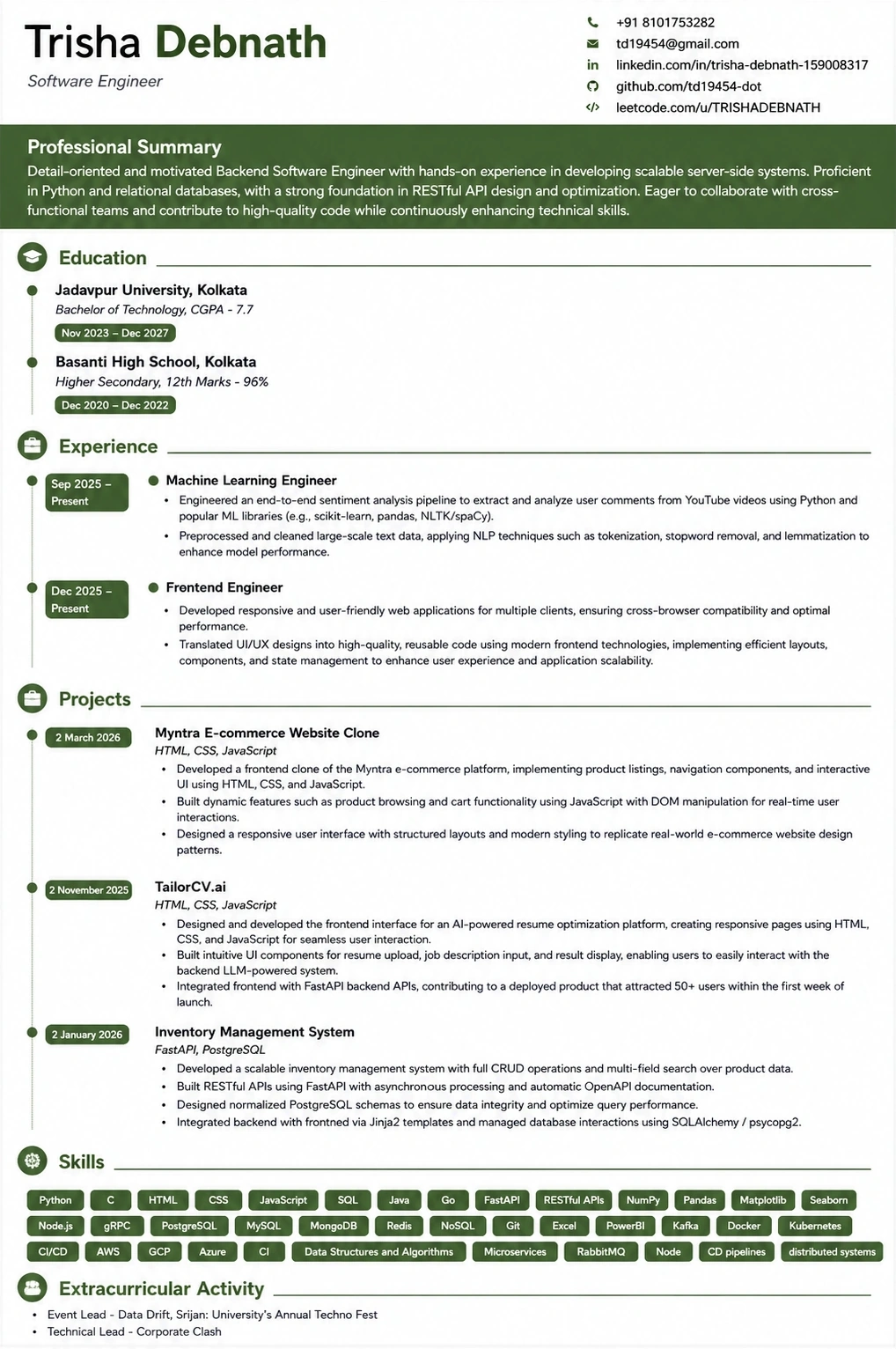
This template is ATS-tested — start from it and the formatting rules in this guide are already handled.
Was this guide useful?
Be the first to rate it.