SS
SS
Key Takeaways
- A rejection inside 24 hours almost never involved a human reading your resume.
- Fast rejections are usually knockout questions, not resume scoring — and knockout questions are answered by you, not your resume.
- The speed is actually useful information: it narrows the cause to a small list.
- If it was a knockout question, no amount of resume rewriting will help.
- If it was scoring, the fix is specific and checkable in a minute.
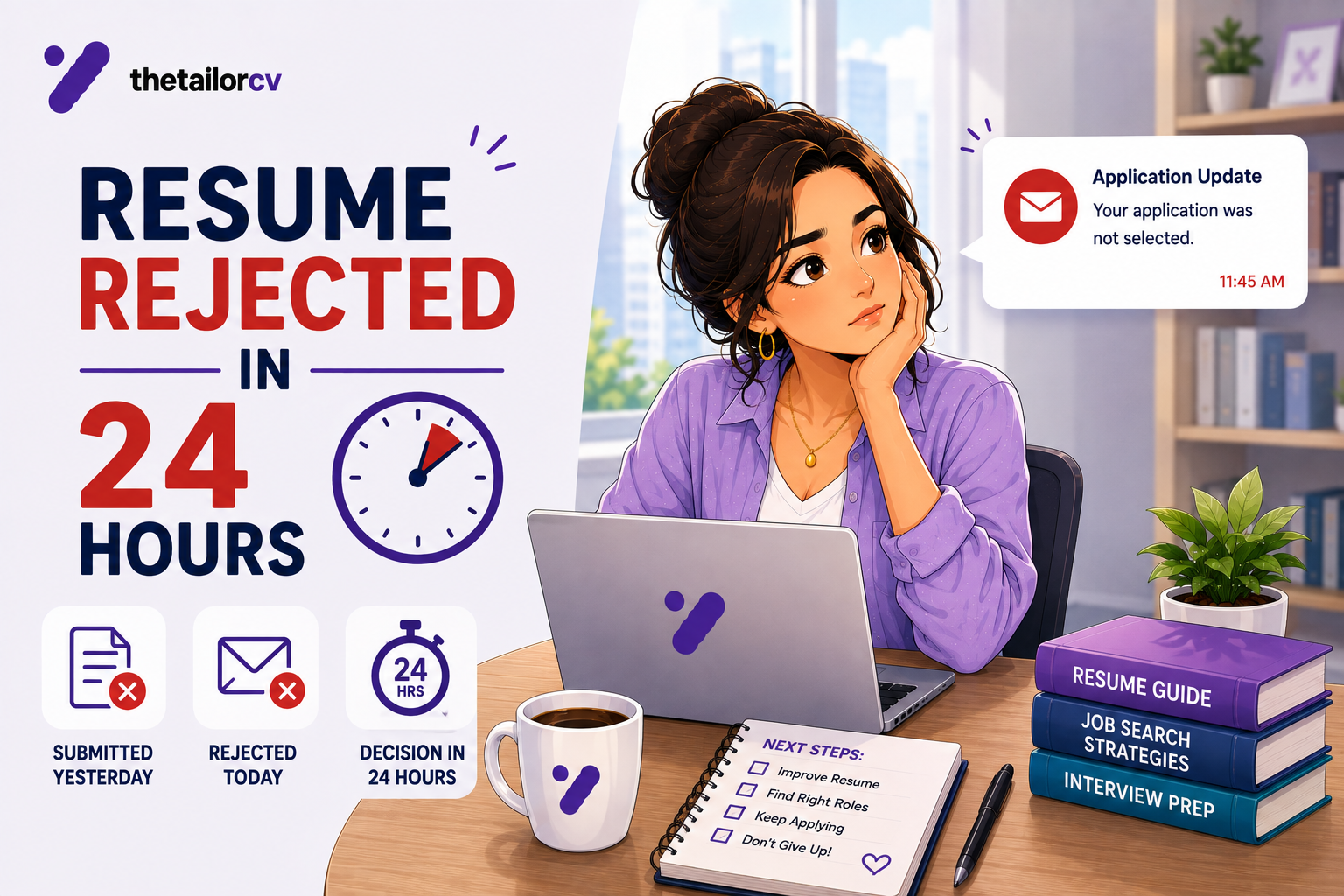
Getting rejected the same day you applied feels worse than silence. It reads as instant dismissal. In practice it is the most diagnosable kind of rejection you can get, because the speed itself rules out most explanations.
What Happens in the First 24 Hours
An application typically passes through three automated stages before a human sees anything:
Stage 1 — Parsing. Your file is converted to structured data. If it fails badly here, you may be rejected or simply score near zero on everything.
Stage 2 — Knockout questions. The application form questions: work authorisation, willingness to relocate, years of experience, salary expectation, licence held, notice period. These are usually configured as hard filters with automatic dispositions.
Stage 3 — Match scoring. Your parsed resume is scored against the requisition. Low scores may be auto-rejected or simply ranked below the review threshold.
A rejection arriving within hours almost always came from stage 2, sometimes stage 1, rarely stage 3. Recruiters do not typically review and reject within a few hours of posting — they batch-review.
Knockout Questions Are the Usual Cause
This is the part most people miss. The rejection may have nothing to do with your resume at all.
Common knockout configurations:
- "Are you legally authorised to work in [country] without sponsorship?" Answering no is an immediate filter on most postings that ask it.
- "Do you have X years of experience with Y?" Answering below the threshold filters you out even if your resume shows adjacent experience.
- "Are you willing to work on-site in [city]?" A no here ends it, regardless of how the posting was advertised.
- "Do you hold [licence/certification]?" Hard requirement in regulated fields.
- "What is your expected salary?" Some systems filter above a configured band.
- "Have you previously worked for this company?" Sometimes filters rehire-ineligible applicants.
If a knockout question filtered you, rewriting your resume changes nothing. That is worth knowing before you spend a weekend on it. The only useful responses are: apply to roles where you meet the hard requirement, or answer more accurately if you rushed and answered wrong.
Be careful with the last point — some people answer knockout questions strategically. Misrepresenting work authorisation or a licence gets discovered at offer stage and wastes everyone's time including yours.
When It Was the Resume
Fast rejection can come from parsing or scoring, particularly at large employers with aggressive auto-disposition settings.
Signs it was parsing:
- You applied with an unusual file type, a design template, or a scanned document
- Your resume uses columns, tables, or text boxes
- You have had this pattern across many employers, not just one
Signs it was scoring:
- The posting listed specific required tools or credentials you did not name in your resume
- You applied with a generic resume to a specialised posting
- Your job titles differ substantially from the posting's title
Our ATS formatting mistakes guide covers the parsing side, and why is my ATS score low covers scoring.
How to Tell Which One You Hit
Take the posting you were rejected from — it is usually still open — and work through this:
1. Re-read the application questions. Most systems let you view your submitted application. Look at what you answered. If you answered "no" to authorisation, relocation, or a required licence, that is your answer and the resume is irrelevant.
2. Check what the parser extracted from your file. Scan your resume and look at the extracted data before the score. Missing job titles, wrong dates or an empty skills section mean a parsing problem that affects every application you send.
3. Check the match. Look at which of the posting's stated requirements your resume failed to evidence. If several required items are missing, scoring is a plausible cause.
Twenty minutes of this beats weeks of guessing.
The Rejection Speed Tells You Something Useful
Compare these three patterns:
Rejected in hours, repeatedly, across many employers. Strongly suggests a knockout answer you give consistently — most often work authorisation — or a parsing failure in your file. Both are systematic and both are findable.
Rejected in hours at large companies, silence at small ones. Large employers run more aggressive automation. This pattern suggests your resume is scoring below threshold rather than failing outright.
Rejected after several days or weeks. A human was probably involved. That is a genuine competitive rejection, not a filter, and it means your resume did its job.
The third one is the least discouraging even though it feels worst — it means you reached a person.
What Not to Do
Do not immediately redesign your resume. If a knockout question filtered you, a redesign is wasted effort. Diagnose first.
Do not apply again to the same posting with a tweaked resume. Most systems flag duplicate applications, and re-applying within days rarely helps.
Do not assume it was personal. At this speed, nobody formed an opinion about you. A rule fired.
Do not answer knockout questions dishonestly. It surfaces later, at a worse time.
What to Do Instead
- Identify whether it was a knockout. Look at your submitted answers first — it is the fastest check and the most common cause.
- If it was, filter your applications. Apply where you meet the hard requirements. Use search filters for sponsorship, location and seniority rather than applying broadly and being filtered.
- If it was not, scan your resume against the posting. Check extraction first, then the missing requirements.
- Fix the wording gaps. Most missing requirements are things people have but did not state in the posting's language — see matching keywords to a job description.
- Re-scan to confirm the change registered.
Frequently Asked Questions
Does a fast rejection mean a human never saw my resume? Almost certainly, if it arrived within hours. Recruiters batch-review; automated dispositions are instant.
Can I ask why I was rejected? You can, and occasionally you will get a useful answer, but automated rejections rarely come with a reviewable reason.
Should I reapply after fixing my resume? To the same posting, usually not. To the same company for a different role, yes — most systems do not hold a prior rejection against a new application.
Is being rejected fast worse than being ghosted? No. A fast rejection gives you information and frees you up. Silence gives you neither.
Do all companies auto-reject? No. Configuration varies widely. Large employers with high application volume are far more likely to use hard filters.
Start With the Check That Takes a Minute
Before rewriting anything, find out whether your resume is even being read correctly.
Scan your resume against the posting you were rejected from. Look at what the parser pulled out, then at which requirements came back unevidenced. That distinguishes a formatting problem from a matching problem from a knockout — and only one of the three is fixed by editing your resume.
For more on the underlying causes, see why your resume gets no responses and our ATS score guide.
Find out why your score is low
Scan your resume against the job description and see exactly which checks fail.
Drop your resume here or choose a file
PDF only. Max 2 MB.
We never share your data or use it to train AI models.

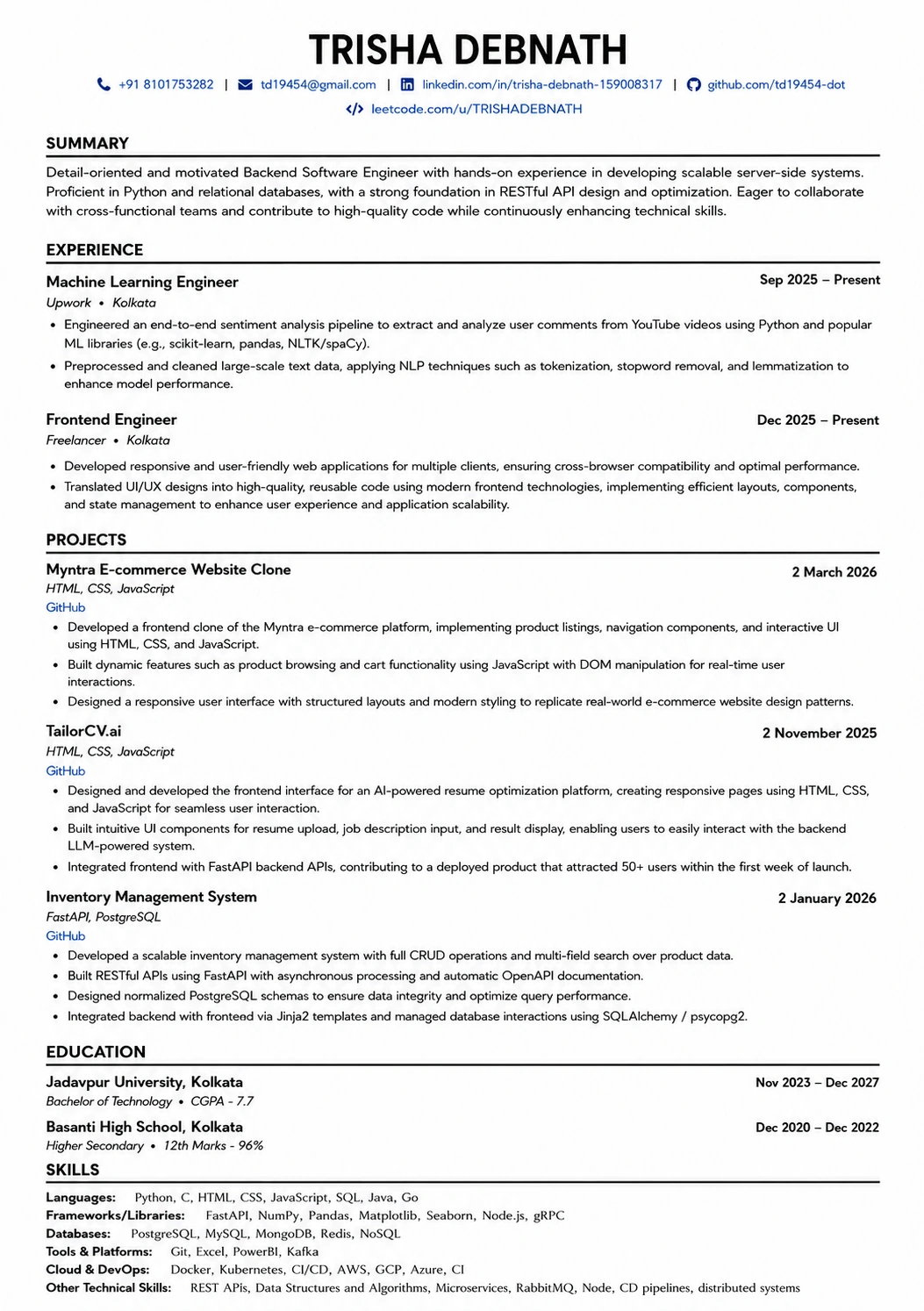
Templates that keep this structure intact
This template is ATS-tested — start from it and the formatting rules in this guide are already handled.
Was this guide useful?
Be the first to rate it.