 SS
SS
Key Takeaways
- An open work permit lets you work for almost any employer, which removes the largest barrier in a Canadian job search.
- Employer-specific permits tie you to one employer, and changing jobs requires a new permit.
- The Post-Graduation Work Permit is the strongest route for anyone who studied in Canada.
- Spousal open work permits are widely underclaimed and can give a partner full labour market access.
- State your permit type and expiry on your resume, because employers screen on it before anything else.
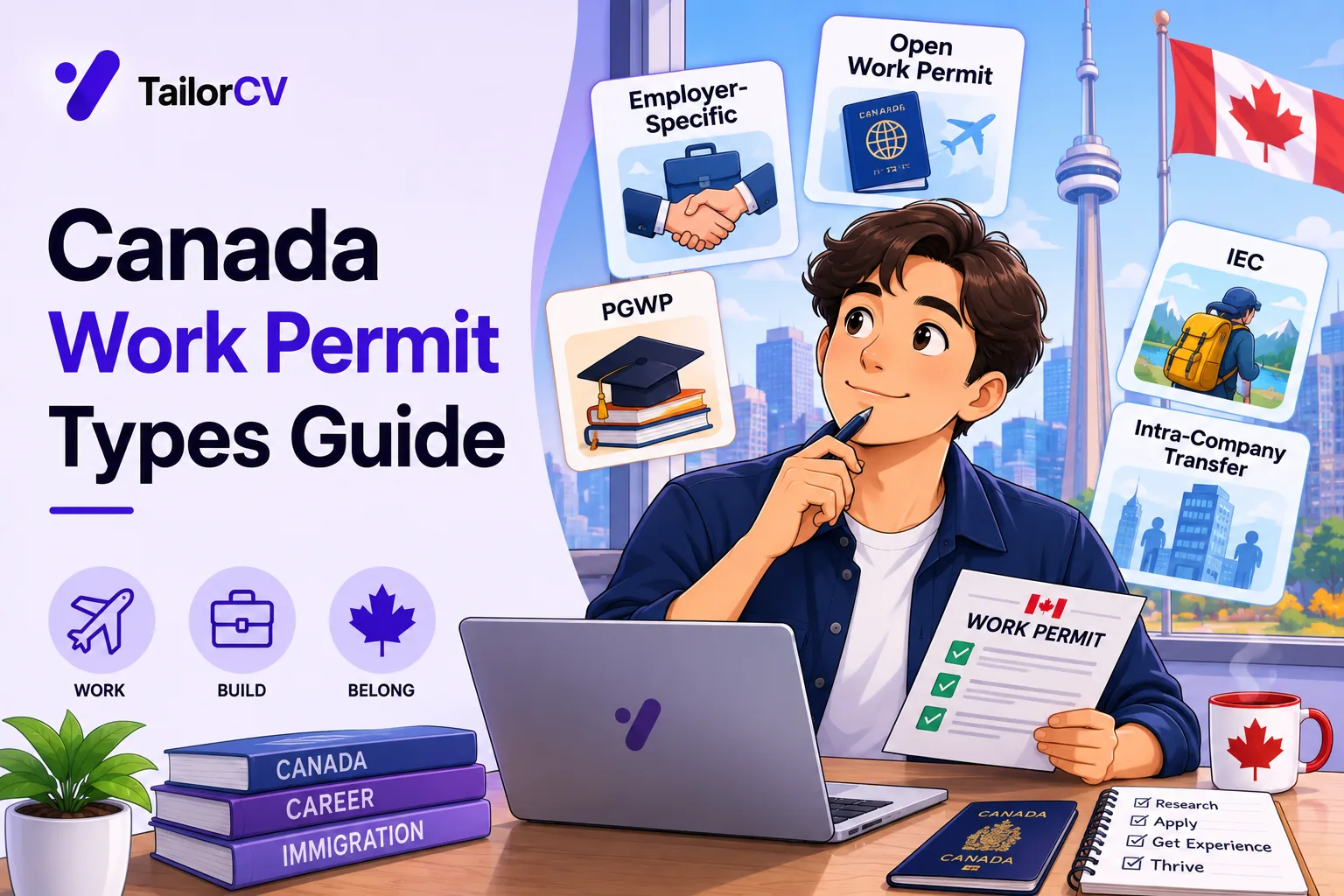
Canadian work permits fall into two categories that matter far more than the individual program names: permits that let you work for anyone, and permits that tie you to one employer. Which one you hold determines whether your job search resembles a Canadian citizen's or something considerably harder.
Many people hold, or are eligible for, a more useful permit than they realise.
This guide covers the types, the exemptions, and how to present your status.
Immigration rules change frequently and PGWP eligibility in particular has been revised. Verify current requirements with IRCC before acting.
While you plan, check your resume parses — the free ATS score checker.
Open work permits
The category worth caring about most.
An open work permit lets you work for almost any employer in Canada, without a job offer, without an LMIA, and without employer sponsorship. Some exclusions apply, typically around employers who have failed compliance requirements or certain sectors.
Main routes to one:
Post-Graduation Work Permit (PGWP). For graduates of eligible Canadian programs. Duration relates to the length of your study program. This is the single strongest position an international graduate can hold — you compete for jobs on essentially equal terms, and it lets you accumulate the Canadian work experience that feeds the Canadian Experience Class. Eligibility rules have been tightened, so confirm current criteria for your program before relying on it.
Spousal open work permit. If your partner holds certain work or study permits, you may be eligible for an open permit. This is widely underclaimed — couples arrive assuming only the principal applicant can work, and one of them spends a year not working when they were eligible all along.
Bridging Open Work Permit. For people with a permanent residence application in progress whose current permit is expiring, allowing continued work while the application processes.
International Experience Canada. Youth mobility arrangements with participating countries, age-limited, offering open or employer-specific permits depending on the category.
Certain humanitarian and protected person categories.
Employer-specific permits
Also called closed permits. You may work only for the named employer, in the named role, at the named location.
Typically requires an LMIA, in which the employer demonstrates no Canadian was available — see the LMIA job search guide.
Consequences worth understanding:
- Changing jobs requires a new permit, which takes time and depends on the new employer's willingness
- You cannot freelance or take a second job
- A bad situation is harder to leave, which is a real vulnerability
Vulnerable worker permits exist for people on employer-specific permits experiencing abuse, allowing a move to an open permit. Worth knowing this protection exists.
LMIA-exempt employer-specific permits
A middle category that is frequently overlooked and often easier than a standard LMIA route.
Intra-company transfers. Moving within a multinational to its Canadian office.
Trade agreement provisions. CUSMA and CETA among others allow certain professionals and transferees from partner countries to work without an LMIA, depending on nationality and occupation.
Global Talent Stream. Faster processing for designated in-demand occupations, particularly in technology.
Francophone mobility provisions, supporting French-speaking workers destined for communities outside Quebec — see the Canada French language advantage.
Significant benefit and reciprocal employment categories.
Check these before pursuing a standard LMIA, because they are faster, cheaper for the employer, and therefore far easier to get an employer to agree to.
Why it matters for your search
On an open permit, you apply like anyone else. Say so clearly and the sponsorship question disappears entirely.
On an employer-specific permit, your search is constrained and any move requires paperwork. Factor that into how you evaluate a role.
Needing a permit you do not yet hold means targeting employers who can support one — a much smaller set.
On your resume, state it plainly:
Post-Graduation Work Permit valid to August 2028 — open permit, no sponsorship required
Permanent resident — no sponsorship required
That last phrase is what recruiters screen on. Leaving your status unstated means the recruiter assumes, and the assumption is usually the least favourable one — see the resume for newcomers to Canada guide.
Common Mistakes
Not claiming a spousal open work permit. Couples routinely arrive assuming only one of them can work, and lose a year of a partner's income and Canadian experience.
Leaving permit status off the resume. Recruiters resolve ambiguity unfavourably, so an unstated status reads as needing sponsorship.
Writing "requires sponsorship" while holding an open permit. You need no employer action at all, and describing it otherwise is a self-inflicted rejection.
Pursuing a standard LMIA without checking exemptions. Intra-company transfer, trade agreement categories and the Global Talent Stream are faster and far easier to persuade an employer to use.
Not knowing an employer-specific permit blocks side work. You cannot freelance or take a second job on one.
Assuming PGWP eligibility. Rules have been tightened and depend on your program, so confirm before building a plan around it.
Staying in a bad situation on a closed permit. Vulnerable worker permits exist specifically to allow a move, and most people do not know that.
Forgetting the Bridging Open Work Permit. It allows continued work while a permanent residence application processes and prevents an avoidable gap.
Frequently Asked Questions
What is an open work permit?
A permit allowing you to work for almost any employer in Canada without a job offer, LMIA or sponsorship, subject to limited exclusions.
What is a PGWP?
The Post-Graduation Work Permit, an open permit for graduates of eligible Canadian study programs, with duration related to program length. Eligibility rules have been revised, so confirm current criteria.
Can my spouse work in Canada?
Frequently yes, through a spousal open work permit if you hold certain work or study permits. It is widely underclaimed.
What is an employer-specific permit?
A permit tying you to one named employer, role and location. Changing jobs requires a new permit, and you cannot take additional work.
Can I change jobs on a closed permit?
Only by obtaining a new permit for the new employer. If you are experiencing abuse, a vulnerable worker permit allows a move to an open permit.
Do all employer-specific permits need an LMIA?
No. Intra-company transfers, trade agreement categories, the Global Talent Stream and francophone mobility provisions are among the LMIA-exempt routes.
What should my resume say?
Your permit type and expiry, followed by whether sponsorship is required. "Open permit, no sponsorship required" is what recruiters screen on.
Check your resume before applying anywhere. Check your ATS score free.
Make This Practical
Work out whether you hold, or could hold, an open permit — because that single fact determines whether your job search looks like a citizen's or something far harder. If you have a partner on a work or study permit, check spousal open work permit eligibility today; it is the most commonly missed entitlement in Canadian immigration.
Then check the LMIA exemptions before asking any employer to pursue a standard LMIA. Intra-company transfer, trade agreement provisions and the Global Talent Stream are faster and cheaper for the employer, which makes them dramatically easier to get agreement on.
Finally, state your status plainly on your resume with the permit type and expiry, ending with whether sponsorship is required. Recruiters screen on that phrase, and leaving it unstated means they assume the hardest case.
What is your resume scoring right now?
Scan it against a job description and get your ATS match score in about a minute.
Drop your resume here or choose a file
PDF only. Max 2 MB.
We never share your data or use it to train AI models.

Was this guide useful?
Be the first to rate it.