 TD
TD
Key Takeaways
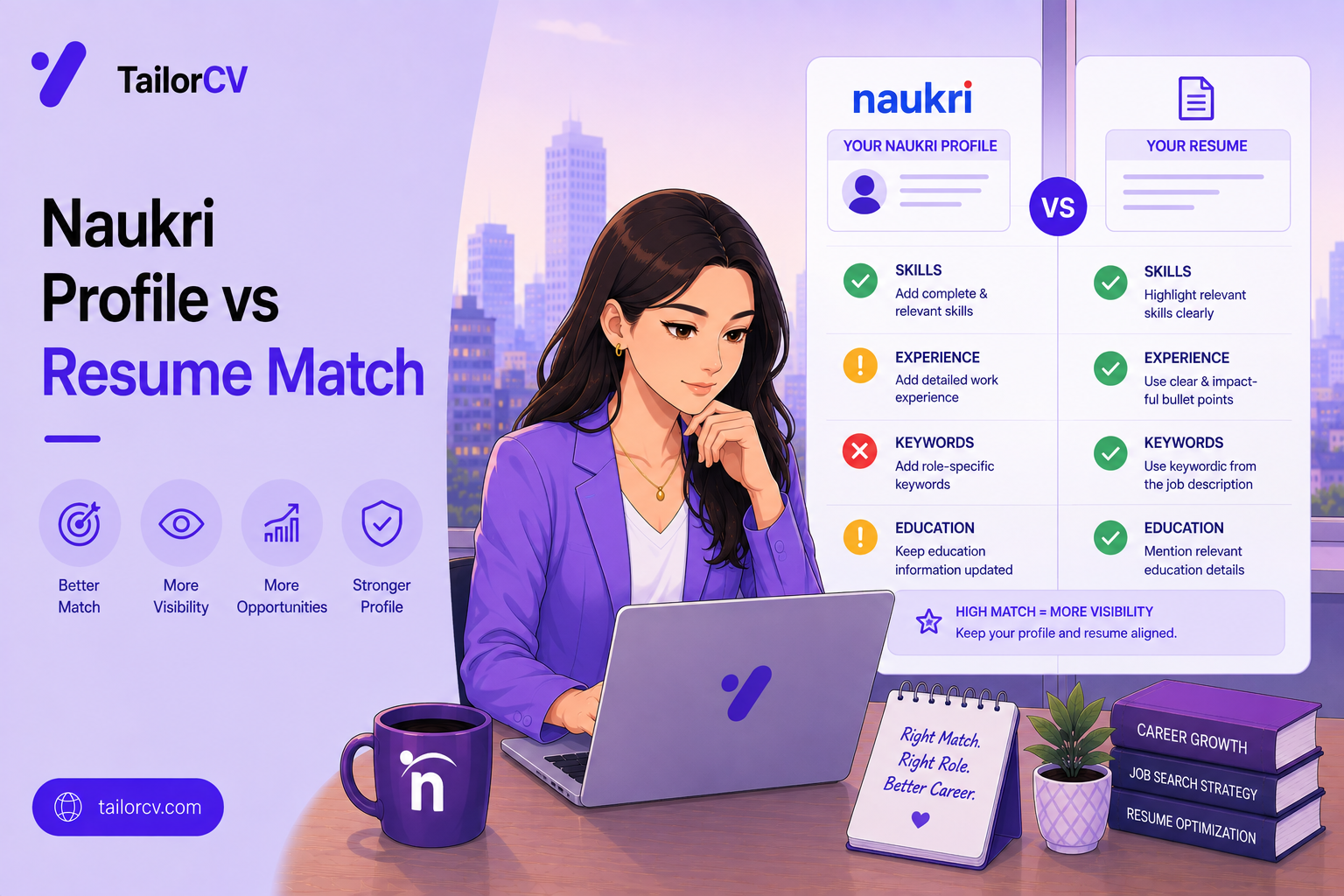
- Your Naukri profile and your uploaded resume serve two different, separate functions — the profile gets you found, the resume gets you shortlisted.
- Recruiters search and filter primarily using your profile fields — headline, key skills, current and expected CTC — not your uploaded resume file.
- Profile recency matters more than people expect: recruiters commonly sort by last-active or last-modified, so a stale profile sinks in search results even if the content is strong.
- Inconsistency between your profile and your resume is a real, common problem — a recruiter who finds you through one and reviews the other can be confused by mismatches.
- Both need independent attention; updating one without the other is a common and avoidable mistake.
Naukri works differently from platforms where your resume is the primary object recruiters interact with. Here, your profile — a structured set of fields you fill in directly on the platform — and your uploaded resume file are two separate things, and both matter for different reasons.
Two Different Functions
Your Naukri profile gets you found. Recruiters searching Naukri's candidate database are primarily searching and filtering on your profile fields — your headline, your key skills list, your current and expected CTC, your experience level, your location. This structured data is what surfaces you in a recruiter's search results in the first place.
Your uploaded resume gets you shortlisted. Once a recruiter finds you through the profile and opens your file, the actual resume document is what they review to decide whether to shortlist and contact you.
This means a strong resume sitting behind a weak, incomplete, or outdated profile may never get seen at all — you have to be found before your resume's quality matters.
Profile Completion and Recency Both Affect Visibility
Naukri's search and ranking is influenced by how complete your profile is — fields like headline, key skills, and CTC contribute meaningfully to how you rank in recruiter searches, beyond just whether you technically have a resume uploaded.
Recency matters more than most people expect. Recruiters commonly sort or filter candidates by how recently their profile was active or updated, which means a technically excellent but stale profile — one you have not touched in months — can sink well below more recently active profiles in search results, even if its actual content is stronger. Periodically updating your profile, even with minor edits, helps maintain visibility for this reason specifically.
Your Headline and Key Skills Do Heavy Lifting
Because these are primary fields recruiters search and filter on directly, your profile headline and key skills list deserve as much careful attention as your resume's own summary and skills section. A generic, vague headline ("Experienced Professional Seeking Opportunities") does none of the work a specific, keyword-rich one does ("Senior Data Analyst | SQL, Python, Tableau | 5 Years in Retail Analytics").
The same principle behind reordering your resume's skills section applies here — lead with what is specific and what recruiters in your target roles are actually searching for.
Consistency Between Profile and Resume Matters
A recruiter who finds you through your profile and then opens your uploaded resume expects reasonable consistency between the two. If your profile states one current role and CTC, and your uploaded resume tells a noticeably different story — different dates, different title, different scope — this reads as confusing at best and as a red flag at worst.
This is a genuinely common, avoidable problem: people update one and forget the other. Whenever you update your resume for an active search, take a few minutes to check that your Naukri profile reflects the same core facts — current role, key skills, experience summary.
CTC Fields Function as a Filter
Your current and expected CTC fields on Naukri are commonly used by recruiters as an explicit filter — similar in effect to the knockout questions covered in rejected within 24 hours, though functioning through profile search rather than an application form. An expected CTC set unrealistically high or low relative to the roles you actually want can filter you out of relevant searches or into irrelevant ones. Keep this field genuinely reflective of your actual expectations, and revisit it periodically as those expectations change.
Should Your Resume Be Tailored Per Application on Naukri Too?
Yes — the general principle from why one resume cannot serve every application applies here as much as anywhere. Your Naukri profile is necessarily a single, standing document optimised for general discoverability. Your uploaded resume, particularly when applying to a specific posting rather than relying purely on inbound profile discovery, can and should still be tailored to that specific role where the extra effort is warranted.
A Practical Naukri Checklist
- Complete your profile fully — headline, key skills, CTC, experience — since these fields drive search visibility directly.
- Update your profile periodically, even with minor edits, to maintain recency-based ranking.
- Write a specific, keyword-rich headline rather than a generic one.
- Check consistency between your profile and your uploaded resume whenever you update either.
- Keep your CTC expectations current and realistic, since this field commonly functions as a search filter.
- Tailor your uploaded resume per application where you are applying directly to a specific posting, separate from relying on inbound profile-based discovery.
Frequently Asked Questions
Does my uploaded resume affect my search visibility on Naukri? Uploading one contributes to overall profile completion, which affects ranking, but the specific fields recruiters search and filter by are primarily your structured profile data, not the resume file's content itself.
How often should I update my Naukri profile? Regularly enough to avoid appearing stale in recency-based sorting — even small updates every few weeks during an active search help maintain visibility.
What happens if my profile and resume don't match? This can confuse a recruiter reviewing both and may read as a red flag — keep the core facts (role, dates, key skills) consistent across both.
Should my expected CTC be flexible or a fixed number? Reflect your actual, current expectations honestly — an unrealistic figure in either direction can filter you out of searches you would otherwise be a good match for.
Confirm Your Resume Content Independently
Whether a recruiter finds you through your Naukri profile or you are applying directly to a specific posting, the underlying resume content is what ultimately gets you shortlisted.
Scan your resume against a specific posting to check it evidences what that role requires — a useful step regardless of whether the recruiter reached it through profile-based discovery or direct application.
Free, about a minute. See also why one resume cannot serve every application and rejected within 24 hours.
What is your resume scoring right now?
Scan it against a job description and get your ATS match score in about a minute.
Drop your resume here or choose a file
PDF only. Max 2 MB.
We never share your data or use it to train AI models.

Templates that keep this structure intact
This template is ATS-tested — start from it and the formatting rules in this guide are already handled.
Was this guide useful?
Be the first to rate it.