 TD
TD
Key Takeaways
- Remote work expanded significantly but many Japanese employers have returned substantially to the office.
- Foreign-owned companies and startups offer far more remote flexibility than established domestic firms.
- Fully remote roles exist but are a minority, and hybrid is the realistic expectation.
- Your visa ties you to work in Japan, so working remotely from another country is generally not permitted.
- Physical presence still carries cultural weight, which affects how remote workers are perceived at traditional companies.
Remote work in Japan followed a familiar arc — rapid adoption, then substantial retreat. What remains is a genuinely mixed picture where the answer depends almost entirely on what kind of company you join.
For foreign professionals there is an additional constraint that catches people out: your status of residence permits you to work in Japan, which is not the same as permitting you to work from anywhere.
This guide covers what is realistically available and what to check.
Before applying, check your documents work — the free ATS score checker.
The current picture
Adoption expanded, then partially reversed. Many large Japanese employers have brought staff back for most of the week, citing collaboration and training — particularly for new graduates, whose development model assumes proximity.
Hybrid is the realistic norm where flexibility exists at all, typically two to three office days.
Fully remote roles exist but are a minority, concentrated in specific segments.
It varies enormously by employer type, more than by industry.
By company type
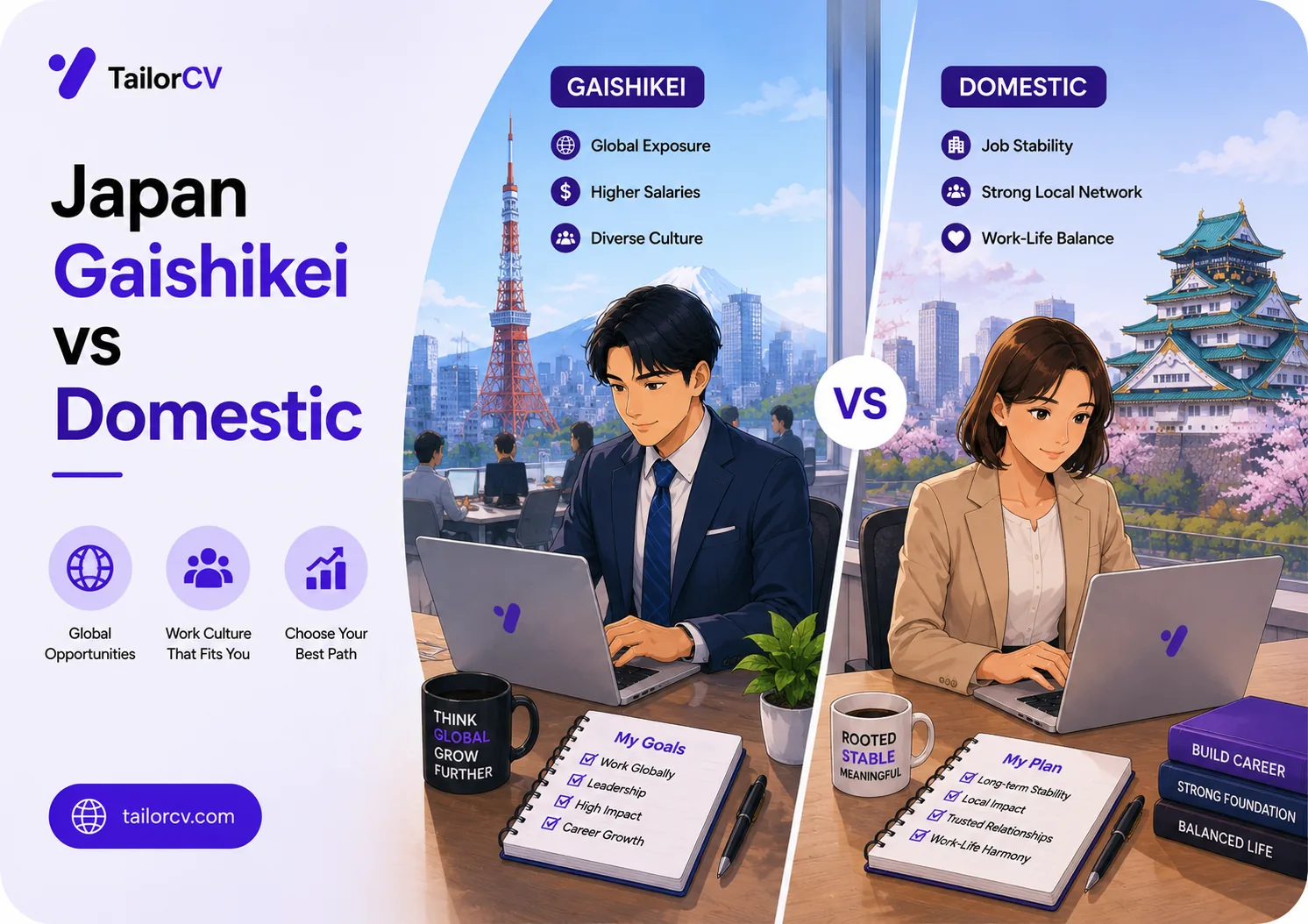
Foreign-owned companies (gaishikei). Generally the most flexible, frequently following the parent company's global policy. If remote or hybrid matters to you, this segment is the most reliable — see gaishikei vs domestic.
Startups. Often flexible, sometimes fully remote, and considerably less attached to presence-based norms — see the Japan startup jobs guide.
Large domestic companies. Mixed. Some have retained substantial remote policies; many have returned to the office for most of the week. Technology functions tend to be more flexible than other departments.
Traditional firms and SMEs. Frequently office-based, and remote requests can be received as unusual rather than routine.
IT services and SES. Depends heavily on the client site rather than your employer — see IT jobs in Japan for foreigners.
The cultural layer
Worth naming because it affects how remote work goes rather than whether it is permitted.
Physical presence carries weight. In workplaces where informal consultation before meetings does much of the real work — nemawashi — being absent means missing the conversations where decisions actually form. That is a practical disadvantage, not merely a perception issue.
Horenso matters more remotely, not less. The convention of proactive reporting becomes essential when nobody can see what you are doing. Remote workers who communicate at the same frequency they would in an office are under-communicating — see the Japan business manners guide.
New graduate training assumes proximity. The extensive development model for the graduate cohort is hard to deliver remotely, which is part of why companies pulled back — see new grad vs mid-career hiring.
For a mid-career hire, this matters less, but it still shapes how visible your contribution is.
The visa constraint
The part foreign professionals most often get wrong.
Your status of residence authorises you to work in Japan. It does not authorise you to work from another country while employed by a Japanese company.
Working from abroad creates problems with tax residency, with your employer's obligations, and potentially with your residence status if you spend extended periods outside Japan.
Extended absence can affect your residence permit. Long periods outside Japan may raise questions at renewal or affect permanent residency applications, which depend on continuous residence.
Some employers permit short defined periods abroad under a formal policy. Ask rather than assume, and do not do it quietly — see the Japan work visa guide.
Conversely, working for a foreign company while living in Japan raises its own questions about whether your activity falls within your status — worth confirming rather than assuming.
What to ask before accepting
How many office days, at which location, and is it policy or team discretion? The most important question and the one job postings most often omit.
Has the policy changed recently? A company that pulled people back last year may do so again.
Who else on the team is remote? One remote person on an office-based team has a different experience from a distributed team.
Is the arrangement in your contract or informal? Informal arrangements do not survive manager changes.
What equipment and allowance is provided? Many Japanese companies offer a telework allowance.
Are there core hours? Flexible location does not always mean flexible hours.
Common Mistakes
Assuming remote work is now standard in Japan. Many employers returned substantially to the office, and hybrid with two to three office days is the realistic expectation.
Not asking how many office days. Postings frequently omit it, and it is the detail that defines the job.
Working from another country on a Japanese visa. Your status authorises work in Japan specifically, and extended absence can affect renewals and permanent residency.
Communicating at office frequency while remote. Horenso becomes more important, not less, when nobody can see what you are doing.
Relying on an informal arrangement. Manager changes and policy reversals leave verbal agreements worthless.
Underestimating nemawashi. Much of the real deciding happens in informal pre-meeting conversation, and remote workers miss it.
Expecting the same flexibility across employer types. Gaishikei and startups differ enormously from traditional domestic firms.
Assuming flexible location means flexible hours. Core hours frequently still apply.
Frequently Asked Questions
Is remote work common in Japan now?
More than before, but many employers returned substantially to the office. Hybrid with two to three office days is the realistic norm where flexibility exists.
Which companies offer the most flexibility?
Foreign-owned companies and startups, generally. Large domestic firms are mixed, and traditional companies and SMEs are frequently office-based.
Can I work remotely from another country?
Generally not on a Japanese work visa. Your status authorises work in Japan, and extended absence can affect renewals and permanent residency applications.
Does remote work affect how I am perceived?
It can, particularly at companies where informal pre-meeting consultation does much of the decision-making. Over-communicating substantially offsets this.
Are there fully remote jobs in Japan?
Yes, but they are a minority, concentrated at startups and foreign-owned companies rather than established domestic firms.
Should I get the arrangement in writing?
Yes. Informal agreements with a manager do not survive policy changes or a change of manager.
Does remote mean flexible hours?
Not necessarily. Many Japanese employers retain core hours regardless of location.
Check your application documents. Check your ATS score free.
Make This Practical
Ask how many office days, at which site, and whether it is formal policy or team discretion — before accepting anything. Postings routinely omit this, policies have been reversed at many employers, and it is the single detail that determines what the job actually is.
Then get it into your contract rather than agreeing it verbally, and target the segments where flexibility is genuine. Foreign-owned companies and startups offer substantially more than established domestic firms, and that difference is larger than any variation between industries.
Finally, adjust your communication upward if you work remotely here. Proactive reporting matters more when nobody can see you, and much of the real decision-making happens in informal conversation before meetings — so make your progress visible deliberately rather than assuming good work speaks for itself.
What is your resume scoring right now?
Scan it against a job description and get your ATS match score in about a minute.
Drop your resume here or choose a file
PDF only. Max 2 MB.
We never share your data or use it to train AI models.

Was this guide useful?
Be the first to rate it.