 TD
Key Takeaways
- Recruiters want to see modern .NET: .NET 6/8, ASP.NET Core, Entity Framework Core and Azure. Lead with those, even if you also maintain older .NET Framework code.
- Write ".NET" and "C#" exactly as the ad does. ATS filters match the literal text, and "dotnet" or "C Sharp" can score differently.
- Migration work - .NET Framework to .NET 8, on-prem to Azure - is one of the most valued bullets you can have. Make it specific.
- Pair every framework name with what you built and what it changed.
A .NET developer resume gets read when the first third shows you work in current .NET - ASP.NET Core APIs, EF Core, Azure - with numbers on the systems you built. Many .NET developers maintain legacy code too, and that's valuable, but it should support the story, not lead it.
Run your resume against a real .NET job ad in the free ATS score checker first to see which frameworks and Azure services the ad expects.
What the job ad is really asking for
| Job ad says | What it means for your resume |
|---|---|
| "C#, .NET 6+ / ASP.NET Core" | Name the version you worked in and what you built with it. |
| "Entity Framework / SQL Server" | One bullet on data modelling or query performance. |
| "Azure (App Service, Functions, Service Bus)" | Name the Azure services, not just "Azure". |
| "Experience modernising legacy applications" | A migration bullet with before/after numbers. |
.NET Developer Resume Summary
Experienced: .NET developer with 6 years building ASP.NET Core APIs and Blazor front ends in C# on Azure. Led the migration of a .NET Framework 4.7 monolith to .NET 8 microservices, cutting deployment time from 2 hours to 12 minutes. Strong in EF Core, SQL Server, Azure Service Bus and automated testing.
Entry-level: Junior .NET developer with a B.Sc. in Computer Science and 1 year building internal tools in C# and ASP.NET Core MVC. Built a leave-management app used by 250 employees with SQL Server and Azure App Service.
Skills Section
Languages:     C#, SQL, TypeScript, JavaScript
.NET:          .NET 8, ASP.NET Core (Web API, MVC), Blazor, Entity Framework Core, LINQ, SignalR
Legacy:        .NET Framework 4.x, WCF, Web Forms
Data:          SQL Server, PostgreSQL, Redis, Cosmos DB
Azure:         App Service, Functions, Service Bus, Key Vault, Azure DevOps, AKS
Testing/tools: xUnit, NUnit, Moq, Docker, Git, GitHub Actions
Keep legacy skills in their own line so they don't crowd the top of the list.
Bullet Rewrites
Before: Developed APIs in .NET. After: Built 30+ ASP.NET Core Web API endpoints for an insurance claims platform serving 60K agents, with p95 response under 150ms.
Before: Upgraded the application to .NET Core. After: Migrated a 400K-line .NET Framework 4.7 application to .NET 8, cutting server costs by 40% and enabling Linux container deployment.
Before: Worked with Entity Framework. After: Rewrote 18 slow EF Core queries with projections and compiled queries, reducing report load time from 11s to 1.8s.
Before: Used Azure. After: Moved nightly batch jobs to Azure Functions triggered by Service Bus, removing 3 always-on VMs and $2.1K/month in hosting.
See how to quantify achievements for finding numbers.
ATS Keywords for .NET Developer Resumes
C#, .NET, .NET Core, .NET 8, ASP.NET Core, ASP.NET MVC, Web API, Entity Framework Core, LINQ, SQL Server, Azure, Azure DevOps, microservices, REST API, Blazor, xUnit, unit testing, CI/CD, Docker, design patterns, SOLID, Agile.
Tailoring Walkthrough
- Backend / API ad: lead with ASP.NET Core Web API, EF Core and performance work.
- Full-stack .NET ad: lead with Blazor or React/Angular plus the API behind it - see the full stack developer resume guide.
- Modernisation ad: lead with your migration bullet and Azure moves.
Let the resume optimizer reorder your skills and bullets against each ad, or follow how to tailor your resume for every job.
Common Mistakes
- Only legacy versions on the resume. If you've used .NET 6+, say so explicitly.
- "Microsoft technologies" as a skill. Too vague to match any filter.
- No testing. Senior .NET ads almost always mention unit tests.
- Listing every Azure service. List the ones you configured or built against.
Related Guides
- Backend Developer Resume 2026
- Java Developer Resume 2026
- Software Engineer Resume 2026
- Cloud Engineer Resume 2026
- Node.js Developer Resume 2026
Make This Practical
Paste your resume and the job ad into the free ATS score checker, then use the resume optimizer to match your C# and Azure experience to that ad in one pass.
Frequently Asked Questions
Should I write ".NET" or "dotnet" on my resume?
Use ".NET" and "C#", the standard spellings. Most job ads use them, and ATS filters often match the literal text.
How do I present mostly legacy .NET Framework experience?
Lead with the parts that transfer - C#, SQL Server, architecture decisions and business impact - then show any modern .NET exposure from side projects or upgrades. A migration you led, even a small one, is a strong bullet.
Is a .NET developer resume different from a C# developer resume?
In practice they are the same role. Use whichever title the job ad uses in your headline, and keep both ".NET" and "C#" in your skills.
See which keywords you are missing
Scan your resume against the posting and get the exact terms it did not find.
Drop your resume here or choose a file
PDF only. Max 2 MB.
We never share your data or use it to train AI models.
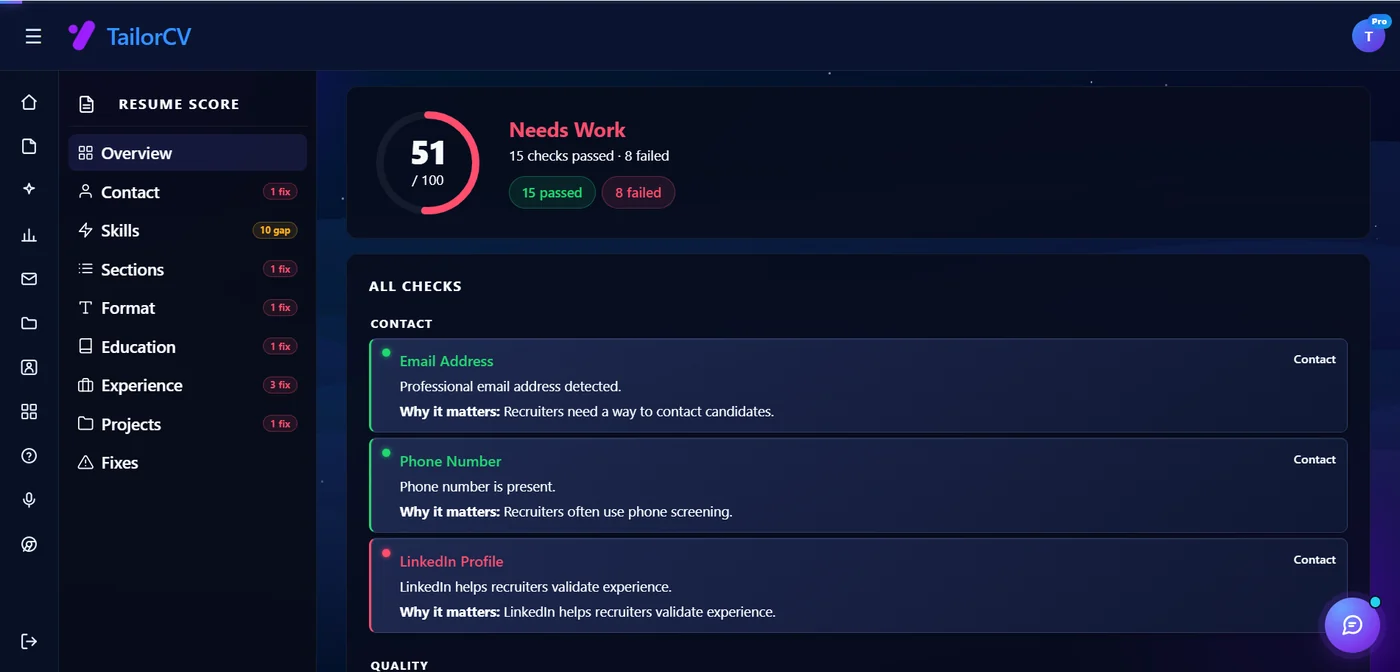
Where those keywords actually go
A layout with a real skills section gives the parser somewhere clean to find every term you just added.