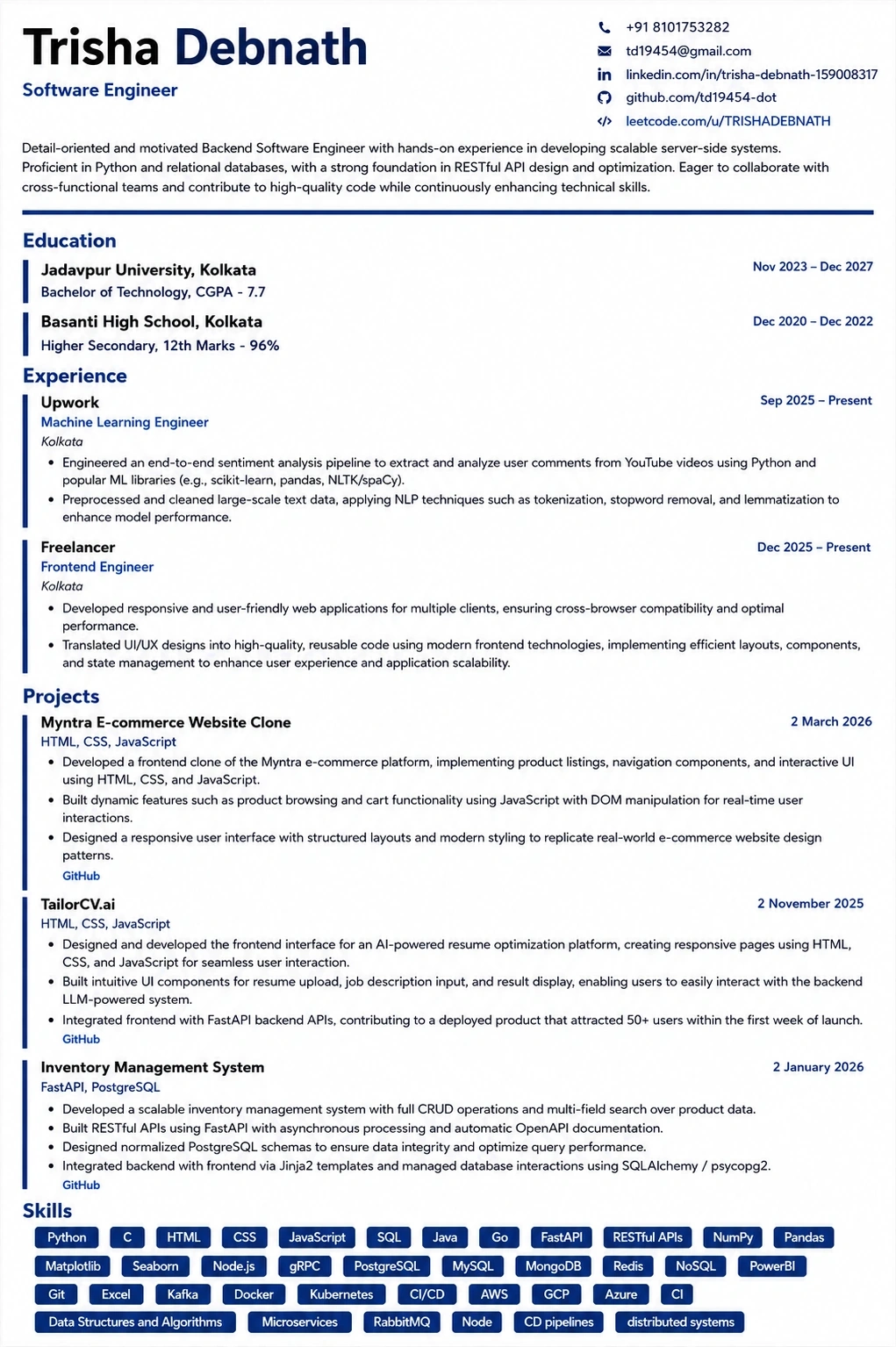
 SS
Key Takeaways
- Node.js hiring managers look for production backend work: APIs, queues, databases and how your services behaved under load.
- TypeScript is now expected in most Node.js ads. If you use it, put it next to Node.js in your headline and skills.
- Name the framework (Express, NestJS, Fastify) and the data layer (PostgreSQL, MongoDB, Redis, Prisma) exactly as the ad does.
- Show async and real-time work - queues, WebSockets, background jobs - because that's what separates Node.js backend roles from generic JavaScript ones.
A Node.js developer resume gets shortlisted when it reads like backend engineering, not "knows JavaScript". That means APIs with traffic numbers, latency improvements, queues and real-time features, all in the TypeScript and framework vocabulary the job ad uses.
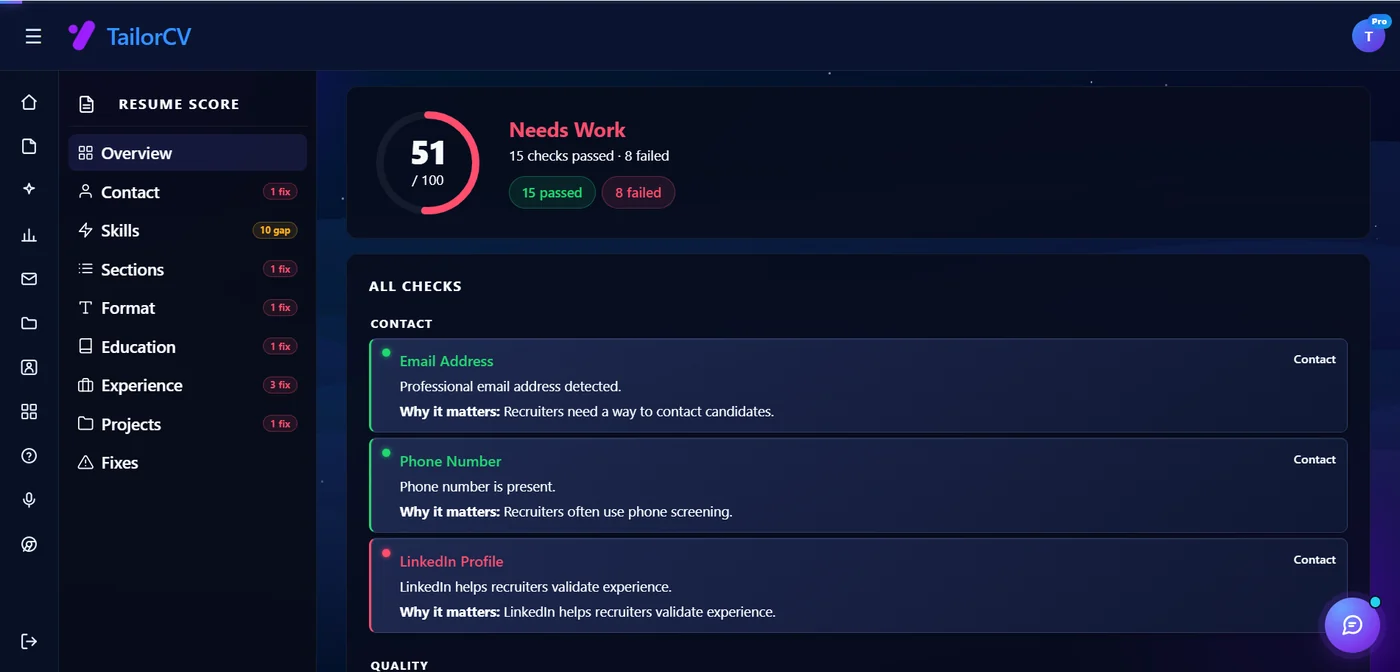
Run your resume against the posting in the free ATS score checker to see which frameworks and data stores you're missing.
What the job ad is really asking for
| Job ad says | What it means for your resume |
|---|---|
| "Node.js and TypeScript" | Put both in the headline and at least two bullets. |
| "Experience with NestJS or Express" | Name the framework you used and what you built with it. |
| "Event-driven architecture / message queues" | A bullet with Kafka, RabbitMQ, SQS or BullMQ and its volume. |
| "Performance and scalability" | A latency or throughput before/after. |
Node.js Developer Resume Summary
Experienced: Node.js developer with 5 years building TypeScript backends with NestJS and Express. Built a real-time order service handling 2,500 requests/second with p99 under 120ms. Strong in PostgreSQL, Redis, Kafka and AWS (Lambda, ECS).
Entry-level: Junior Node.js developer skilled in TypeScript, Express and MongoDB. Built a chat app with Socket.IO and JWT auth used by 400 students, and a job-queue service with BullMQ during a 6-month internship.
Skills Section
Languages:   TypeScript, JavaScript (ES2023), SQL
Node.js:     Express, NestJS, Fastify, Socket.IO
Data:        PostgreSQL, MongoDB, Redis, Prisma, TypeORM, Mongoose
Messaging:   Kafka, RabbitMQ, BullMQ, AWS SQS
APIs:        REST, GraphQL (Apollo), WebSockets, OpenAPI
Cloud/DevOps: AWS (Lambda, ECS, RDS), Docker, GitHub Actions
Testing:     Jest, Supertest, Mocha
Bullet Rewrites
Before: Built APIs using Node.js. After: Built 40 REST endpoints in NestJS and TypeScript for a logistics platform handling 2,500 requests/second at peak.
Before: Improved performance. After: Cut API p95 latency from 640ms to 110ms by adding Redis caching and fixing N+1 queries in Prisma.
Before: Worked on real-time features. After: Built a Socket.IO notification service delivering 1.2M live updates a day across 3 Node.js instances behind a Redis adapter.
Before: Used queues for background jobs. After: Moved invoice generation to BullMQ workers, removing request timeouts and processing 80K jobs a day with automatic retries.
More bullet formulas in how to write resume bullet points.
ATS Keywords for Node.js Developer Resumes
Node.js, TypeScript, JavaScript, Express, NestJS, REST API, GraphQL, microservices, PostgreSQL, MongoDB, Redis, Kafka, RabbitMQ, WebSockets, event-driven architecture, AWS, Docker, CI/CD, Jest, unit testing, asynchronous programming, scalability.
Use "Node.js" (with the dot) as the main spelling and match the ad's casing - see exact match vs synonyms in ATS.
Tailoring Walkthrough
- Pure backend ad: lead with APIs, queues, databases and performance.
- Full-stack ad (React + Node): add your strongest front-end bullet near the top and read the full stack developer resume guide.
- Serverless ad: lead with Lambda, API Gateway and event-driven work.
The resume optimizer reorders your Node.js experience for each ad without adding anything you haven't done.
Common Mistakes
- Front-end bullets on a backend application. Keep them, but move them down.
- "MERN stack" with no details. Say what you built with each part.
- No numbers on load. Requests per second, users, or jobs per day make backend work real.
- Tutorial projects as the main proof. Use projects with users, traffic or a real problem - see side projects on your resume.
Related Guides
- Backend Developer Resume 2026
- React Developer Resume 2026
- Full Stack Developer Resume 2026
- Software Engineer Resume 2026
- Python Developer Resume 2026
Make This Practical
Check your resume against a Node.js posting with the free ATS score checker, then tailor it in one pass with the resume optimizer.
Frequently Asked Questions
Should I list JavaScript and TypeScript separately?
Yes. Many filters search for each one, and listing both makes clear you can work in modern typed codebases.
Is NestJS worth learning for my resume?
It shows up in a large share of enterprise Node.js job ads. If you only know Express, a small NestJS project is a reasonable way to show you can work in it - but describe it as a project, not job experience.
How do I show Node.js skills without professional experience?
Build one project with real backend depth - auth, a database, a queue, tests, deployment - and describe it with the same metrics-first bullets. One serious project beats five to-do apps.
See which keywords you are missing
Scan your resume against the posting and get the exact terms it did not find.
Drop your resume here or choose a file
PDF only. Max 2 MB.
We never share your data or use it to train AI models.
Where those keywords actually go
A layout with a real skills section gives the parser somewhere clean to find every term you just added.