 TD
TD
Key Takeaways
- Easy Apply usually does not bypass an employer's own ATS — most submissions feed into the same underlying system a direct company-site application would.
- The real difference is not the destination system, it is the volume of competition and the quality of what gets submitted.
- Easy Apply pulls from your LinkedIn profile, which is not built the same way a tailored resume is, and this shows in outcomes.
- Easy Apply favours speed and volume; a direct application favours a more considered, individually tailored submission.
- Neither is universally better — the right choice depends on the role, the posting's freshness, and how much time you have to tailor.
Job seekers often assume Easy Apply and a direct company-site application are meaningfully different processes with different destinations. In most cases, they are not — they usually end up in the same underlying applicant tracking system. The real difference is elsewhere.
They Usually Feed the Same System
This is the fact that reframes the whole comparison: Easy Apply generally does not create some separate, lesser application track — in most cases, it submits your application into the same ATS the employer uses for applications from their own careers page. The employer sees the application through the same system either way.
So the meaningful difference is not "which system reviews me" — it is what actually gets submitted, and how much competition surrounds it.
What Actually Differs: Volume and Quality
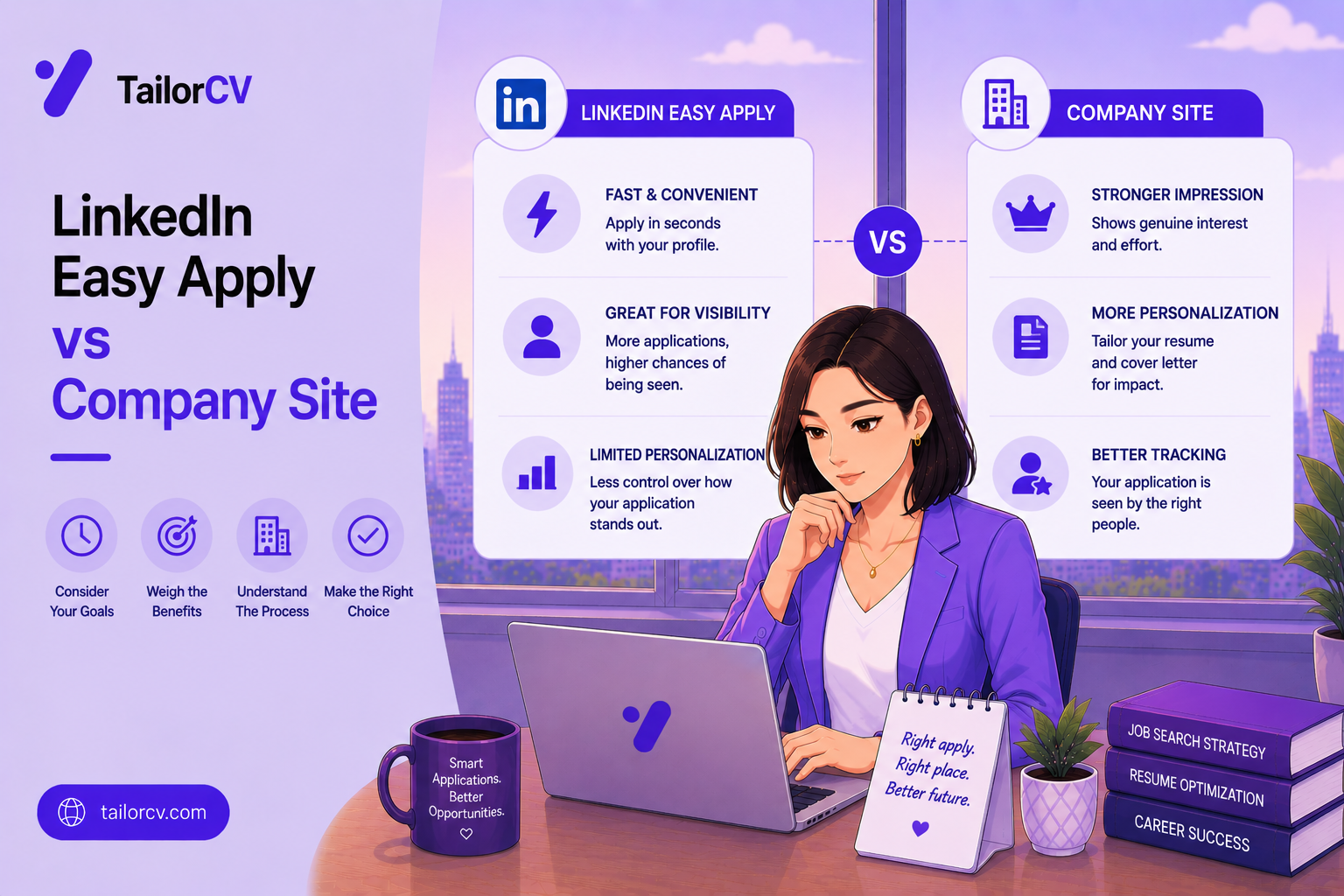
Easy Apply pools tend to be significantly larger. Because it removes friction — often just a click or two, with no need to leave LinkedIn or fill out a full form — Easy Apply attracts a much higher volume of applicants per posting than a direct company-site application typically does. More competition for the same role.
Easy Apply submissions tend to be less tailored, on average. Precisely because it is fast and low-friction, many Easy Apply submissions are the applicant's standing LinkedIn profile or a generic saved resume, sent with no per-posting tailoring. A direct company-site application, requiring more deliberate effort to complete, correlates with somewhat more considered, individually prepared submissions on average — though this is a tendency, not a rule for any specific applicant.
Cover letters are less common with Easy Apply. Direct company applications more often include the option or requirement for a cover letter; Easy Apply frequently skips this step, which can be an advantage (speed) or a disadvantage (less opportunity to differentiate), depending on the role.
Why Your LinkedIn Profile Is Not a Resume
If Easy Apply submits your LinkedIn profile data directly rather than an uploaded resume, this matters: a LinkedIn profile is not structured or written the same way an effective, tailored resume is. Profiles tend toward broader, less role-specific language, and they are not typically rewritten per application the way a well-tailored resume should be. Our LinkedIn profile vs resume differences guide covers this distinction directly.
Where possible, use Easy Apply's option to upload a specific, tailored resume rather than relying solely on your LinkedIn profile as submitted. Many Easy Apply flows allow this; taking the extra step to attach a tailored document rather than accepting the default profile-based submission meaningfully improves what actually reaches the employer's ATS.
When Easy Apply Makes Sense
Fresh postings, applied to early. Since many roles are effectively decided before a posting closes, speed can matter more than marginal polish for a role you are well-qualified for and can catch early.
High-volume hiring categories, where the employer expects and processes large numbers of similar applications and a highly tailored approach per application is less differentiating than usual.
When you can still attach a tailored resume rather than relying on your default profile — this captures the speed advantage without the quality cost.
When a Direct Company-Site Application Makes Sense
Senior or highly competitive roles, where the additional effort of a full, considered application — including a tailored resume and often a cover letter — signals genuine interest and gives you more room to differentiate against a smaller, more self-selected pool of applicants.
Roles you are genuinely excited about and want to invest real time tailoring for. The extra friction of a direct application is not a downside here — it is where the tailoring effort pays off most.
When the posting is not fresh and speed is less of a factor, since the volume advantage of Easy Apply matters most in the earliest window after a posting goes live.
A Reasonable Default Strategy
For roles you are seriously interested in, use whichever channel is available but always attach a specifically tailored resume rather than relying on a generic default — regardless of whether you are using Easy Apply or a direct company application. The channel matters less than what actually gets submitted through it.
For roles where you are casting a wider, faster net — genuinely comfortable with lower individual odds in exchange for higher volume — Easy Apply's speed is a legitimate strategy, provided you are not relying on volume alone as covered in how many jobs should you apply to per day.
Frequently Asked Questions
Does using Easy Apply hurt my chances compared to applying directly? Not because of the channel itself — both typically feed the same underlying system. The real risk is submitting an untailored, profile-based resume rather than a specifically prepared one, which is more common with Easy Apply's default flow but not required by it.
Should I always attach a custom resume even when using Easy Apply? Yes, where the option exists — this captures Easy Apply's speed advantage without accepting its common quality downside.
Is it worth applying to the same role through both channels? Generally not necessary and can appear as a duplicate submission — pick one channel and submit your best, most tailored version through it.
Do recruiters treat Easy Apply applicants differently? Not typically based on the channel alone, since both usually arrive through the same system — differences in outcome more often trace to submission quality and competition volume than to the channel itself.
Is Easy Apply worth using for senior roles? It can be, particularly if you attach a genuinely tailored resume rather than your default profile — but the additional friction of a direct application is less of a downside at the senior level, where a more considered application often serves you better regardless.
Whichever Channel You Use, Check the Match First
Regardless of which application method you choose, the resume that actually gets submitted is what determines your match — not the channel itself.
Scan the specific resume you plan to submit against the posting, whether you are using Easy Apply or a direct company application. This confirms the document itself is doing its job before you rely on either channel's speed or reach.
Free, about a minute. See also LinkedIn profile vs resume differences and how many jobs to apply to per day.
What is your resume scoring right now?
Scan it against a job description and get your ATS match score in about a minute.
Drop your resume here or choose a file
PDF only. Max 2 MB.
We never share your data or use it to train AI models.

Was this guide useful?
Be the first to rate it.