SS
SS
Key Takeaways
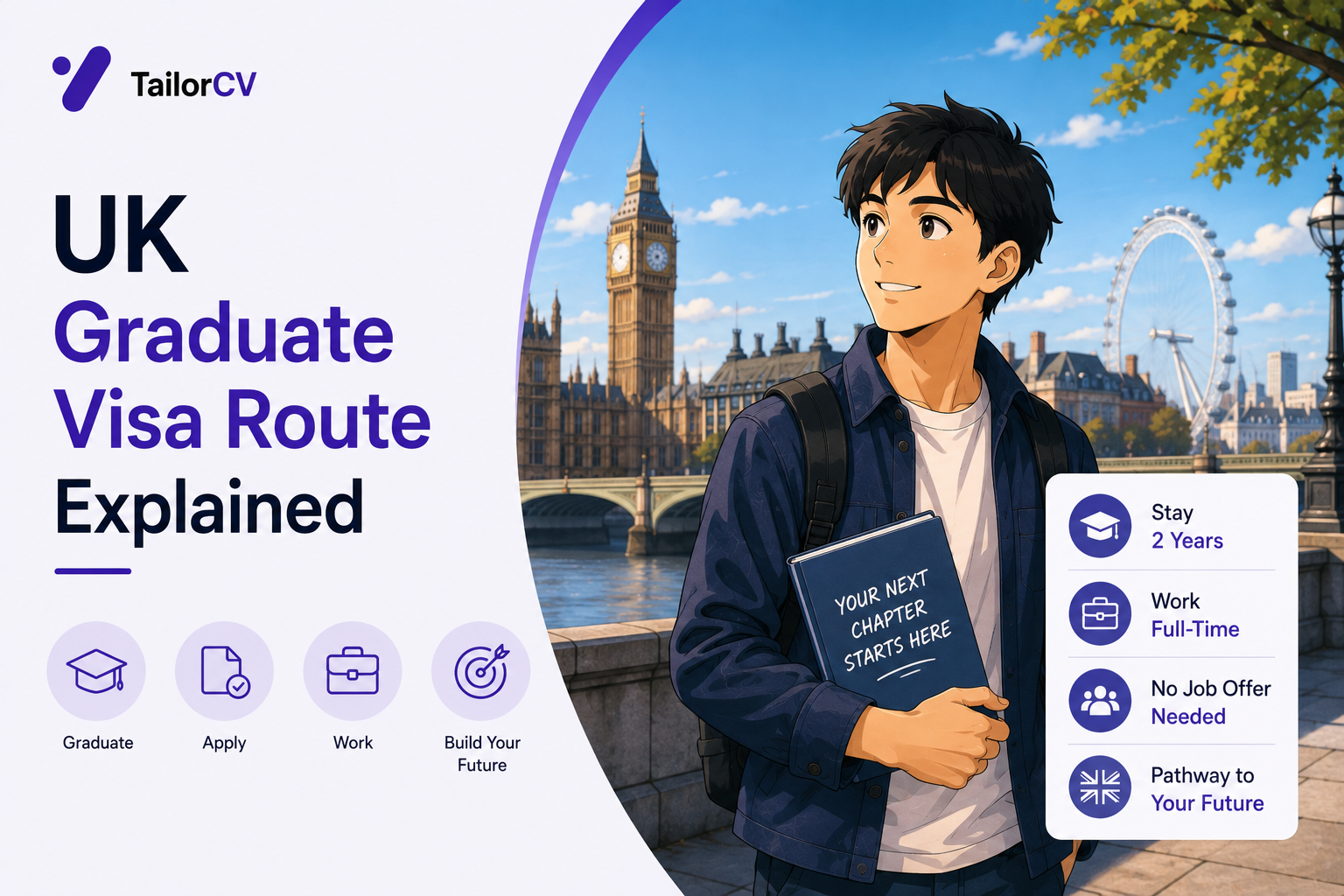
- The Graduate route allows you to work in the UK without employer sponsorship for a defined period after completing an eligible course.
- It is an open permission, so you can take any job, change employers freely, and work while you look.
- It is generally granted once, is not extendable, and does not itself lead to settlement.
- Moving onto a sponsored route before it expires is the standard next step, and it has salary and sponsorship requirements that need planning for.
- Using the period to reach a sponsorable role, rather than simply to work, is what determines whether it leads anywhere.
What it actually gives you
Unsponsored permission to work. No employer needs a sponsor licence, no job offer is required to apply, and there is no minimum salary threshold attached to the route itself. You can work at any skill level, for any employer, in almost any role.
A defined period. A set length for most graduates, with a longer period for doctoral graduates. It is generally granted once and is not extendable.
Freedom that most graduate routes do not offer. You can take a job at an employer who has never hired an international graduate, leave a bad first role without losing your status, work while you search, and be self-employed. This is the same structural advantage the Canadian open permit provides, and it is a genuine contrast with the employer-controlled US route.
What it does not do. It does not count toward settlement, and it does not lead anywhere by itself. It is a window, not a destination.
Eligibility and applying
You must have completed an eligible course at a licensed higher education provider with a track record of compliance, and the institution must have reported your successful completion.
You apply from inside the UK, while you still hold valid student permission.
Apply after your course completion has been reported and before your student permission expires. The timing of these two things is the practical constraint, and your institution's international office is the authority on when your completion is reported.
There is a fee and an immigration health surcharge, and the surcharge for the full period is a substantial upfront cost that graduates routinely under-budget for.
Dependants who were already on your student visa can generally apply, subject to conditions.
The transition that actually matters
The Graduate route expires and does not renew. Everything about how you use it should be shaped by that.
The standard next step is the Skilled Worker route, which requires an employer holding a sponsor licence, a job at an appropriate skill level, and a salary meeting the applicable threshold. The detail is covered separately, and the headline is that it is a genuinely different bar from the Graduate route's near-absence of requirements.
Which creates a specific risk. A graduate who spends the whole period in a role that is below the skill threshold, or at an employer without a sponsor licence, arrives at the end with nothing to switch onto. This is the most common way the route is wasted, and it is entirely avoidable.
So the practical instruction is unambiguous: from early in the period, target employers who hold a sponsor licence and roles that would meet the skill and salary requirements. The register of licensed sponsors is public and searchable, and checking it before you apply somewhere takes seconds.
You can switch onto a sponsored route from within the Graduate route, without leaving the UK, which makes the transition administratively straightforward once you have the right job.
Using the period well
Treat month one as the start of the clock. The period is shorter than it feels, and job searches take time.
Check the sponsor register before applying anywhere you would want to stay with. An employer without a licence can employ you now and cannot keep you afterwards.
Ask directly whether they sponsor. Holding a licence and being willing to use it are different things, and the question is entirely normal.
Target roles that clear the thresholds. A role that is genuinely below the skill level will not convert regardless of how well you perform.
Build the evidence anyway. A strong CV that survives screening and a track record in a relevant role are what make you worth sponsoring.
Do not treat any job as good enough for now. Work that does not lead to a sponsorable position uses time you cannot recover.
Verify current rules before relying on them. Route lengths, thresholds and requirements have all changed in recent years, and the Home Office guidance is the authoritative source rather than any article.
Understanding what "unsponsored" actually means in practice
No employer needs to hold a sponsor licence to hire you during this period, this is genuinely the route's central structural advantage, worth understanding precisely what it means: you can take any role at any employer, including one that has never previously hired an international graduate and has no immigration infrastructure whatsoever, without them needing to navigate any application process on your behalf.
This is meaningfully different from routes in other countries where an employer's willingness and administrative capacity to sponsor filters your realistic options from the very start, exactly the constraint that shapes an international graduate's search in the US, the absence of this constraint here is a genuine structural gift, worth using deliberately rather than taking for granted.
Because of this, your job search during this period can be genuinely broader than a search constrained by sponsorship availability, worth applying to smaller employers, startups and organisations you might otherwise assume could not consider an international candidate, since none of the usual sponsorship barriers apply during this specific window.
Scenarios: timing the switch
Scenario 1: You are still on a student visa and about to graduate
Apply for the Graduate Route while you are in the UK and your student visa is still valid. Letting it lapse first closes the route entirely.
Scenario 2: You have a job offer already
Compare the Graduate Route against going straight onto a Skilled Worker visa — an employer with a sponsor licence may prefer to sponsor immediately.
Scenario 3: Your Graduate Route is running out
Start the sponsorship conversation months before expiry, not weeks. Sponsored applications take time an expiring visa does not give you.
Tip: Apply for the Graduate Route before your student visa expires — you must be in the UK and still hold valid student status. Letting it lapse first closes the route entirely.
Common Mistakes
- Treating it as an end. It does not lead to settlement by itself.
- Spending it in non-sponsorable work. Spending it in non-sponsorable work the most common way the period is wasted.
- Not checking the sponsor register. Public, searchable, and it determines whether an employer can keep you.
- Applying too late. You must apply from inside the UK while student permission remains valid.
- Under-budgeting the health surcharge. Payable upfront for the full period.
- Assuming rules are stable. Lengths and thresholds have changed; check current guidance.
Planning realistically around the fixed, non-renewable window
Because this route is generally granted once and does not renew, treat the entire period as a single, continuous planning window from the moment it begins, rather than assuming you can simply apply again later if the first attempt to transition does not work out.
Build a rough internal timeline for yourself within the broader period, an early phase focused on exploring options and building experience broadly, followed by a later phase focused specifically on securing a role that will genuinely support the transition onto a sponsored route, rather than treating the whole window as undifferentiated time.
If you reach the midpoint of your available time without a clear path toward a sponsorable role, treat this as a genuine signal to adjust your approach, rather than continuing the same strategy and hoping the remaining time resolves itself, this might mean widening your target employer list, seeking more direct outreach and networking, or reconsidering which roles you are realistically targeting.
Related Guides
Keep building on this with the related guides in this series:
- The UK Skilled Worker Visa for Graduates
- UK Accountancy Graduate Routes - Qualifications and Employers
- The UK Civil Service Fast Stream - What the Process Involves
- UK Cover Letters for Graduates - When They Matter and What to Write
- The UK CV Format for Students and Graduates
- Degree Classification and UK Employers - How Much It Actually Matters
You can also check your resume's ATS score for free, generate a tailored cover letter, or build a portfolio website in minutes.
Frequently Asked Questions
Do I need a job offer to apply?
No. That is the route's central advantage — it is unsponsored and does not require employment.
Can I extend it?
Generally no. It is granted once for a defined period and the expected step is switching onto a sponsored route.
Can I be self-employed?
Yes, the route permits it, and self-employment does not build a path onto a sponsored route the way employment with a licensed sponsor does.
Does time on this route count toward settlement?
No. This is why the transition onto a qualifying route matters and why planning for it early is essential.
Can I switch to the Skilled Worker route without leaving the UK?
Yes, switching from within is generally possible once you have a qualifying job with a licensed sponsor.
What if I cannot find a sponsored role before it expires?
Options narrow considerably at that point, which is the argument for targeting sponsorable roles from the beginning rather than treating the search as something to start later.
What is your resume scoring right now?
Scan it against a job description and get your ATS match score in about a minute.
Drop your resume here or choose a file
PDF only. Max 2 MB.
We never share your data or use it to train AI models.

Was this guide useful?
Be the first to rate it.