 SS
SS
Key Takeaways
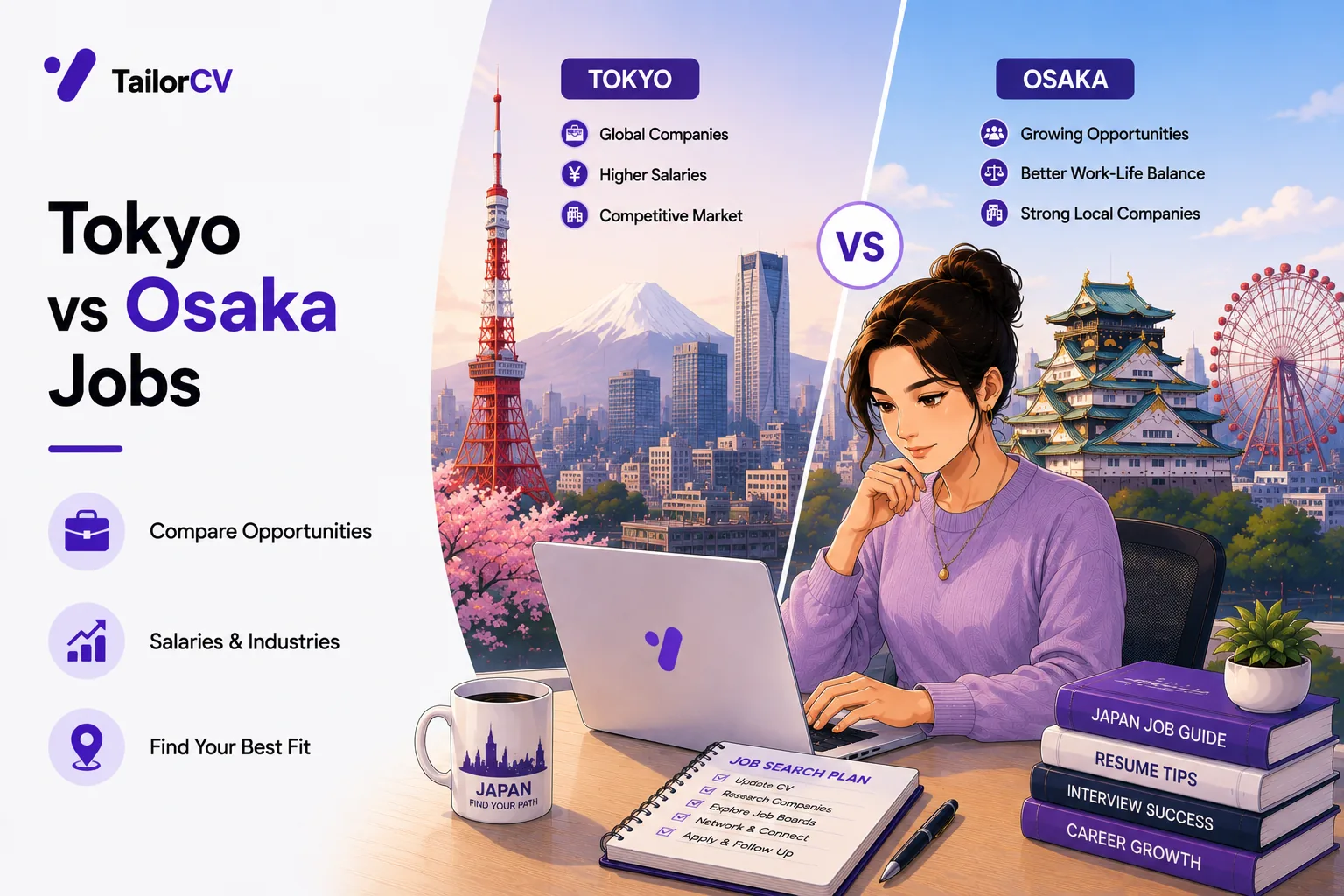
- Tokyo has the overwhelming majority of foreign-friendly roles, and for many specialisms it is the only realistic option.
- Osaka and the wider Kansai region are strong in manufacturing, pharmaceuticals and trading, with genuine depth.
- Housing costs meaningfully less in Osaka, though the gap is smaller than the London-to-regional comparison people expect.
- English-operating roles are far more concentrated in Tokyo, so lower Japanese ability points strongly toward it.
- The foreign professional community is much larger in Tokyo, which affects both networking and daily life.
Tokyo dominates Japanese employment to a degree that makes the comparison lopsided for most foreign professionals — the question is usually whether Osaka is viable rather than whether it is better.
That said, for people in the right sectors and with reasonable Japanese, Kansai offers real depth at lower cost, and it is worth understanding rather than dismissing.
This guide compares the two honestly.
Before applying, check your documents work — the free ATS score checker.
The scale difference
Tokyo is not merely larger — it is the centre of almost everything. Corporate headquarters, foreign company Japan offices, finance, technology, media, and the overwhelming majority of roles that operate in English.
For most foreign professionals this settles it. If you work in finance, consulting, technology at a gaishikei, or anything requiring an English-operating employer, Tokyo has the roles and Osaka largely does not — see gaishikei vs domestic.
Osaka's strength is different, not simply smaller: it is a manufacturing and commercial centre rather than a corporate headquarters city.
What Osaka and Kansai actually offer
Manufacturing and industrial. The Kansai region has genuine depth in electronics, machinery, materials and precision manufacturing. For engineers in these fields it is a serious market rather than a fallback.
Pharmaceuticals and life sciences. A long-established cluster, particularly around Osaka, with major domestic pharmaceutical companies headquartered there.
Trading and commerce. Osaka's merchant history persists in a substantial trading and wholesale sector.
Kyoto is within commuting distance and adds precision manufacturing, materials science, gaming and a strong university research base.
Kobe adds shipping, steel and its own manufacturing base.
The regional market functions together. Osaka, Kyoto and Kobe are all within reasonable commuting distance, which makes Kansai one labour market rather than three cities.
Cost and salary
Housing costs less in Osaka, meaningfully so — central Osaka rents are below equivalent central Tokyo, and space goes further.
But the gap is smaller than people expect. Osaka is Japan's second city, not a provincial town, and it is not cheap in absolute terms.
Salaries also run somewhat lower for equivalent roles, which narrows the disposable income advantage further.
The realistic comparison: Osaka leaves you somewhat better off on housing for a given salary, but the gap is nothing like the London-to-Manchester or Toronto-to-Calgary differences. For most people, opportunity volume matters more than the cost difference.
Both cities have excellent public transport, so a car is unnecessary in either.
Language requirements
This is frequently the deciding factor.
Tokyo has the concentration of English-operating roles. Foreign company offices, international teams and English-language positions are overwhelmingly here.
Osaka expects Japanese in most professional roles. English-operating positions exist but are far fewer, so the market genuinely narrows if your Japanese is below N2.
Practical implication: if your Japanese is limited, Tokyo is not a preference, it is close to a requirement. If you are at N2 or above, Kansai becomes genuinely viable — see the JLPT for jobs guide.
Community and daily life
Tokyo has a much larger foreign professional community, which affects networking, referrals, and how easy it is to find services in English.
Osaka is frequently described as more open and informal — the regional stereotype has some basis, and many foreign residents find it socially easier despite the smaller community.
Kansai dialect takes adjustment if your Japanese was learned in standard form, though it is not a barrier.
Tokyo's density cuts both ways: more of everything, and correspondingly crowded.
Which to choose
Tokyo if: your Japanese is below N2, you work in finance, consulting, technology at foreign companies, or media, you want maximum options, or you value the size of the foreign professional network.
Osaka or Kansai if: you work in manufacturing, industrial engineering, materials or pharmaceuticals, your Japanese is solid, and you would rather have lower costs and a less intense environment.
A practical note: starting in Tokyo and moving later is far easier than the reverse, because Tokyo experience and network travel to Kansai while the opposite is less true. If uncertain, Tokyo is the lower-risk starting point.
The startup picture differs too — activity is heavily concentrated in Tokyo, as the Japan startup jobs guide covers.
Common Mistakes
Choosing Osaka for cost savings without checking role availability. The market genuinely narrows, particularly for English-operating positions.
Assuming Osaka is dramatically cheaper. It is Japan's second city, and the gap to Tokyo is much smaller than regional comparisons in other countries.
Ignoring Kansai's manufacturing depth. For engineers in electronics, machinery, materials or pharmaceuticals it is a serious market rather than a compromise.
Searching only one city within Kansai. Osaka, Kyoto and Kobe are commutable and function as one labour market.
Underestimating the language difference. English-operating roles are concentrated in Tokyo to a degree that makes Japanese ability the deciding variable.
Overlooking the network effect. Tokyo's much larger foreign professional community matters for referrals and for daily life.
Assuming you can move to Tokyo later just as easily. Tokyo experience travels to Kansai more readily than the reverse.
Dismissing Kansai on lifestyle grounds without visiting. Many foreign residents find it socially easier despite the smaller community.
Frequently Asked Questions
Is Tokyo the only option for foreign professionals?
For many specialisms and for anyone below N2, effectively yes — English-operating roles and foreign company offices are overwhelmingly concentrated there.
What is Osaka good for?
Manufacturing, industrial engineering, materials, pharmaceuticals and trading. With Kyoto and Kobe it forms a genuine regional labour market.
Is Osaka much cheaper than Tokyo?
Meaningfully cheaper on housing, but the gap is smaller than people expect — it is Japan's second city, not a provincial town, and salaries run somewhat lower too.
Do I need Japanese to work in Osaka?
Generally yes for professional roles. English-operating positions exist but are far fewer than in Tokyo, so N2 or above makes the market viable.
Should I consider Kyoto and Kobe?
Yes — both are within commuting distance and add precision manufacturing, materials science, gaming and shipping to the regional market.
Which has a better foreign community?
Tokyo's is much larger, which helps with networking and English-language services. Osaka's is smaller but many residents find the city socially more open.
Can I move between them later?
Yes, though Tokyo experience and network travel to Kansai more readily than the reverse — which makes Tokyo the lower-risk starting point if you are uncertain.
Check your application documents. Check your ATS score free.
Make This Practical
Let your Japanese level decide first. Below N2, Tokyo is close to a requirement rather than a preference, because English-operating roles and foreign company offices are concentrated there to a degree that makes Osaka genuinely thin.
Then check whether your sector has real depth in Kansai before weighing cost. Manufacturing, industrial engineering, materials and pharmaceuticals are strong there; finance, consulting and gaishikei technology largely are not — and role availability matters far more than a housing gap that is smaller than most people assume.
Finally, if you are uncertain, start in Tokyo. Its experience and network transfer to Kansai more readily than the reverse, and searching Osaka, Kyoto and Kobe together as one regional market gives you a fairer picture when you do look.
What is your resume scoring right now?
Scan it against a job description and get your ATS match score in about a minute.
Drop your resume here or choose a file
PDF only. Max 2 MB.
We never share your data or use it to train AI models.

Was this guide useful?
Be the first to rate it.