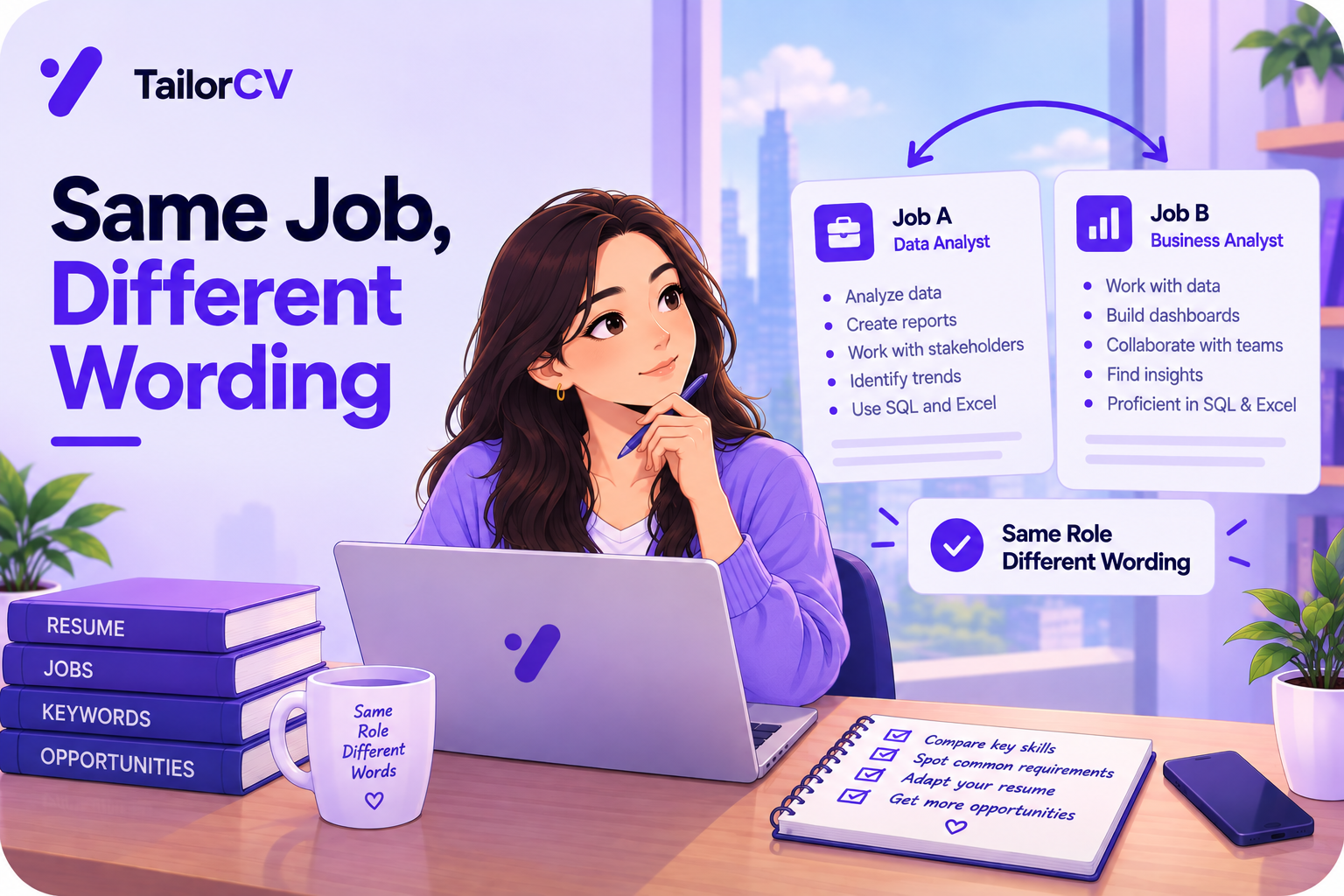
 SS
SS

Key Takeaways
- Postings often bury "preferred" items inside a list that reads as if everything is required.
- The language around each item is the real signal — "must have" and "a plus" mean very different things.
- Years of experience listed as a single hard number is frequently more flexible in practice than it reads.
- A named licence, degree, or security clearance is usually a genuine hard filter, unlike most other line items.
- Missing several preferred items is normal. Missing one clearly required item changes your odds substantially.
Most job postings mix genuine requirements with an aspirational wish list, and few clearly separate the two into different sections. Learning to read the difference is one of the most useful, underrated job-search skills, because it directly answers "should I even apply?"
Why This Distinction Matters So Much
Applying to a posting where you meet the required items but miss a few preferred ones is a completely reasonable use of your time. Applying to one where you miss a genuine required item is usually not — not because you cannot try, but because the odds are structurally different, and your time is better spent elsewhere. Getting this distinction right changes how you should be spending your search time, which is a bigger effect than almost any resume edit.
The Language Signals
Postings rarely use a clean "Required" and "Preferred" header split, but the language around each item usually gives it away:
Required language: - "Must have," "required," "essential" - A specific stated minimum ("5+ years of experience") - A named credential with no qualifier ("CPA required") - "Non-negotiable"
Preferred language: - "Nice to have," "a plus," "bonus" - "Preferred," "ideally," "we'd love if" - "Familiarity with," "exposure to" - Anything appearing only in a section titled "Preferred Qualifications" or similar, separate from the main list
Genuinely ambiguous: - Items with no qualifying language at all, sitting in a single undifferentiated bullet list — this is the most common format and the hardest to read, covered below.
The Undifferentiated List Problem
Most postings do not cleanly separate required from preferred — they present one bullet list where everything looks equally weighted:
- 5+ years of experience in data analysis
- Proficiency in SQL and Python
- Experience with Tableau or similar BI tools
- Familiarity with A/B testing methodologies
- Strong communication skills
- Experience in e-commerce a plus
Notice only the last item explicitly says "a plus" — everything above it reads with equal weight, even though in practice a hiring manager likely treats some of these as harder filters than others.
A rough heuristic for unlabeled lists: items appearing first, and items that are specific and technical (a named tool, a specific years-of-experience number), are more likely to be genuine requirements. Items appearing last, and items that are broad or soft ("strong communication skills"), are more likely to be softer preferences even without explicit qualifying language.
This is a heuristic, not a certainty — when genuinely unsure, the safest read is to treat specific technical items as likely required and generic ones as likely preferred.
Years of Experience Is More Flexible Than It Reads
A posting stating "5+ years required" is frequently more negotiable in practice than the number suggests, for a structural reason: that number is often set by whoever wrote the requisition as a rough proxy for seniority, not as a precisely calibrated cutoff.
If you have 3-4 years with unusually relevant, dense experience, applying is often still reasonable — many hiring managers will consider a candidate close to the stated number if the quality of experience is strong. If you have 1-2 years against a "5+" requirement, the gap is large enough that it usually reflects a genuine seniority mismatch rather than a soft buffer.
This flexibility does not extend to every requirement type — see below for the ones that do not bend.
What Almost Never Bends
Some requirements are genuinely hard filters regardless of how strong the rest of your application is:
- A required licence or certification (bar admission, RN licence, CPA, PE stamp)
- A required security clearance
- A required degree in a regulated field (certain engineering, medical, legal roles)
- Legal work authorisation, where a posting explicitly states no sponsorship
These are not soft preferences dressed in strong language — they are usually genuine, structural filters, often for legal or regulatory reasons outside the hiring manager's discretion. If you are missing one of these specifically, that is worth taking seriously rather than applying anyway on the theory that requirements are generally flexible.
Should You Apply If You're Missing a Preferred Item?
Yes, almost always. Missing several preferred items is the normal, expected state for most applicants to most postings — postings routinely list more wish-list items than any single candidate is likely to have. Do not self-select out over a "nice to have" line.
Should You Apply If You're Missing a Required Item?
Depends on which kind:
Missing a required item that is soft-required (a years-of-experience number, a specific tool with reasonable substitutes): applying is often still worthwhile, particularly if you can speak to adjacent, transferable experience honestly in your resume — see improving your score without lying for how to state genuine adjacent experience.
Missing a required item that is a hard filter (licence, clearance, regulated degree): applying is usually a poor use of time, and that time is better spent on postings where you clear the genuine bar.
A Practical Checklist
For any posting, go through the list and mark each item:
- Does it say "required," "must have," or state a specific number with no softening language? Likely required.
- Does it say "preferred," "a plus," "nice to have," or sit in a clearly separate section? Likely preferred.
- Is it a licence, clearance, or regulated credential? Almost certainly a hard filter regardless of surrounding language.
- Everything else, unlabeled? Use the heuristic above — specific and technical leans required; broad and soft leans preferred.
Once sorted, you have a genuinely actionable list rather than one undifferentiated wall of text — see which missing skills actually matter for what to do with each category once separated.
Frequently Asked Questions
Should I mention in my cover letter that I'm missing a requirement? Generally no, unless directly asked. Drawing attention to a gap rarely helps; focus your space on what you do bring instead.
How do I know if "5+ years" really means 5 or if 3-4 is acceptable? There is no way to know for certain without asking. As a rough guide, being one to two years short of a stated number is commonly still worth applying for; being three or more years short usually reflects a genuine mismatch.
Are all licences and certifications truly non-negotiable? In regulated fields, generally yes — these often exist for legal reasons the hiring manager cannot waive, regardless of how strong the rest of an application is.
What if a posting lists 15 requirements and I meet 8? Sort them first using the method above. Meeting most of the genuinely required items while missing several preferred ones is a normal, reasonable position to apply from.
Does this distinction matter for ATS scoring specifically? Yes — missing a stated required item typically affects your match assessment more than missing several preferred ones, even if a raw score treats them somewhat similarly. Reading the posting's own language remains the more reliable signal.
Sort Your Own List Against a Real Posting
The clearest way to apply this is against a specific posting you are actually considering, rather than in the abstract.
Scan your resume against the posting and, using the missing list it returns, go back to the original posting text and check the language around each item — required or preferred. That combination tells you far more than either the score alone or the posting alone.
Free, about a minute. See also which missing skills actually matter and score 70%, should I apply.
What is your resume scoring right now?
Scan it against a job description and get your ATS match score in about a minute.
Drop your resume here or choose a file
PDF only. Max 2 MB.
We never share your data or use it to train AI models.

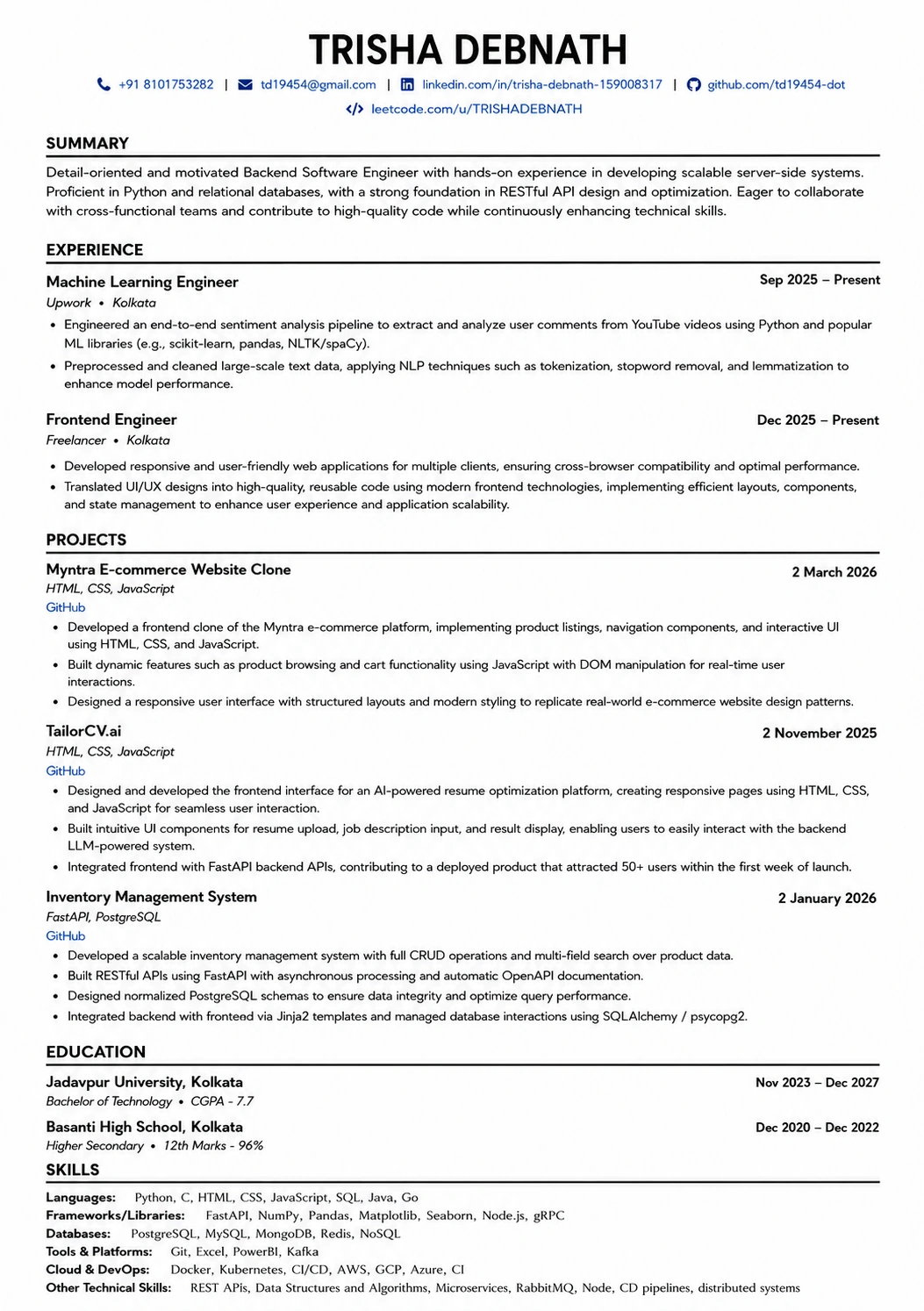
Templates that keep this structure intact
This template is ATS-tested — start from it and the formatting rules in this guide are already handled.
Was this guide useful?
Be the first to rate it.