 TD
TD
Key Takeaways
- Having no US credit history is the single most disruptive practical surprise, affecting housing, cars, and phone contracts from day one.
- Health insurance is tied to your employer and the details vary enormously, so compare plans before accepting rather than after.
- Relocation support is negotiable and frequently not offered unless you ask specifically.
- Salary comparisons across US cities are meaningless without adjusting for housing, state income tax, and health costs.
- Apply for a Social Security Number immediately on arrival, because almost everything else depends on it.
Most guidance about working in America stops at the visa. The visa is the hard part legally, but the disorienting part is everything that follows - a credit system you are invisible to, healthcare tied to your job, and salary numbers that mean completely different things in different states.
None of it is difficult once you know it is coming. All of it is expensive and stressful if you arrive unprepared.
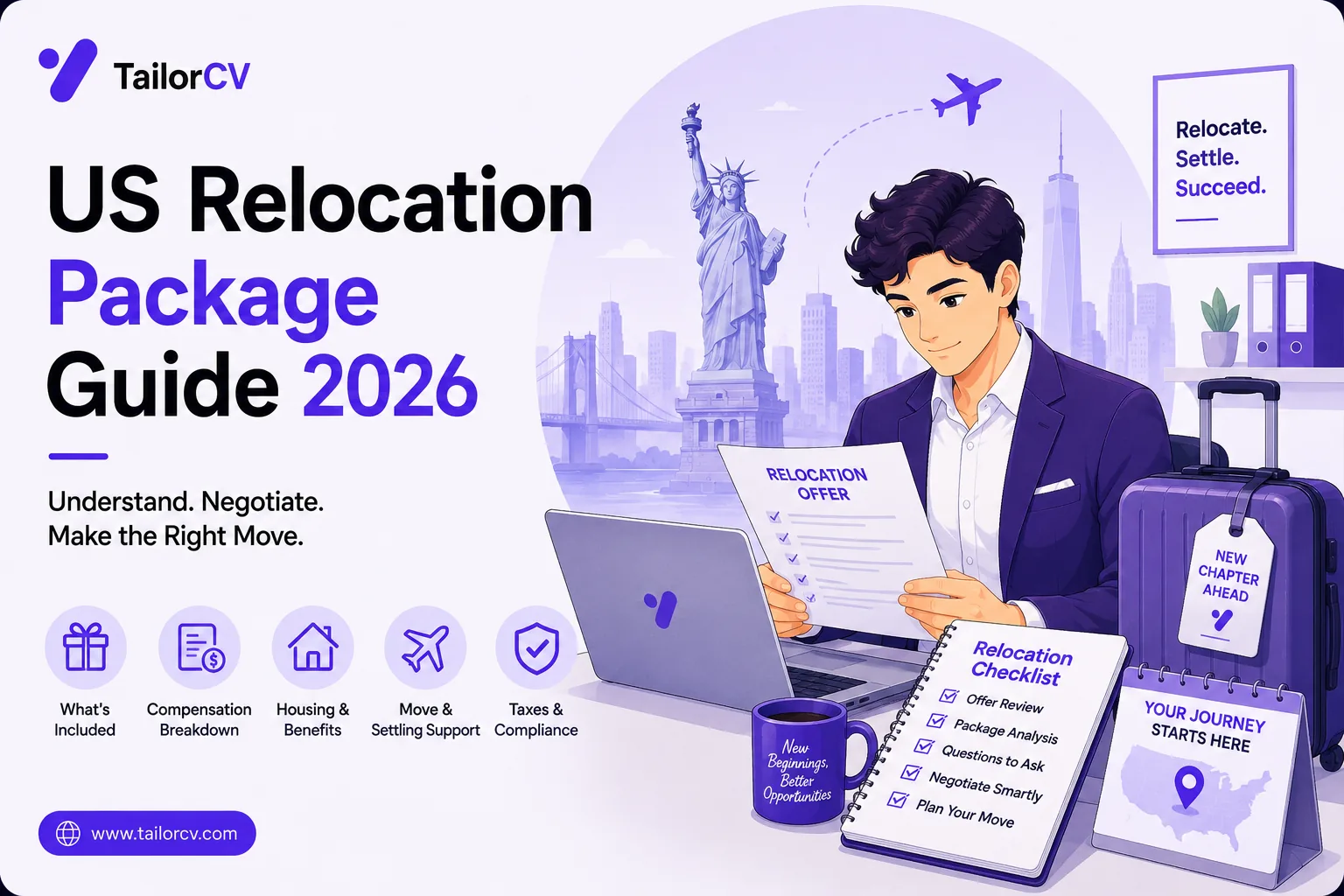
This guide covers what to negotiate before you sign, what to do in your first weeks, and the differences that catch international arrivals out.
If you are still at the job search stage, start with how to get a job in the USA as an international candidate and run your resume through the free ATS score checker.
Negotiate Before You Sign
Your leverage is highest before you accept, and relocation support is frequently available but rarely volunteered.
Ask about:
Relocation allowance. Either a lump sum or reimbursement of specific costs. Lump sums are simpler but note they are generally taxable income.
Shipping and storage. Moving household goods internationally is expensive. Some employers cover a container or an air freight allowance.
Temporary housing. Thirty to sixty days in corporate housing while you find somewhere permanent. Genuinely valuable, because finding a rental without US credit history takes time.
Flights for you and any dependents.
Immigration legal fees. The employer typically covers the petition, but the application fee and other costs may fall to you unless negotiated - see the H-1B visa job search guide.
A housing assistance or rental deposit guarantee. Some employers will act as guarantor or advance a deposit, which solves the credit history problem directly.
Start date flexibility, so you have time to arrange the move properly.
Spouse support. Some employers offer job search help for a relocating partner. Ask, because a trailing spouse's work authorization is a real constraint depending on your visa category.
The broader negotiation approach is in US salary negotiation.
The Credit History Problem
This surprises almost everyone, and it is the most disruptive practical issue.
The US runs on credit scores. Arriving with an excellent credit record from another country means nothing - you start at zero, effectively invisible. Your history does not transfer.
What this affects immediately:
- Renting. Landlords run credit checks. No history often means a larger deposit, several months' rent upfront, or a guarantor requirement.
- Phone contracts. You may need to pay a deposit or use prepaid initially.
- Car purchase or lease. Financing is difficult without history, and cars are near-essential in most of the country.
- Credit cards. Standard cards will decline you.
- Utilities. Deposits are common.
How to build credit quickly:
Get a secured credit card. You deposit a sum and it becomes your limit. Use it for small purchases, pay in full every month, and it reports to the credit bureaus. This is the standard route and it works within months.
Check whether your existing bank has a US presence. Some international banks offer products that use your home-country history to open a US account or card, which is worth asking about before you leave.
Ask your employer about relationship banking. Some large employers have arrangements with banks that ease account opening for relocating staff.
Never miss a payment. Payment history is the largest component of a US credit score.
Do not close your first card once you get better ones. Length of history matters.
First Weeks Checklist
Social Security Number. Apply immediately on arrival - almost everything downstream depends on it, including payroll, bank accounts, and credit. There is a waiting period after entry before you can apply, so check the current guidance and go as soon as you are eligible.
Bank account. Bring your passport, visa documentation, and proof of address. Some banks will open an account before your SSN arrives; others will not.
Driver's license. State-issued, and the rules differ by state - some accept your foreign license for a period, others require a test quickly. It also functions as your everyday ID, which matters because carrying a passport around is a bad idea.
Health insurance enrollment. There is usually a limited enrollment window after starting a job. Miss it and you may wait until the next open enrollment period.
Phone number. A US number is genuinely necessary - verification codes, delivery notifications, and appointments all assume one.
Address. Everything asks for one. Temporary housing or a colleague's address works initially.
Health Insurance Is Different
If you come from a country with universal healthcare, this is the largest cultural adjustment.
It is tied to your employer. Losing your job usually means losing coverage, though continuation options exist at your own cost.
You choose a plan from the options your employer offers, usually during a limited window. The choices matter and the terminology is unfamiliar:
- Premium - what you pay each month, often partly covered by your employer
- Deductible - what you pay yourself before insurance contributes
- Copay - a fixed amount per visit
- Coinsurance - your percentage share after the deductible
- Out-of-pocket maximum - the annual ceiling on your own spending
- In-network vs out-of-network - using a provider outside the network can cost dramatically more
A low premium with a high deductible is not automatically cheaper. Estimate your likely usage.
Dental and vision are usually separate plans, not included in medical.
Cover dependents deliberately. Adding family increases premiums significantly, and the enrollment window applies to them too.
Ask for the full benefits summary before accepting an offer. The difference between two employers' health plans can be worth thousands a year, which materially changes an offer comparison.
Salary Only Means Something With Context
A US salary figure is not comparable across cities or to your home country without adjustment.
State income tax varies enormously. Some states levy none at all; others take a substantial percentage. Two identical salaries in different states produce different take-home pay.
Housing dominates. The gap between coastal metros and mid-sized cities is very large, and it swamps most salary differences.
Health costs come out of your pay in premiums plus whatever you spend against your deductible.
Retirement contributions. Employers commonly offer a 401(k) with matching. Contribute at least enough to get the full match - it is straightforwardly part of your compensation, and declining it is leaving money behind.
Paid time off is not guaranteed by law. The US has no statutory minimum paid vacation, so it varies enormously between employers. Compare it explicitly, because an offer with fifteen days and one with twenty-five days are meaningfully different jobs.
Workplace Culture Differences
At-will employment. In most states, either party can end employment at any time for almost any lawful reason, usually without a notice period. This is a significant shift if you come from a market with statutory notice and protection.
Two weeks' notice is the customary resignation courtesy, far shorter than the one to three months common elsewhere - see notice period negotiation.
Vacation is often not fully used. Taking your full allocation is normal and reasonable, whatever the local culture suggests.
Direct communication is the norm, and self-promotion is expected rather than immodest. Candidates from more reserved cultures often undersell themselves - this applies in performance reviews as much as interviews. See performance review preparation and the first 90 days in a new job.
Networking is explicit and normal. Reaching out to strangers professionally is unremarkable in the US and often expected.
Common Mistakes
Not negotiating relocation support. It is frequently available and almost never volunteered, so candidates who do not ask simply do not get it - and the sums involved are substantial.
Assuming your credit history transfers. It does not, and discovering this while trying to rent an apartment in your first week is an expensive and stressful way to learn it.
Choosing a health plan by premium alone. A low premium with a high deductible can cost far more overall depending on your actual usage, and the enrollment window rarely lets you correct the choice quickly.
Comparing salaries across cities without adjusting. State income tax and housing costs vary enough that a higher headline figure regularly produces lower real income.
Missing the health insurance enrollment window. Miss it and you may be uninsured until the next open enrollment period, which in the US carries real financial risk.
Delaying the SSN application. Payroll, banking, and credit all depend on it, so every week of delay compounds into other blocked tasks.
Declining the 401(k) match. It is part of your compensation package rather than a savings option, and not contributing enough to receive the full match is a direct pay cut.
Underestimating car dependence. Outside a handful of cities, daily life assumes a car - and financing one without credit history is difficult, which makes this a problem to solve before arrival rather than after.
Frequently Asked Questions
Does my credit history transfer to the US?
No. You start with no US credit history regardless of your record elsewhere, which affects renting, phone contracts, car financing, and credit cards. A secured credit card is the standard way to start building it.
How soon should I apply for a Social Security Number?
As soon as you are eligible after arrival - there is typically a short waiting period after entry. Payroll, banking, and credit all depend on it, so it should be your first administrative task.
Is relocation assistance standard?
It varies enormously and is frequently not offered unless you ask. Lump sums, shipping, temporary housing, and flights are all commonly available, particularly for roles the employer is sponsoring.
How does US health insurance work?
Coverage is usually provided through your employer, and you select a plan during a limited enrollment window. You pay a monthly premium plus a deductible and copays when you use care. Compare the full details before accepting an offer.
Do I need a car?
In most of the country, yes. A handful of major cities have workable public transport, but outside those, daily life assumes driving. Plan for how you will finance one without credit history.
How much notice do I give when leaving a job?
Two weeks is the customary courtesy in the US, far shorter than in many other markets. Most employment is at-will, meaning no statutory notice period applies.
Can my spouse work?
It depends entirely on your visa category - some allow dependent work authorization, others do not or require a separate application. Confirm this before accepting, because it materially affects household finances.
Get the job first, with a resume that reads as American. Check your ATS score free.
Make This Practical
Negotiate the move before you sign, because your leverage disappears afterwards. Ask specifically about relocation allowance, shipping, temporary housing, flights, immigration fees, and whether the employer will act as guarantor on a rental - that last one directly solves the credit history problem.
Then solve credit and admin in your first weeks. Apply for your SSN as soon as you are eligible, open a bank account, get a secured credit card and use it for small purchases paid in full monthly, and complete health insurance enrollment inside the window rather than assuming you can revisit it.
Finally, compare the offer in real terms rather than headline terms. Adjust for state income tax, housing costs, health premiums and deductible, PTO days, and the 401(k) match - and contribute at least enough to receive the full match, since it is compensation rather than savings. The negotiation framework is in US salary negotiation, and settling in is covered in the first 90 days in a new job.
What is your resume scoring right now?
Scan it against a job description and get your ATS match score in about a minute.
Drop your resume here or choose a file
PDF only. Max 2 MB.
We never share your data or use it to train AI models.

Was this guide useful?
Be the first to rate it.