 SS
SS

Key Takeaways
- Holiday allowance is a legal entitlement of at least 8% of annual salary, usually paid as a lump sum in May.
- CAO collective agreements set pay scales across many sectors, which decides how much of your salary is negotiable at all.
- The 30% ruling materially changes take-home for qualifying incoming workers, though its terms have been tightened.
- Dutch employers quote gross annual or gross monthly figures, and clarifying whether holiday allowance is included is essential.
- Non-salary items move more readily than base pay — pension, training, travel allowance, working hours and home-office budget.
Holiday allowance, explained
The Dutch feature that confuses every newcomer.
Vakantiegeld is a statutory minimum of 8% of your gross annual salary, accrued month by month and typically paid in a single lump in May.
It is not a bonus. It is deferred salary, legally owed, and it exists whether or not your employer chooses to describe it as generous.
Some employers pay it monthly instead, and some pay above the minimum.
The critical question in any offer is whether the figure quoted includes it or excludes it. A salary quoted "including holiday allowance" is meaningfully lower than the same number quoted excluding it.
Holiday days are separate from holiday allowance — the statutory minimum is four times your weekly working days, and most employers offer more.
A thirteenth month exists at some employers on top of holiday allowance, usually paid in December, and is a genuine addition rather than a rebranding.
And when you leave, accrued but unpaid holiday allowance and untaken holiday days are paid out.
CAO scales and what is negotiable
The structure behind most Dutch salaries.
A CAO is a collective labour agreement covering a whole sector or a large employer, negotiated between unions and employer organisations.
Where one applies, it sets pay scales, working hours, holiday, pension terms, overtime rules and notice periods.
Your salary is a scale and a step within it, determined by role and experience, and the room to move is in the placement rather than in the number.
Very large parts of the Dutch workforce are covered — healthcare, education, government, retail, construction, hospitality, banking and many industrial sectors.
Technology, startups and many international employers are frequently outside any CAO, and there normal negotiation applies.
The first question to ask is therefore whether a CAO applies and which scale the role sits in, because the answer reframes the whole conversation.
And where one does apply, asking to be placed a step higher on the basis of relevant experience is a legitimate, expected request.
The 30% ruling in context
The single largest variable for incoming workers.
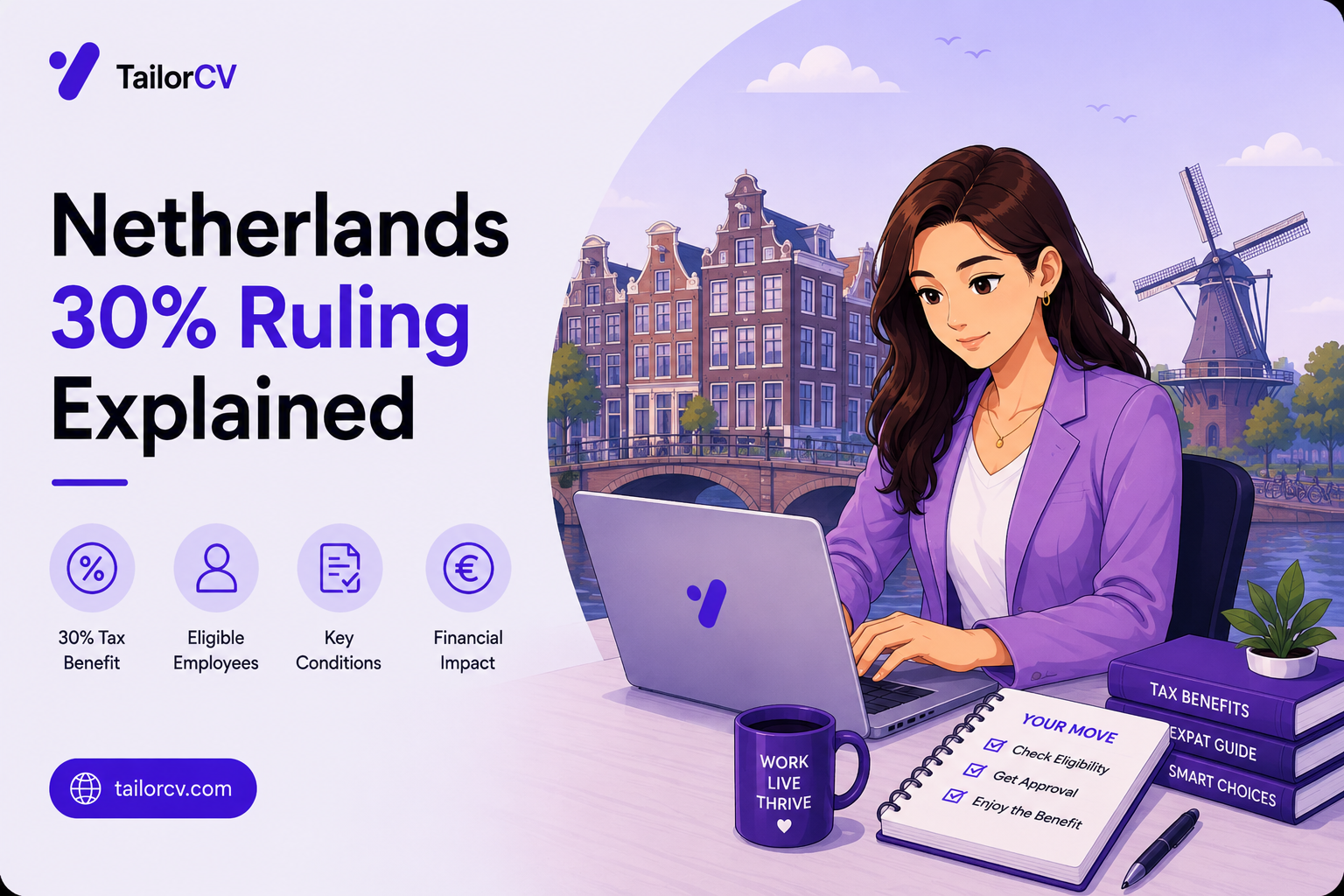
It allows a portion of salary to be paid as a tax-free allowance for qualifying employees recruited from abroad, on the basis that international moves carry extra costs.
Eligibility depends on being recruited from outside the Netherlands, meeting a minimum salary threshold, and having lived outside a defined radius of the Dutch border beforehand.
A reduced salary threshold applies to younger applicants holding a Dutch master's degree or equivalent.
The duration has been shortened over successive reforms, and the structure of the benefit has been adjusted, so anything written more than a year or two ago should be treated with suspicion.
It is applied for jointly by you and your employer, which means it is a live subject during offer negotiation rather than something you sort out later.
It affects more than income tax in ways worth taking advice on, including how certain assets are treated.
And it ends. Modelling your finances on the post-ruling position rather than the first year is the sensible approach, since people who buy houses on ruling-inflated take-home have a difficult adjustment ahead.
Pension, and why it matters more here
An underrated part of Dutch packages.
The Dutch pension system is among the strongest anywhere, built on a state pension plus substantial occupational schemes.
Most CAO-covered employers enrol you in a sector pension fund with meaningful employer contributions.
Employer contribution levels vary considerably outside CAO coverage, and at startups they can be minimal or absent.
The difference between a scheme contributing generously and one contributing little is a large amount of deferred pay, and it rarely appears in the headline salary comparison.
Ask for the contribution percentage and the split between employer and employee, in writing.
Transfers between schemes — waardeoverdracht — are possible when changing employers and worth understanding.
And if you leave the Netherlands, accrued pension generally stays and pays out later, which is worth knowing before you write it off.
Costs and the real picture
What the money actually buys.
Housing is the dominant cost and the dominant constraint, with Amsterdam and Utrecht rents high and supply genuinely scarce.
Health insurance is mandatory and individually purchased, which surprises people from systems where it is bundled into payroll.
Transport is cheap and excellent if you cycle, which most people do, and a travel allowance is a common benefit.
Childcare is expensive with partial subsidy, and it is a major line item for families.
Groceries and everyday costs are moderate by northern European standards.
Utilities and local taxes add up more than newcomers expect.
And the compensation is quality of life — short commutes, genuine work-life separation and excellent public infrastructure — which does not appear on a payslip but is a real part of the offer.
How the conversation runs
The negotiation itself.
Salary comes up early, frequently in the first recruiter call, and giving a specific gross annual figure is normal.
Dutch directness applies here too. State your number, give your reasoning, and expect a plain answer rather than a dance.
Employers generally do not lowball theatrically. An offer is usually close to what the role is budgeted at, particularly under a CAO.
Counter with evidence — market data, the scale you believe applies, your specific experience.
Ask about the whole package in one conversation rather than returning repeatedly with new requests, which reads as disorganised.
Get it in writing including holiday allowance treatment, holiday days, pension contribution and any allowances.
And review annually. Dutch employers generally run structured yearly review cycles, and CAO increases apply on top of individual movement.
Run your application through an ATS check before applying, and use a tailored CV per role — Dutch employers screen at volume like everyone else.
Regional pay differences
Where the money is, and what it costs to be there.
| Area | Character | Housing pressure |
|---|---|---|
| Amsterdam | International, tech, finance, highest pay | Severe |
| Utrecht | Services, health, tech, central | High |
| The Hague | Government, law, institutions | High |
| Rotterdam | Port, logistics, energy, engineering | Moderate |
| Eindhoven | High-tech, semiconductors, engineering | Moderate, rising |
| North and east | Lower pay, far lower costs | Low |
Amsterdam pays most and costs most, and the net-after-rent position frequently favours Utrecht, Rotterdam or Eindhoven.
Eindhoven is the quiet strong option for engineers — genuine high-technology employers, an international community and housing that has not yet reached Amsterdam levels.
Rotterdam offers Amsterdam-adjacent access at meaningfully lower cost, and the two are a short train apart.
And the country is small enough that commuting between cities is normal, which widens your options more than in most markets.
Four things people get wrong
Misreadings that cost real money.
"Holiday allowance is a bonus." It is deferred salary you have already earned, owed by law, and paid out even if you leave mid-year.
"The 30% ruling is automatic." It is applied for jointly with your employer, has eligibility conditions, and has been narrowed repeatedly.
"Startups pay better than corporates here." Frequently not, once pension contributions, holiday allowance treatment and CAO benefits are priced in.
"Amsterdam is where the money is." It is where the highest gross salaries are, and after rent the Eindhoven or Rotterdam version of the same job often leaves you better off.
A note on contract types
Something that changes the whole calculation.
A vast contract — permanent — carries the strongest position on income durability, mortgages and residence applications.
A tijdelijk contract — fixed term — is common as a starting point, and Dutch law limits how many consecutive fixed terms an employer may offer before a permanent contract must follow.
Payroll and uitzend arrangements place you with an agency rather than the employer, which affects pension, CAO coverage and security, and is worth identifying before you accept.
ZZP — self-employed — is common in Dutch technology and consulting, pays a higher headline rate, and carries no holiday allowance, no pension, no sick pay and a more difficult path through residence and mortgage applications.
And the choice is consequential. A ZZP day rate that looks far better than a salary frequently is not, once holiday allowance, pension, paid leave and income security are priced back in.
Mini checklist
- unchecked: CAO status of the employer confirmed
- unchecked: Scale and step identified if one applies
- unchecked: Holiday allowance confirmed as included or excluded
- unchecked: Thirteenth month checked separately
- unchecked: Holiday days stated in the contract
- unchecked: 30% ruling eligibility assessed before signing
- unchecked: Pension scheme and employer contribution checked
- unchecked: Travel and home-office allowances discussed
- unchecked: Net pay modelled rather than assumed
Scenarios
Scenario 1: The offer says a monthly gross figure
Multiply by twelve, then ask explicitly whether holiday allowance sits on top. The difference between the two readings is 8% of your annual pay and it is the most common misunderstanding in Dutch offers.
Scenario 2: A CAO applies to your employer
Focus on the scale and step rather than the figure. Making the case for a higher step with relevant experience is normal and is where your leverage genuinely sits.
Scenario 3: You are moving to the Netherlands from abroad
Check 30% ruling eligibility before you sign anything, since the arrangement is applied for jointly with your employer and the conditions have tightened in recent years.
Tip: Ask one question about every Dutch offer: "Is the holiday allowance included in this figure or paid on top?" It is 8% of your annual salary, employers quote it both ways, and candidates accept the wrong reading every single year.
Do's and Don'ts
Do
- Confirm whether holiday allowance is included
- Ask which CAO applies and which scale
- Argue for a higher step with evidence
- Check 30% ruling eligibility early
- Compare net rather than gross
- Negotiate pension, training and allowances
Don't
- Assume the quoted figure is all-in
- Confuse holiday allowance with a thirteenth month
- Ignore the pension contribution split
- Overlook travel and home-office allowances
- Assume base pay is always negotiable
- Rely on outdated 30% ruling summaries
Common Mistakes
- Misreading holiday allowance. Worth 8% and quoted inconsistently.
- Not asking about the CAO. It decides whether negotiation exists.
- Confusing vakantiegeld and thirteenth month. They are separate things.
- Missing 30% ruling eligibility. It must be applied for, not assumed.
- Ignoring pension terms. Employer contribution levels vary widely.
- Comparing gross across borders. The Dutch deduction structure is its own.
Related Guides
Keep building on this with the related guides in this series:
- Jobs in the Netherlands for International Graduates
- The 30% Ruling Explained
- Dutch Work Culture
- The Dutch CV Format
- Technology and Startup Jobs in the Netherlands
You can also check your resume's ATS score for free, generate a tailored cover letter, or build a portfolio website in minutes.
Frequently Asked Questions
What is vakantiegeld?
Holiday allowance — a statutory minimum of 8% of your gross annual salary, accrued monthly and usually paid as a lump sum in May. It is deferred salary rather than a bonus.
Is holiday allowance included in a quoted salary?
It depends on the employer, which is why you must ask. The difference between the two readings is 8% of your annual pay.
What is a CAO?
A collective labour agreement covering a sector or large employer, setting pay scales, hours, holiday and pension terms. Where one applies, your leverage is in the scale placement.
What is the 30% ruling?
A tax arrangement for qualifying incoming workers that materially increases take-home pay. Its conditions have tightened, so check current terms and eligibility before signing.
How many holiday days do I get?
The statutory minimum is four times your weekly working days, and most employers offer more. Holiday days are entirely separate from holiday allowance.
What else is negotiable?
Pension contributions, training budget, travel allowance, home-office budget, working hours and the number of holiday days above the statutory floor.
How does the 30% ruling work?
A portion of salary is paid as a tax-free allowance for qualifying workers recruited from abroad. Eligibility depends on recruitment from outside the Netherlands, a salary threshold and prior residence distance.
Why does the Dutch pension matter so much?
Occupational schemes are substantial and employer contributions vary widely, particularly outside CAO coverage. The difference is a large amount of deferred pay that never appears in a headline salary.
What are the main living costs?
Housing dominates and is genuinely scarce in Amsterdam and Utrecht. Health insurance is mandatory and purchased individually, and childcare is expensive despite partial subsidy.
How does salary negotiation work in the Netherlands?
Directly. Salary comes up early, a specific gross annual figure is expected, employers rarely lowball theatrically, and the whole package should be discussed in one conversation rather than in instalments.
Which Dutch city pays best after costs?
Amsterdam pays most and costs most; the net position after rent frequently favours Utrecht, Rotterdam or Eindhoven, and the country is small enough that commuting widens the options.
Find out why your score is low
Scan your resume against the job description and see exactly which checks fail.
Drop your resume here or choose a file
PDF only. Max 2 MB.
We never share your data or use it to train AI models.

Was this guide useful?
Be the first to rate it.