 SS
SS
Key Takeaways
- Five years of continuous legal residence is the standard requirement for permanent residence.
- The civic integration exam — inburgering — is a genuine requirement including Dutch language, and it is where most preparation goes.
- Income must be sufficient, independent and durable, and short-term contracts complicate the durability test.
- Two permits exist — Dutch permanent residence and the EU long-term residence permit — with different mobility consequences.
- Naturalisation is a separate, later step with its own conditions and a higher language expectation.
What permanent residence gives you
Why it is worth applying for.
It is not tied to an employer or a purpose of stay, so job changes, freelancing and career breaks stop being immigration events.
It does not expire in substance, though the document is renewed periodically as an identity card.
It removes the annual anxiety of temporary permits and their renewal cycle.
It strengthens your position with lenders for mortgages.
Family members benefit from more straightforward arrangements.
And the EU long-term variant additionally makes moving to another EU member state easier than starting from scratch, which matters if your career might take you elsewhere in Europe.
The requirements
What the IND actually assesses.
Five years of continuous, legal residence on a qualifying permit. Time on certain permits — including some study periods — counts differently or not at all.
A valid residence permit at the time of application.
Sufficient, independent and durable income. Sufficient means at or above a defined threshold; independent means not from benefits; durable means expected to continue, which is where short contracts and freelance income create friction.
The civic integration exam passed, covering Dutch language and knowledge of Dutch society, unless you hold an exemption.
No relevant criminal record.
Continuous health insurance.
And no lengthy absences that break the continuity of residence, with the permitted limits stricter than people assume.
The integration exam
The requirement that needs the most planning.
Inburgering covers Dutch language across reading, writing, listening and speaking, plus knowledge of Dutch society and orientation on the labour market.
The language level required for civic integration was raised in the reformed system, which makes early preparation considerably more valuable than it used to be.
Courses are widely available and quality varies enormously, so choose on results rather than convenience.
Exemptions exist for certain qualifications and circumstances, including some Dutch-taught degrees, and checking eligibility first can save a year of study.
A higher-level alternative — the state exam, staatsexamen NT2 — satisfies the requirement and is more useful if you intend to work or study in Dutch.
Booking and waiting times are real, so treat the exam as something to schedule early rather than to arrange once you become eligible.
And this is the single most common reason otherwise-qualified people delay their application by a year or more.
The application process
What the IND actually requires from you.
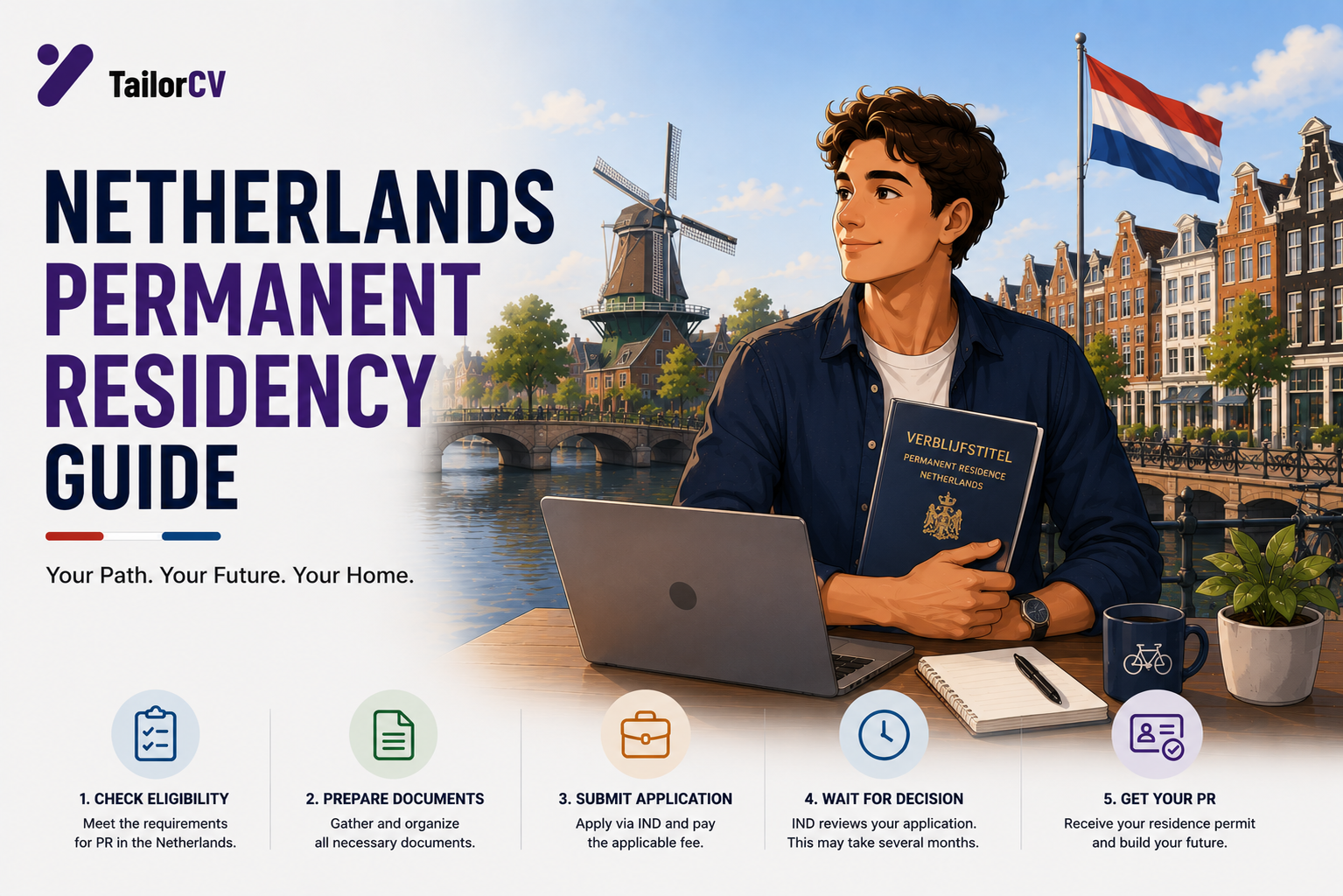
You apply to the IND — the Immigration and Naturalisation Service — online or by post, with a fee that varies by permit type.
The document set typically includes your passport, current residence permit, proof of income across the relevant period, your integration diploma or exemption decision, health insurance evidence and registration details from the BRP.
Income evidence means payslips, employment contract and often an employer statement; for self-employed applicants it means annual accounts and tax assessments across several years.
Processing takes months rather than weeks, and the IND publishes decision periods that are worth checking before you plan around a date.
Your existing permit must stay valid during the process, so apply well before it expires.
Biometrics and an appointment form part of the process.
And decisions can be appealed, which matters if a refusal turns on a technical reading of the income durability test.
Naturalisation, the step beyond
Where the route continues if you want it.
Dutch citizenship generally becomes available after a qualifying residence period, shorter for spouses and partners of Dutch nationals.
The language expectation is higher than for permanent residence, and the civic integration requirement sits at a more demanding level.
The Netherlands restricts dual nationality more than several neighbours, and many applicants are required to renounce their existing citizenship, with exceptions for defined categories.
That renunciation requirement is the single biggest reason long-term residents stop at permanent residence rather than continuing.
The option procedure offers a faster route for certain categories including some people born in the Netherlands and some long-term residents.
And citizenship carries EU free movement, which is the practical difference between settling in the Netherlands and being able to work anywhere in the Union.
Where to verify
Requirements change and this article should be checked against the sources.
The IND for permit categories, current income thresholds, fees and processing times.
DUO for the civic integration exam, exemptions and the state exam.
Your gemeente for BRP registration and local procedures.
Nederland Wereldwijd for consular and citizenship questions.
And an immigration lawyer if your case involves self-employment, long absences, or a mixed permit history, because those are exactly the cases where a wrong assumption costs a year.
Common problems
What actually goes wrong with these applications.
The integration exam is unfinished when the five years elapse, delaying everything.
Income dips below the threshold in one of the assessed months, particularly for people who changed jobs.
Freelance income fails the durability test despite being substantial, because the assessment looks at continuity rather than size.
A permit gap between jobs or between permit types breaks the continuity of residence.
Absences exceed the limits, frequently through long visits home that people did not think to count.
Health insurance lapses during a job change and shows up in the record.
And documents from abroad arrive without the required legalisation or translation, which adds months.
Planning it from year one
The approach that avoids all of the above.
Book an integration course early and take the state exam if you can, since it is more useful and satisfies the requirement.
Keep a personal file of payslips, contracts, permits and insurance confirmations from your first month.
Log your travel so that absence totals are a matter of record rather than reconstruction.
Never let insurance or permits lapse, including in the gap between two jobs.
Prefer a permanent contract where a genuine choice exists, purely for the residence and mortgage consequences.
Check permit-type changes against the clock before making them, not afterwards.
And decide early whether citizenship matters to you, because the renunciation requirement may change how you weigh the whole path.
Comparing the Dutch route regionally
Where it sits among European settlement options.
Against Germany. Both run five-year standard routes with language requirements. Germany offers a Blue Card fast track the Netherlands does not; the Dutch process is generally more administratively predictable.
Against Belgium. Comparable timelines with a different integration framework and language depending on region.
Against Ireland. No integration exam and long-term residence after a qualifying period, which is simpler in that respect.
Against the Nordics. Sweden and Denmark both impose their own demanding conditions, with Denmark notably strict.
Against Portugal and Spain. Both offer shorter citizenship routes for some nationalities, which matters for applicants from Latin America and Lusophone countries.
The Dutch advantage is predictability and a well-documented process.
The Dutch friction is the integration exam at its raised level, and the restriction on dual nationality at the citizenship stage.
A note on partners and family
How household circumstances change the picture.
Family members on dependent permits build their own residence history, and their eligibility is assessed on their own terms rather than automatically following yours.
A partner's income can matter for the sufficiency test in some configurations, and can complicate it in others.
Children born in the Netherlands do not automatically acquire Dutch nationality, which surprises many parents from jus soli countries.
Registered partnership and marriage shorten the naturalisation timeline for partners of Dutch nationals.
And the integration requirement applies individually, so a partner who has not completed inburgering cannot rely on your diploma.
Mini checklist
- unchecked: Five years of qualifying residence confirmed
- unchecked: Permit types across that period checked for eligibility
- unchecked: Integration exam booked or exemption confirmed
- unchecked: Income tested against sufficiency and durability
- unchecked: Health insurance continuity evidenced
- unchecked: Absences from the Netherlands tracked
- unchecked: Dutch permanent versus EU long-term decided
- unchecked: Documents gathered well before the application
- unchecked: Naturalisation timeline considered separately
Scenarios
Scenario 1: You are on a permanent contract with a stable salary
You are in the straightforward case. Focus your effort on the integration exam, which is the part that takes months rather than weeks.
Scenario 2: You are self-employed or on rolling short contracts
The durability of income test is where your application will be scrutinised. Gather several years of accounts and be ready to evidence continuity rather than a single strong year.
Scenario 3: You may move elsewhere in Europe later
Compare the EU long-term residence permit against the Dutch national one. The EU variant makes onward movement within the Union considerably easier.
Tip: Start the integration exam in your second or third year, not your fifth. Course places and exam slots have real waiting times, the required language level was raised in the reformed system, and this single item delays more applications than every other requirement combined.
Do's and Don'ts
Do
- Start integration exam preparation early
- Check for exemptions before enrolling
- Consider the state exam as a stronger alternative
- Track absences carefully
- Keep health insurance continuous
- Compare Dutch and EU long-term permits
Don't
- Assume all five years count equally
- Leave the exam until you are eligible
- Ignore the durability test on income
- Let a permit lapse between jobs
- Forget that study time may count differently
- Rely on pre-reform descriptions of the exam
Common Mistakes
- Leaving the exam late. The commonest cause of delay by a wide margin.
- Miscounting qualifying years. Not every permit type counts the same way.
- Underestimating the income durability test. Short contracts get scrutiny.
- Ignoring exemptions. Some qualifications remove the requirement entirely.
- Breaking residence continuity. Absence limits are stricter than assumed.
- Overlooking the EU variant. It matters if you may move within Europe.
Related Guides
Keep building on this with the related guides in this series:
- Jobs in the Netherlands for International Graduates
- Dutch Work Culture
- Dutch Salary and Holiday Allowance
- The Orientation Year and Zoekjaar
- The 30% Ruling Explained
You can also check your resume's ATS score for free, generate a tailored cover letter, or build a portfolio website in minutes.
Frequently Asked Questions
How long until permanent residence in the Netherlands?
Five years of continuous legal residence on a qualifying permit, with some permit types counting differently and study time treated separately.
What is the inburgering exam?
The civic integration exam covering Dutch language and knowledge of Dutch society. The required language level was raised in the reformed system, so early preparation matters.
What income do I need?
Sufficient, independent and durable income — at or above a threshold, not from benefits, and expected to continue. Short contracts and freelance income receive more scrutiny.
What is the difference between Dutch and EU long-term residence?
Both give settled status in the Netherlands. The EU long-term permit additionally makes moving to another EU member state considerably easier.
Can I be exempt from the integration exam?
Some qualifications and circumstances confer exemption, including certain Dutch-taught degrees. Checking eligibility before enrolling on a course can save a year.
Is naturalisation the same thing?
No, it is a separate later step to citizenship with its own conditions and a higher language expectation.
How long does a Dutch permanent residence application take?
Months rather than weeks. The IND publishes decision periods, and your existing permit must remain valid throughout, so apply well before it expires.
Does the Netherlands allow dual citizenship?
It is restricted more than in several neighbouring countries, and many naturalisation applicants must renounce their existing nationality, with exceptions for defined categories.
Where should I verify the current rules?
The IND for permits and thresholds, DUO for the integration exam and exemptions, your gemeente for registration, and a lawyer for complex permit histories.
What usually goes wrong with these applications?
An unfinished integration exam, income dipping below the threshold during a job change, freelance income failing the durability test, permit gaps, uncounted absences and lapsed health insurance.
How should I plan for permanent residence from the start?
Book the integration course early, keep a personal file of payslips and permits from month one, log your travel, never let insurance or permits lapse, and prefer a permanent contract where you have the choice.
How does Dutch permanent residence compare to neighbouring countries?
Comparable to Germany and Belgium on timeline, simpler than the Nordics on conditions, and more demanding than Ireland which has no integration exam. The main friction is the raised exam level and dual-nationality restrictions at citizenship.
What is your resume scoring right now?
Scan it against a job description and get your ATS match score in about a minute.
Drop your resume here or choose a file
PDF only. Max 2 MB.
We never share your data or use it to train AI models.
Was this guide useful?
Be the first to rate it.