 TD
TD
Key Takeaways
- An ECA is for immigration — it converts your foreign qualification into a Canadian equivalent for CRS points.
- Employers generally do not require an ECA, but having one removes doubt about an unfamiliar qualification.
- Regulated professions need licensing through their provincial body, which is a completely separate and longer process.
- Assess every credential you hold, not just the highest — multiple assessments can score better.
- Start early; transcripts sent directly by institutions abroad are the usual bottleneck.
Newcomers to Canada frequently conflate three different processes: getting immigration points for a degree, convincing an employer your degree is real, and being licensed to practise a regulated profession. They have different purposes, different providers and wildly different timelines.
Getting the sequence wrong costs months.
This guide separates them and explains how to run them in the right order.
While the assessments process, get your resume right — the free ATS score checker.
The three different things
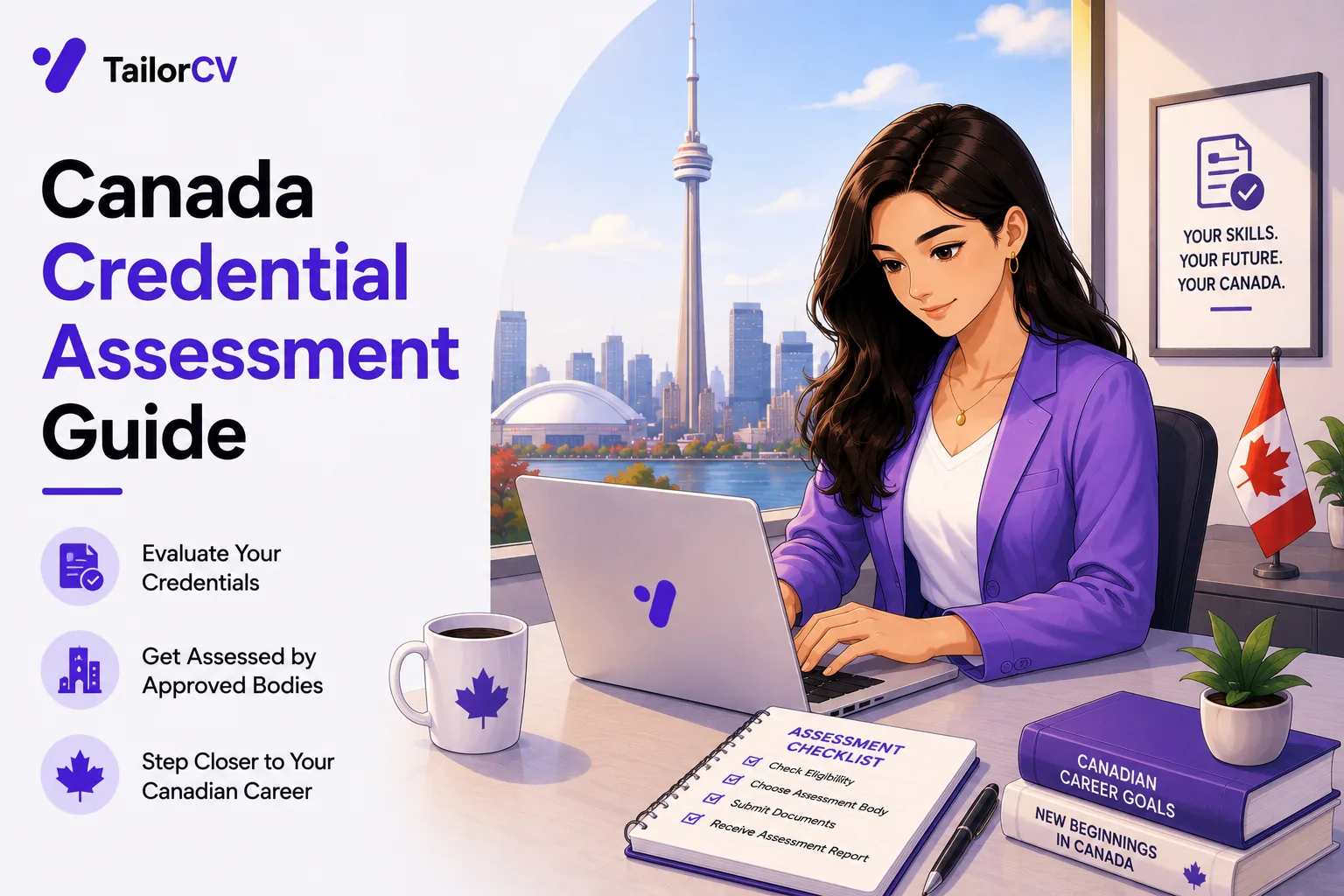
1. Educational Credential Assessment (ECA) — for immigration.
Issued by organisations designated by IRCC. It states that your foreign qualification is equivalent to a specific Canadian credential — a bachelor's degree, a master's, and so on.
Purpose: claiming education points under Express Entry and most PNP streams. Without it, your foreign education generally cannot be counted — see Express Entry and job offers and the provincial nominee guide.
2. Employer recognition — informal.
Most Canadian employers in non-regulated fields do not require any formal assessment. They want to know your degree is genuine and roughly what level it represents.
An ECA helps here as a convenience, because it lets you write "assessed as equivalent to a Canadian bachelor's degree" on your resume, which removes an unknown. It is not usually mandatory.
3. Professional licensing — for regulated professions.
Engineering, nursing, medicine, teaching, accounting, law, pharmacy and others are regulated provincially. The regulator assesses your credentials against their own standards, and this is entirely separate from an ECA.
An ECA does not license you. People discover this late and lose months — see the Canada regulated professions guide.
Getting an ECA
Choose a designated organisation. IRCC designates specific bodies, some general and some profession-specific for medical and pharmacy credentials. Check the current designated list before paying anyone.
What you submit: typically your degree certificate, transcripts, and often official documents sent directly from your institution to the assessing body. That last requirement is the usual bottleneck — universities abroad can be slow, and some charge for it.
Timeline: weeks to months, driven mostly by how fast your institution responds. Start before you need it.
Validity: ECAs are valid for a defined period for immigration purposes, so do not obtain one years before you intend to apply.
Assess everything. If you hold a bachelor's and a master's, assess both. Multiple credentials can score better under CRS than a single one, and candidates routinely assess only the highest.
Your spouse's credentials matter too if they are accompanying you, since spousal education contributes points that frequently go unclaimed.
Putting it on your resume
For non-regulated roles, this is the practical payoff.
BEng Mechanical Engineering, [University], India — assessed as equivalent to a Canadian bachelor's degree (WES, 2026)
Why it works: a Canadian hiring manager may have no idea how to weigh a degree from an institution they have never heard of. The assessment converts an unknown into something familiar, which is precisely the uncertainty that drives the "no Canadian experience" objection — see the Canadian experience problem.
Add institutional context too. One clause naming the institution's standing where it is not internationally recognisable.
The resume conventions are in the resume for newcomers to Canada guide.
Sequencing, if you are moving
The order that saves the most time:
1. Start the licensing process first if your profession is regulated. It is almost always the longest item — frequently longer than immigration — and it can begin while you are still abroad.
2. Start the ECA next. It gates your immigration points, and the institutional transcript request is slow.
3. Book language tests. Results are needed for both immigration and many licensing bodies, and retaking to improve a band is the highest-return CRS action available.
4. Build the Canadian-format resume while the above process.
5. Begin the job search once you have a realistic timeline to quote employers.
The mistake is running these in series. They are independent and should overlap.
Common Mistakes
Assuming an ECA licenses you to practise. For regulated professions it does not — licensing runs through a provincial regulator on a separate and usually longer track.
Assessing only your highest credential. Multiple assessed credentials can score better under CRS, and this is unclaimed points for many applicants.
Forgetting a spouse's credentials. Spousal education contributes points and is routinely overlooked.
Requesting transcripts late. Institutions abroad sending documents directly is the usual bottleneck, and it is entirely predictable.
Using a non-designated assessment body. Only organisations designated by IRCC produce assessments valid for immigration.
Obtaining an ECA years early. They are valid for a defined period for immigration purposes.
Running licensing, ECA and language tests sequentially. They are independent processes that should overlap, and running them in series adds months.
Not putting the equivalency on your resume. It converts an unfamiliar qualification into something a hiring manager can weigh.
Frequently Asked Questions
What is an ECA?
An Educational Credential Assessment, issued by an IRCC-designated organisation, stating what your foreign qualification is equivalent to in Canadian terms. It is used for immigration points.
Do employers require an ECA?
Usually not in non-regulated fields. It helps as a convenience because it removes uncertainty about an unfamiliar qualification, but it is rarely mandatory.
Does an ECA let me work in a regulated profession?
No. Regulated professions require licensing through a provincial regulator, which is a separate and generally much longer process.
How long does an ECA take?
Weeks to months, driven largely by how quickly your institution sends documents directly to the assessing body.
Should I assess more than one degree?
Yes if you hold more than one — multiple assessed credentials can score better under CRS than a single assessment.
Does my spouse need one?
If they are accompanying you, their education contributes points to your application, so it is frequently worth assessing.
How long is an ECA valid?
For a defined period for immigration purposes, so avoid obtaining one long before you intend to apply.
Get the resume ready while the assessments process. Check your ATS score free.
Make This Practical
Separate the three processes before starting any of them. An ECA gets you immigration points, employer recognition is informal, and professional licensing is a different track entirely — conflating them is what costs newcomers months.
Then run them in parallel rather than in sequence. If your profession is regulated, start licensing first because it is almost always the longest item and can begin from abroad. Start the ECA next since institutional transcripts are slow, and book language tests alongside both.
Finally, assess everything worth assessing and use it. Include a spouse's credentials and any second degree, since both contribute unclaimed CRS points — and put the equivalency line directly on your resume, because converting an unfamiliar qualification into a familiar one addresses the exact uncertainty behind the Canadian experience objection.
What is your resume scoring right now?
Scan it against a job description and get your ATS match score in about a minute.
Drop your resume here or choose a file
PDF only. Max 2 MB.
We never share your data or use it to train AI models.

Was this guide useful?
Be the first to rate it.