 TD
TD
Key Takeaways
- QTS — Qualified Teacher Status — is the credential; a PGCE is a separate academic qualification you can hold alongside it.
- Salaried routes let you train while earning, which makes teaching one of the more accessible career changes.
- Bursaries and scholarships for shortage subjects can be substantial and are worth checking before self-funding.
- Newly qualified teachers complete a two-year induction as Early Career Teachers before the status is confirmed.
- Overseas-qualified teachers can apply for QTS recognition from certain countries without retraining.
Teaching is one of the more accessible UK career changes because several routes pay you while you train, and because shortage subjects attract genuinely large bursaries. It is also one where the terminology confuses people — QTS, PGCE, ECT, School Direct — in ways that obscure a fairly simple set of choices.
This guide covers the routes, the funding, and what happens after you qualify.
If you are applying for teaching posts, check your CV parses — the free ATS score checker.
QTS versus PGCE
The distinction that causes most confusion.
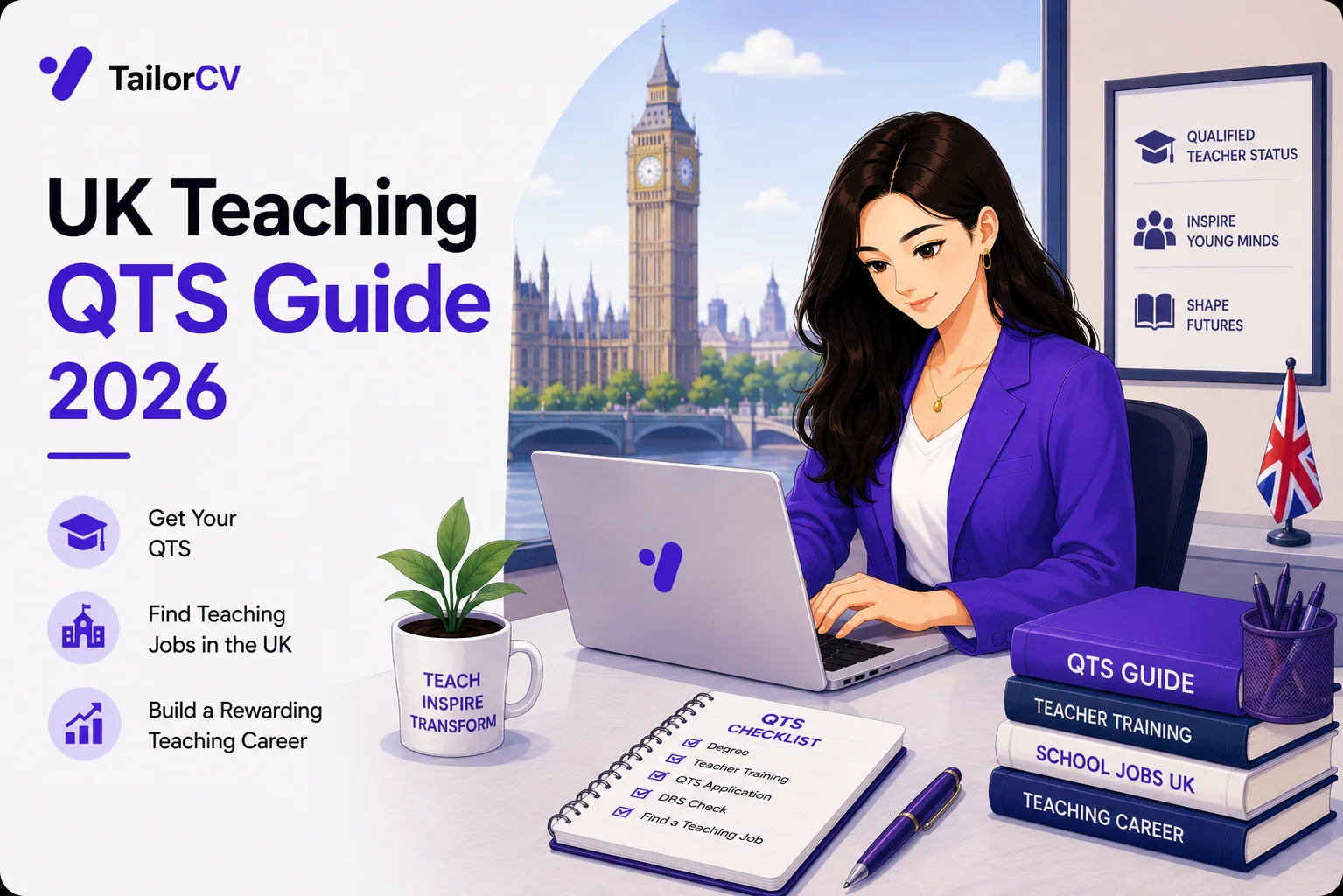
QTS (Qualified Teacher Status) is the professional status required to teach in maintained schools in England. It is what you actually need.
PGCE (Postgraduate Certificate in Education) is an academic qualification awarded by a university, usually carrying master's-level credits. It is not required to teach in England.
Most training routes award both, but not all. Some award QTS only.
Why it matters: a PGCE is more portable internationally and gives you master's credits if you later want a full master's. If you might teach abroad, a route awarding both is worth preferring.
Academies and independent schools can employ teachers without QTS, though most still expect it.
The routes in
University-led training. The traditional route — a PGCE with QTS through a university, including school placements. Fee-paying, with loans and bursaries available.
School-led training. Training based primarily in a school, with a university partner for the academic element. Comes in fee-paying and salaried varieties.
Salaried routes. You are employed by a school as an unqualified teacher and train on the job. You earn a salary and pay no course fees. This is the route that makes teaching viable as a career change for people who cannot afford a year without income — see the UK career change guide.
Teaching apprenticeships. A degree apprenticeship route into teaching, employer-funded — see the UK apprenticeship guide.
Assessment-only route. If you already have substantial teaching experience without QTS — perhaps in an independent school or overseas — you can be assessed against the teaching standards without further training. Considerably faster where you qualify.
Undergraduate routes. Degrees with QTS built in, for those entering from school.
Funding
Bursaries and scholarships are available for shortage subjects and can be substantial. Physics, mathematics, chemistry, computing and modern languages typically attract the largest amounts, while oversubscribed subjects attract little or nothing.
Amounts change annually and by subject, so check the current year's figures before assuming.
Salaried routes pay you instead of a bursary, which is often better for career changers with commitments even where the headline bursary looks large.
Student finance is available for fee-paying routes.
The practical comparison: a large bursary for a year versus a salary for a year. Work out which produces more after tax and living costs, because the answer varies by subject and by your circumstances.
Entry requirements
A degree, usually 2:2 or above depending on the provider.
GCSE English and Maths at grade 4/C or above, plus Science for primary teaching. These are non-negotiable and catch people out — equivalency tests exist if you lack them.
Subject knowledge relevant to what you will teach. Subject knowledge enhancement courses exist where your degree is adjacent rather than exact.
School experience is not always mandatory but strengthens applications considerably and helps you confirm you actually want to do it.
Enhanced DBS check and a fitness-to-teach assessment.
After qualifying: ECT induction
Newly qualified teachers complete a two-year induction period as an Early Career Teacher, extended from one year under earlier arrangements.
During induction you get:
- A reduced timetable — typically 10% off in the first year and 5% in the second
- A designated mentor
- Structured development based on the Early Career Framework
- Formal assessment against the teaching standards
You must pass induction to continue teaching in maintained schools.
It is demanding. The first year of teaching is genuinely hard, and attrition in the early years is significant. Going in expecting it to be difficult is better preparation than expecting it to be smooth.
Overseas-qualified teachers
If you qualified as a teacher outside the UK, you may be able to apply for QTS recognition without retraining, depending on where you qualified. Arrangements have changed and now cover a defined list of countries and qualifications.
What you will generally need: evidence of your teaching qualification, evidence of teaching experience, and English language competence.
Check the current eligible country list before assuming, and confirm your right to work separately — see UK right to work explained.
If recognition is not available, the assessment-only route may suit experienced teachers better than full retraining.
Common Mistakes
Confusing QTS with PGCE. QTS is what you need to teach; PGCE is an academic qualification you may or may not receive alongside it.
Not checking GCSE requirements early. English, Maths and — for primary — Science at grade 4/C are non-negotiable, and equivalency tests take time to arrange.
Self-funding without checking bursaries. Shortage subjects attract substantial amounts that change annually, and physics, maths and computing are frequently well funded.
Overlooking salaried routes. Earning while training makes teaching viable as a career change in a way a fee-paying year does not.
Choosing a QTS-only route while planning to teach abroad. A PGCE is considerably more portable internationally.
Underestimating ECT induction. It runs two years, must be passed, and the first year of teaching is genuinely hard.
Applying without any school experience. It strengthens applications and, more importantly, tells you whether you actually want the job.
Assuming overseas qualifications require full retraining. Recognition routes exist for a defined list of countries, and the assessment-only route suits experienced teachers.
Frequently Asked Questions
What is the difference between QTS and a PGCE?
QTS is the professional status required to teach in maintained schools in England. A PGCE is a separate academic qualification, usually with master's credits, and is not legally required — though it is more portable internationally.
Can I train to teach while earning?
Yes. Salaried school-led routes and teaching apprenticeships employ you as an unqualified teacher and train you on the job, with no course fees.
Are teaching bursaries still available?
Yes, for shortage subjects, and amounts vary substantially by subject and change annually. Physics, maths, chemistry and computing typically attract the largest.
What GCSEs do I need?
English and Maths at grade 4/C or above, plus Science for primary teaching. Equivalency tests are available if you do not hold them.
What is ECT induction?
A two-year statutory induction for newly qualified teachers, with a reduced timetable, a mentor, and formal assessment against the teaching standards. It must be passed.
I qualified as a teacher abroad — do I have to retrain?
Not necessarily. QTS recognition is available for qualifications from a defined list of countries, and the assessment-only route suits experienced teachers otherwise.
Do I need QTS to teach in a private school?
Independent schools and academies can employ teachers without it, though most still expect QTS in practice.
Check your CV before applying. Check your ATS score free.
Make This Practical
Check the two things that gate everything before choosing a route — your GCSE English, Maths and Science position, and whether your subject attracts a bursary this year. Equivalency tests take time to arrange and bursary amounts vary enormously by subject.
Then compare salaried against fee-paying honestly. A salaried route pays you while you train with no fees; a large bursary in a shortage subject may still come out ahead for a year. Work out which produces more after tax and living costs in your situation.
Finally, plan past qualification. ECT induction runs two years and must be passed, the first year is genuinely demanding, and if you might teach overseas later choose a route awarding a PGCE alongside QTS rather than QTS alone.
What is your resume scoring right now?
Scan it against a job description and get your ATS match score in about a minute.
Drop your resume here or choose a file
PDF only. Max 2 MB.
We never share your data or use it to train AI models.

Was this guide useful?
Be the first to rate it.