 SS
SS
Key Takeaways
- The Graduate visa allows you to work for any employer without sponsorship, which is the key advantage most holders undersell.
- You must apply from inside the UK before your Student visa expires — missing that window forfeits the route entirely.
- It cannot be extended, so the goal is converting to a sponsored role before it ends.
- Employers who cannot sponsor can still hire you, which massively widens your search relative to sponsorship-dependent candidates.
- State it on your CV with the expiry date, because "no sponsorship required" is the phrase recruiters screen on.
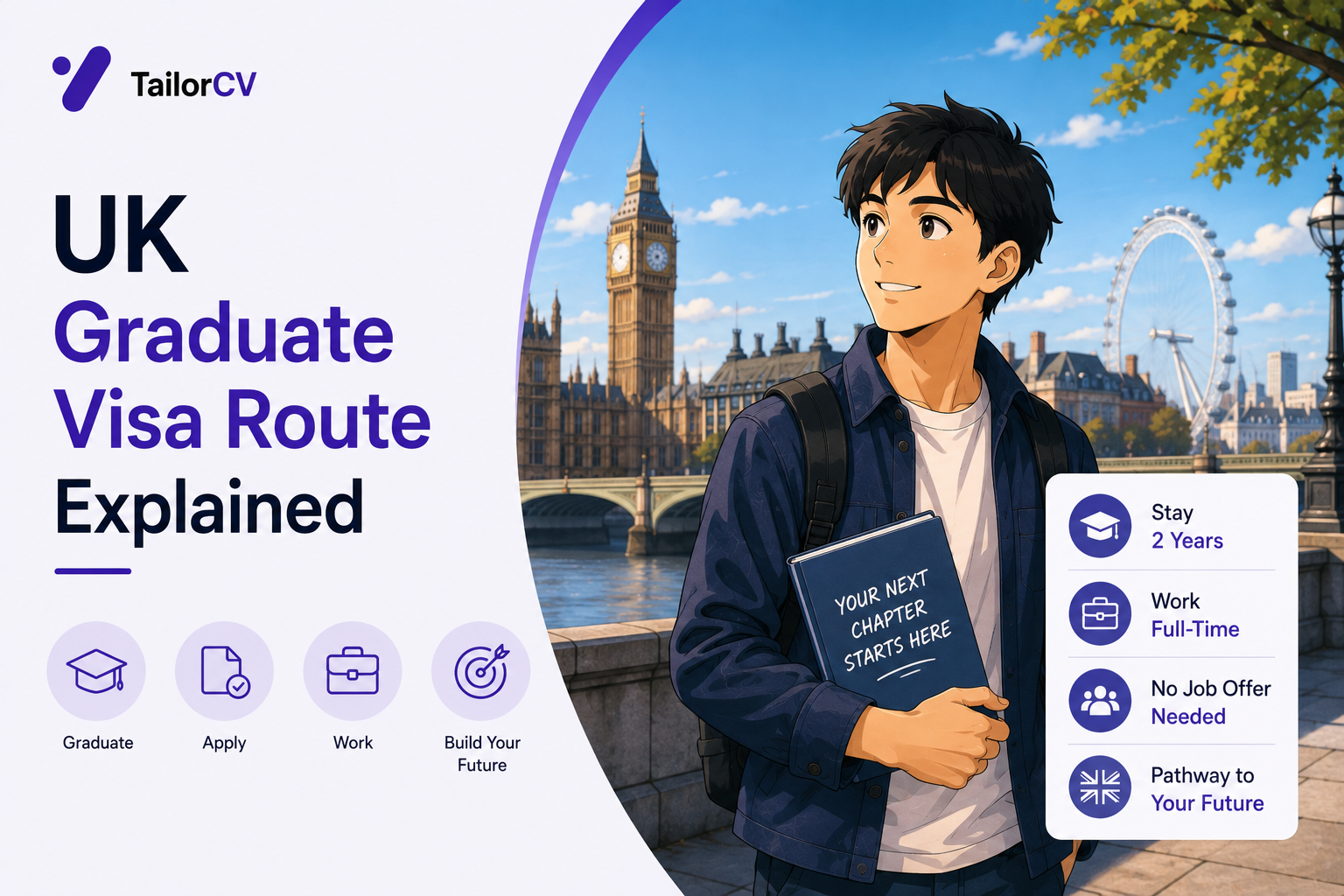
The Graduate visa is the single best position an international graduate can be in for a UK job search, and a surprising number of holders describe it on their CV in a way that makes recruiters think they need sponsorship.
The route gives you a period of unrestricted work rights with no employer involvement at all. You can work for a two-person startup that has never heard of a sponsor licence. That is a fundamentally different search from a sponsorship-dependent one.
This guide covers how it works, how to present it, and how to convert before it ends.
Immigration rules change and this route has been under review. Confirm current terms and duration on GOV.UK rather than relying on any summary.
While you plan, make sure the CV works — the free ATS score checker.
What it gives you
Unsponsored work rights. Any employer, any role, any skill level. No Certificate of Sponsorship, no salary threshold, no occupation code requirement.
No minimum salary. Unlike the Skilled Worker route, there is no wage floor — which matters for graduate roles that would not clear the sponsored threshold.
Freedom to change jobs. No transfer process, no reapplication. You can move employers as freely as a domestic graduate.
Self-employment is permitted. Freelance and contract work are open to you, which the Skilled Worker route does not allow.
Duration. Typically two years for undergraduate and master's graduates, longer for doctoral graduates. Confirm the current position, as this has been subject to policy review.
It cannot be extended. This is the constraint that shapes everything — the visa is a runway, not a destination.
Eligibility and applying
You must have completed an eligible course at a licensed higher education provider that reported your completion to the Home Office.
You must apply from inside the UK, and before your Student visa expires. This is where people lose the route entirely — leaving the country or letting the Student visa lapse first forfeits it.
You do not need a job offer to apply, which is the point.
Costs include the application fee and the Immigration Health Surcharge for the full period, payable upfront. Budget for it before you graduate rather than discovering it afterwards.
Apply as soon as your result is confirmed. Processing takes time and you cannot start certain roles until it is granted.
How to present it on your CV
This is where value is routinely thrown away.
Wrong:
Visa required
Also wrong:
International student seeking sponsorship
Right:
Graduate visa valid to September 2028 — no sponsorship required
Those five words at the end are what a recruiter screens on. A hiring manager reading "no sponsorship required" treats you as a normal candidate for the next two years. One reading "visa required" screens you out at the first pass.
Put it on the contact line or at the end of your personal statement. The conventions are in the UK CV format guide, and the wider status question in UK right to work explained.
Using the two years properly
The visa is a runway. Treat it as one from day one.
Do not spend it in a job that cannot sponsor. This is the most common and most costly mistake. A role at an employer with no sponsor licence is comfortable for two years and then a cliff edge. Working somewhere that can sponsor buys you the option.
Check the sponsor register early. The Home Office publishes every licensed sponsor. When choosing between offers, sponsorship capability is a real factor even if you are not using it yet — see the UK Skilled Worker visa guide.
Raise sponsorship at around twelve months. Not at month twenty-two. Your employer needs time to decide, and the Skilled Worker application itself takes time. Asking early also tells you whether to start looking elsewhere while you still have runway.
Watch the salary threshold. Skilled Worker has a wage floor that was raised substantially in 2024. A graduate salary that was fine on the Graduate visa may not clear it, so your pay progression matters for immigration reasons, not just financial ones — see UK salary negotiation.
Build UK experience deliberately. Employers sponsor known quantities far more readily than unknown applicants. Two years of demonstrated performance is what makes the sponsorship conversation easy.
Converting to Skilled Worker
The standard path onward.
Your employer must hold a sponsor licence, or be willing to apply for one — which is possible but takes time and money, so raise it early.
The role must meet the skill and salary thresholds for the occupation code.
You switch from inside the UK, without leaving.
If your employer cannot sponsor, your options are moving to one that can, or exploring other routes. Either needs runway, which is the argument for starting the conversation at twelve months rather than twenty.
Common Mistakes
Writing "visa required" on the CV. You need no sponsorship for the duration, and describing yourself as if you do is a self-inflicted rejection at the first screen.
Applying from outside the UK. The application must be made from inside the country before your Student visa expires, and leaving first forfeits the route.
Letting the Student visa lapse before applying. There is no recovery from this — the window closes permanently.
Spending two years at an employer who cannot sponsor. Comfortable, then a cliff edge with no options and no time.
Raising sponsorship at month twenty-two. The employer needs time to decide and the application takes time; by then you have no runway to change course.
Ignoring the Skilled Worker salary threshold. It was raised substantially in 2024, and a graduate salary that suited the Graduate visa may not qualify you for the switch.
Not budgeting for the Immigration Health Surcharge. It is charged for the full period upfront and surprises graduates who have just stopped receiving student funding.
Treating the visa as two free years. It is a runway with a fixed end, and the plan needs to exist from the start.
Frequently Asked Questions
Do I need a job offer for the Graduate visa?
No. You apply on the basis of having completed an eligible course, which is precisely why the route is valuable.
Can I work for any employer?
Yes — any employer, any role, any salary, with no sponsorship required. You can also be self-employed, which the Skilled Worker route does not permit.
How long does it last?
Typically two years for undergraduate and master's graduates and longer for doctoral graduates, though this has been subject to policy review. Confirm current terms on GOV.UK.
Can it be extended?
No. You must switch to another route, most commonly Skilled Worker, before it ends.
Can I apply from my home country?
No. The application must be made from inside the UK before your Student visa expires.
What should my CV say?
State the route and the expiry date, followed by "no sponsorship required" — that phrase is what recruiters screen on.
What if my employer cannot sponsor me later?
You would need to move to a licensed sponsor or find another route, which is why raising the question at around twelve months matters more than at twenty.
Make sure your CV says the right thing. Check your ATS score free.
Make This Practical
Rewrite your CV line today. "Graduate visa valid to [month year] — no sponsorship required" is what gets you treated as a normal candidate, and it is the single highest-return edit available to you.
Then plan the runway from day one. Prefer employers who hold a sponsor licence even while you do not need one, check the Home Office register when comparing offers, and treat sponsorship capability as a genuine factor alongside salary and role.
Finally, raise the conversion conversation at around twelve months, not twenty-two. Your employer needs time to decide and the Skilled Worker application takes time — and if the answer is no, twelve months of remaining runway is enough to find an employer who says yes. Watch the salary threshold while you do, since it governs whether the switch is even possible.
What is your resume scoring right now?
Scan it against a job description and get your ATS match score in about a minute.
Drop your resume here or choose a file
PDF only. Max 2 MB.
We never share your data or use it to train AI models.

Was this guide useful?
Be the first to rate it.