 SS
SS
Key Takeaways
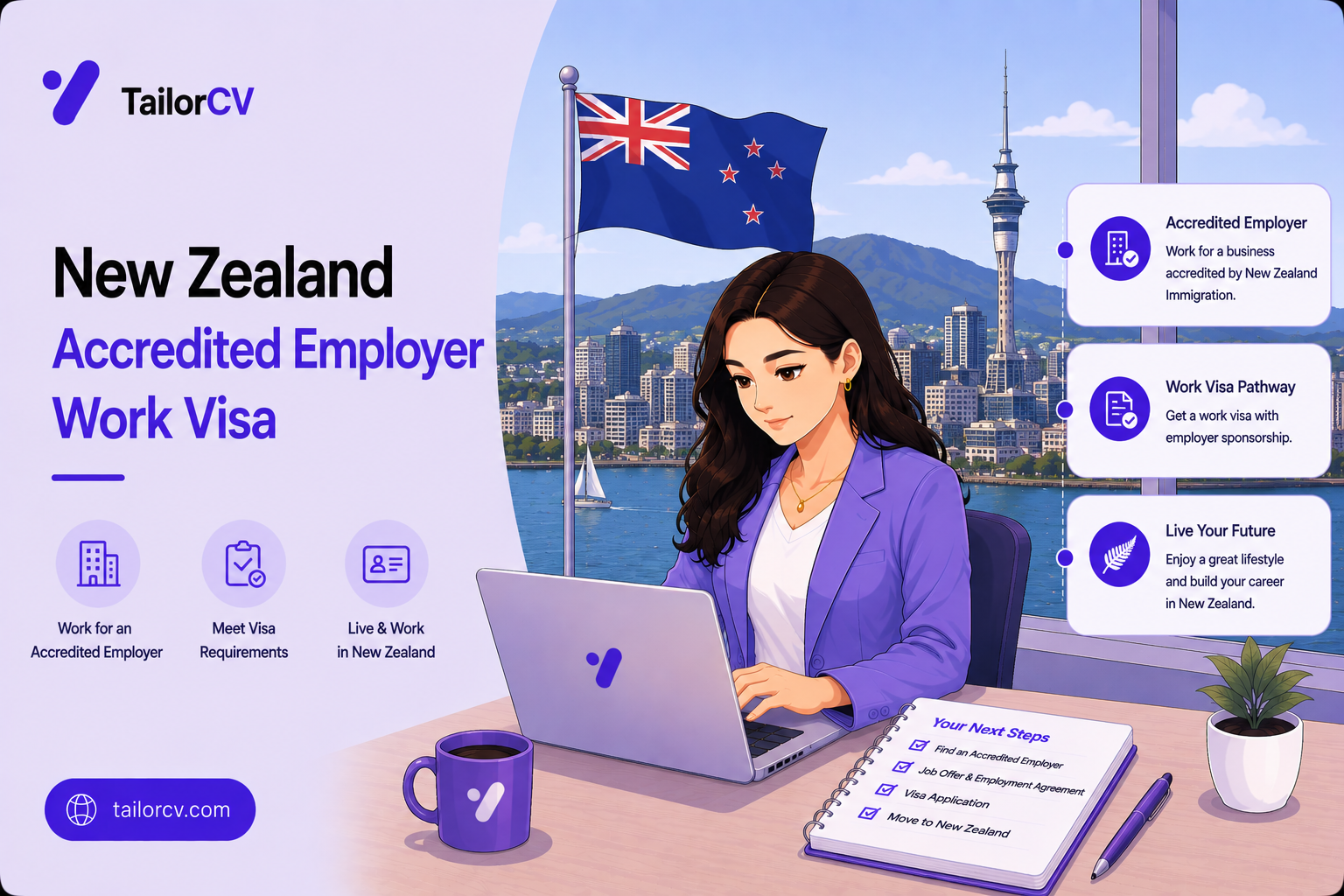
- The AEWV is New Zealand's principal temporary work visa, and it runs through accredited employers only.
- Three checks apply — employer accreditation, a job check on the role, and then your own application.
- The median wage threshold is central to how the system works, affecting duration and onward options.
- The visa is employer-specific, and changing jobs requires a variation or a new application.
- It is a stepping stone, with residence pathways following for those who qualify.
The three-stage system
How the AEWV actually works.
Stage one is employer accreditation. The employer applies to Immigration New Zealand to become accredited, demonstrating they are a genuine, compliant business meeting employment standards.
Stage two is the job check. The specific role is assessed — its terms, its pay against the median wage, and in many cases whether the labour market was tested by advertising it locally first.
Stage three is your application. You apply for the visa itself, evidencing your identity, health, character and that you meet the role's skill and experience requirements.
All three must succeed, and the first two are the employer's responsibility rather than yours.
Which means the practical question for any candidate is whether the prospective employer is already accredited and has a current job check for the role — because if not, your timeline extends considerably.
Labour market testing is waived for roles on the Green List and for those paid above a defined threshold, which is a substantial simplification where it applies.
And accreditation has tiers, with standard accreditation covering a limited number of migrant workers and higher tiers available for employers hiring more.
The median wage and why it matters
The number that governs the system.
New Zealand's median wage is the reference point used throughout the immigration system, updated periodically.
Roles paid at or above it generally receive better treatment on visa duration and onward pathways.
Roles paid below it face more constraints, and policy in this area has changed repeatedly in recent years.
Green List roles — occupations in genuine shortage — carry their own arrangements including faster residence routes.
Sector agreements exist for defined industries with their own wage and condition settings.
Because the threshold moves, an offer that qualified last year may not this year, and checking the current figure rather than a remembered one is genuinely necessary.
And the interaction with residence is the key point — pay level affects not just this visa but what you can apply for afterwards.
Applying in practice
The mechanics from your side.
Your application is online through Immigration New Zealand, once the employer's job check is approved.
You will need your passport, the job check reference, evidence of your qualifications and work experience, and proof you meet any occupational registration requirements.
Health requirements include a medical examination and chest x-ray in many cases, depending on your country and intended stay length.
Character requirements include police certificates from countries where you have lived for a defined period.
Occupational registration is mandatory before you can work in regulated professions — nursing, teaching, engineering, medicine and others — and it is a separate process from the visa that takes its own time.
Processing times are published and vary considerably with application volume.
Fees and the International Visitor Levy apply.
And your partner and dependent children can generally be included or apply alongside, with partner work rights depending on your role's pay level and occupation.
After the AEWV
Where the route goes next.
The Straight to Residence pathway applies to some Green List occupations, allowing residence application immediately rather than after a qualifying period.
The Work to Residence pathway applies to other Green List occupations after a defined period of employment in that role.
The Skilled Migrant Category uses a points system based on skills, qualifications, experience and income, and is the general route for those outside the Green List.
Sector agreement pathways exist for defined industries with their own conditions.
Partner and family categories run separately.
Residence removes the employer tie entirely and grants indefinite stay with work rights.
And citizenship follows after a qualifying period of residence, bringing with it the right to live and work in Australia — which is a substantial and frequently underweighted benefit.
Mini checklist
- unchecked: Employer accreditation status confirmed
- unchecked: Job check completed or in progress for your role
- unchecked: Salary checked against the current median wage
- unchecked: Green List eligibility assessed
- unchecked: Skill and experience requirements evidenced
- unchecked: Health and character requirements understood
- unchecked: Visa duration and conditions confirmed
- unchecked: Residence pathway identified from the start
- unchecked: Family accompanying arrangements checked
Scenarios
Scenario 1: The employer is already accredited with a current job check
You are in the fastest case. Your own application is the only remaining stage and processing is considerably quicker.
Scenario 2: Your occupation is on the Green List
You are in the strongest position available. Labour market testing is generally waived and a defined residence pathway follows, which is why checking the Green List first is worthwhile.
Scenario 3: The employer has never hired a migrant worker
Expect a longer timeline. Accreditation and the job check both take time, and some employers abandon the process once they see what it involves — so confirm their commitment early.
Tip: Before investing in an application, ask the employer two direct questions: are you accredited, and do you have a current job check for this role? Those two answers determine whether your visa takes weeks or months, and most candidates never think to ask.
Do's and Don'ts
Do
- Confirm employer accreditation before anything
- Check the Green List for your occupation
- Verify the current median wage figure
- Evidence your skills and experience thoroughly
- Plan the residence pathway from the start
- Check family accompanying rights
Don't
- Assume any employer can sponsor you
- Rely on a remembered wage threshold
- Change employers without a variation
- Overlook health and character requirements
- Ignore sector agreements if relevant
- Treat this visa as an end point
Common Mistakes
- Not checking accreditation. It determines your entire timeline.
- Using an outdated wage threshold. It moves and it governs everything.
- Missing the Green List. It offers the fastest route where it applies.
- Changing jobs informally. The visa is employer-specific.
- Weak experience evidence. Skill requirements are assessed properly.
- No residence plan. The pay level you accept affects later options.
Related Guides
Keep building on this with the related guides in this series:
- Graduate Jobs in New Zealand
- The Post Study Work Visa
- New Zealand Residence Pathways
- New Zealand Work Culture
- Australian Permanent Residency Pathways
You can also check your resume's ATS score for free, generate a tailored cover letter, or build a portfolio website in minutes.
Frequently Asked Questions
What is the AEWV?
New Zealand's principal temporary work visa, available only through employers accredited by Immigration New Zealand and requiring a job check on the specific role.
What are the three stages?
Employer accreditation, a job check on the role, and your own visa application. The first two are the employer's responsibility and determine your timeline.
Why does the median wage matter?
It is the reference point governing visa duration, conditions and onward residence pathways. Roles at or above it generally receive better treatment.
What is the Green List?
A list of occupations in genuine shortage, carrying waived labour market testing and defined residence pathways — the strongest position available under this system.
Can I change employers?
Not freely. The visa is employer-specific and a change requires a variation of conditions or a new application through another accredited employer.
Does this lead to residence?
It can. Residence pathways follow for those meeting the criteria, and the pay level and occupation you accept materially affect which ones are open.
What documents does an AEWV application need?
Passport, the approved job check reference, qualification and experience evidence, a medical examination in many cases, police certificates, and occupational registration where your profession is regulated.
What comes after the AEWV?
Straight to Residence or Work to Residence for Green List occupations, the points-based Skilled Migrant Category otherwise, and eventually citizenship which carries the right to live and work in Australia.
What is your resume scoring right now?
Scan it against a job description and get your ATS match score in about a minute.
Drop your resume here or choose a file
PDF only. Max 2 MB.
We never share your data or use it to train AI models.

Was this guide useful?
Be the first to rate it.