 SS
SS
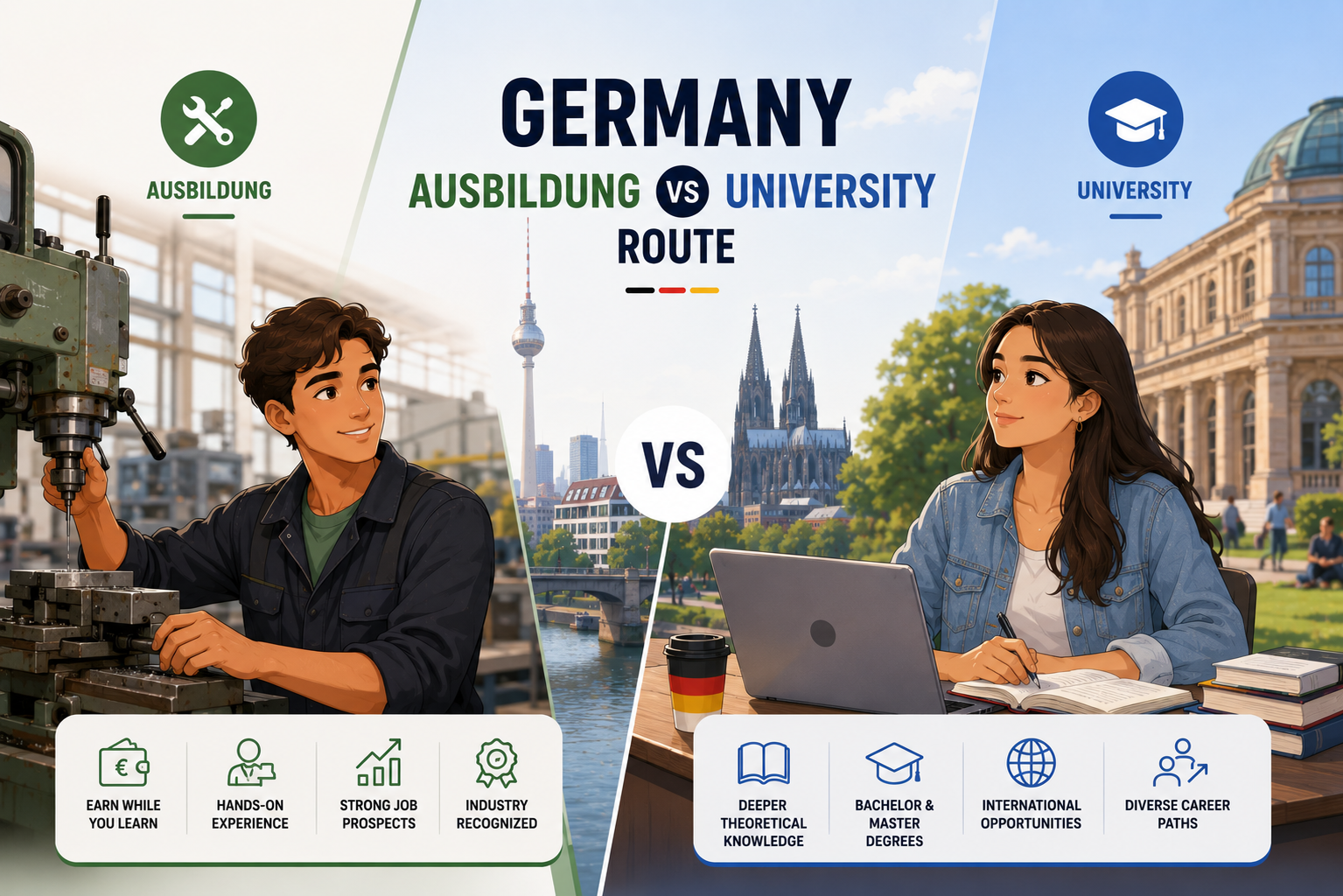
Key Takeaways
- Ausbildung is a paid, structured apprenticeship combining employer training with vocational school, typically running two to three and a half years.
- It carries no stigma in Germany, unlike vocational routes in several other countries, and leads to genuinely skilled and well-paid work.
- Duales Studium combines both — a degree and an apprenticeship simultaneously, with an employer paying you throughout.
- University suits research, medicine, law and roles with formal degree requirements; Ausbildung suits skilled trades, technical roles, and much of commerce and administration.
- Both routes have progression, including the Meister qualification, which can lead to running a business or teaching apprentices.
What Ausbildung actually is
The system foreigners consistently underestimate.
It is a dual system. You are employed by a company, paid a training wage, and spend part of each week or block periods at a Berufsschule, the vocational school.
It runs two to three and a half years depending on the profession, with the length sometimes shortened for those with a higher school qualification.
There are hundreds of recognised professions, from industrial mechanic and electronics technician to bank clerk, IT specialist, medical assistant, chef, logistics specialist and office administrator.
It ends in a national examination administered by the relevant chamber — the IHK for industry and commerce, the HWK for skilled crafts — and the resulting qualification is recognised nationwide.
You are paid throughout, at a rate that rises each year of training, and you accrue pension and social insurance from day one.
Roughly half of German school leavers take this route, which is why it carries no social stigma and why the skilled workforce is as deep as it is.
And employers frequently keep you. Being taken on permanently — übernommen — at the end of training is the normal expectation at a good employer rather than a lucky outcome.
How it compares to university
An honest side-by-side.
| Ausbildung | University | |
|---|---|---|
| Cost | Paid a training wage | Low tuition, living costs to cover |
| Length | 2 to 3.5 years | 3 years bachelor plus 2 masters |
| Entry | School leaving qualification, employer place | Abitur or equivalent |
| Earning starts | Immediately | After graduation |
| Career ceiling | Meister, Techniker, Fachwirt, business ownership | Broadly open, required for regulated professions |
| Best for | Skilled technical and commercial roles | Research, medicine, law, engineering design |
The financial position early on favours Ausbildung considerably — you earn from year one and carry no opportunity cost.
The long-run position depends on field. Engineering, medicine, law and academia require degrees. Many technical and commercial careers do not, and a Meister with a business frequently out-earns a mid-level graduate employee.
Duales Studium is the hybrid — you are employed, paid, and study for a bachelor's degree simultaneously, alternating between company and university. It is competitive, demanding and increasingly popular precisely because it removes the trade-off.
And the routes are not sealed. A Meister or Fachwirt qualification grants access to university study in many federal states even without an Abitur.
Choosing a profession
How to narrow several hundred options.
Start with demand. The Federal Employment Agency publishes shortage occupation data, and training in a shortage profession changes your position on both pay and residence permits.
Technical and industrial professions — mechatronics, electronics, industrial mechanics, plant operation — are in persistent demand across the manufacturing regions.
Healthcare and care professions are in severe shortage nationwide, with training routes that lead directly into secure employment.
IT professions — Fachinformatiker in system integration or application development — are a genuine and underused route into technology work without a degree.
Commercial professions — Industriekaufmann, Bankkaufmann, Speditionskaufmann — lead into administration, finance and logistics across every sector.
Skilled crafts — plumbing, electrical installation, carpentry, heating and ventilation — face acute shortages and lead to business ownership through the Meister.
And regional demand varies, so a profession thriving in Baden-Württemberg may be thinner in the north-east.
Progression after qualification
Where the route actually leads.
Geselle to Meister in the skilled crafts, which confers the right to train apprentices and to run a business in regulated trades.
Techniker, a state-certified technical qualification sitting between vocational training and engineering.
Fachwirt and Betriebswirt, commercial advancement qualifications administered by the chambers, which map onto management roles.
University access, since a Meister or equivalent opens higher education in many federal states without an Abitur.
Specialisation within the employer, moving into quality, planning, training or team leadership.
And self-employment, which the Meister route is explicitly designed to enable and which is a genuinely common destination.
For foreign nationals
The route is open, with specifics.
A residence permit for vocational training exists and is a recognised immigration pathway rather than an afterthought.
Language is the gate. Vocational school teaches and examines in German, and employers generally expect a solid intermediate level before starting.
Recognition of prior qualifications through the Anerkennung process can shorten training or grant direct equivalence, and checking it first can save years.
Shortage professions carry more favourable treatment on permits.
After qualifying, the transition to a work residence permit is well established, and time in training counts toward longer-term residence.
And the Skilled Immigration Act widened these routes considerably, so any advice older than a couple of years should be re-checked against current rules.
Applying for an Ausbildung place
The mechanics, which differ from applying to a university.
You apply to employers, not to a central admissions system. The company selects you and the vocational school follows from that.
Applications open early, frequently a year or more before the training year begins, and popular employers fill places well in advance.
A German-style application set is expected — Lebenslauf, a short Anschreiben, school certificates and any references.
School grades matter, particularly in mathematics and German for technical professions, though a strong application and genuine interest routinely outweigh middling marks.
Practical experience helps disproportionately — a Praktikum with the same employer is the single strongest signal you can send.
Assessment centres and aptitude tests are common at larger employers, testing basic numeracy, logic and German.
The chambers publish vacancy databases — the IHK Lehrstellenbörse and the Federal Employment Agency's own portal — which are the practical places to search.
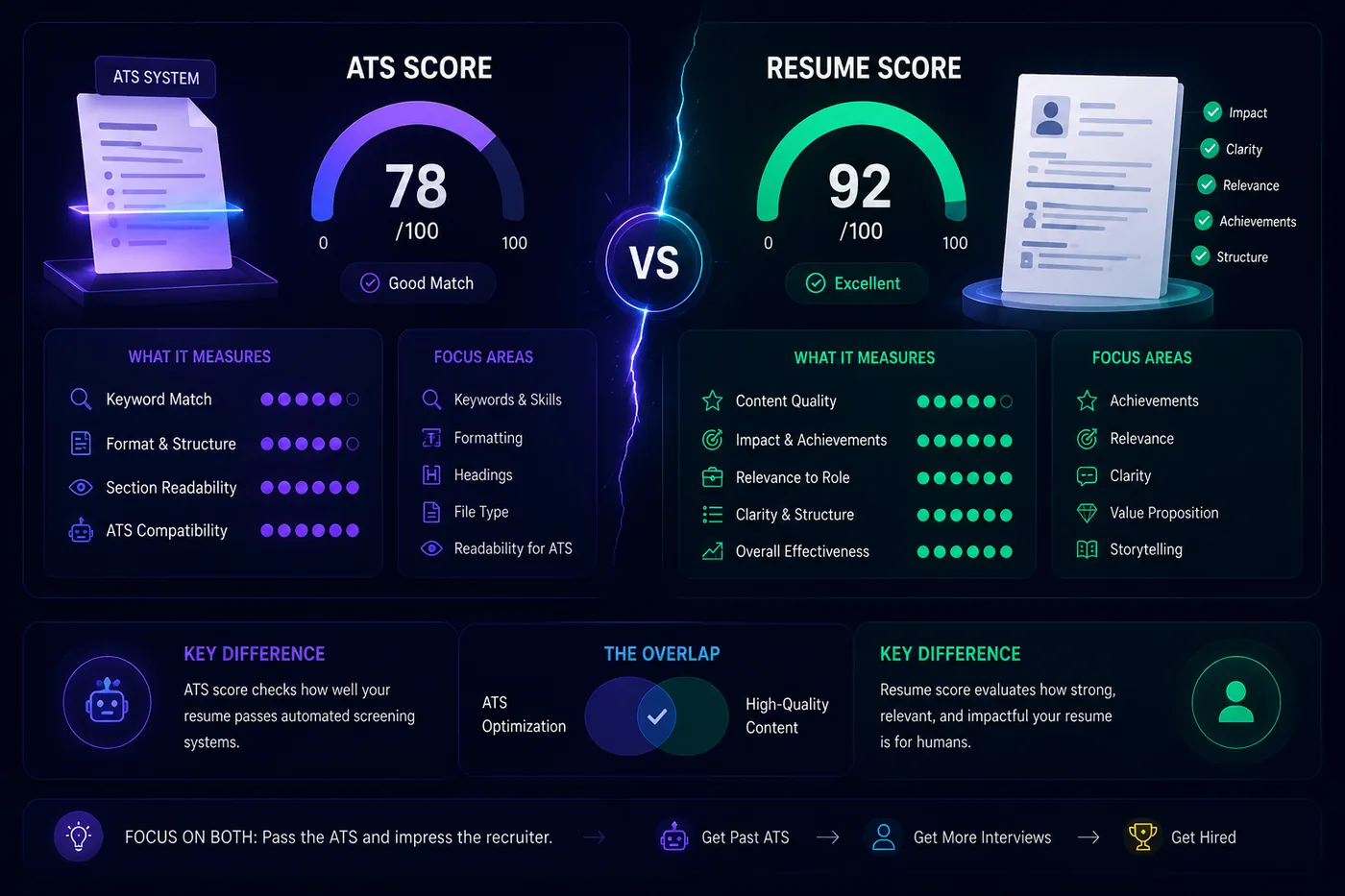
Run your application through an ATS check if you are applying to large industrial employers, since they screen at volume like any other big organisation.
Common misreadings
Four beliefs that mislead people about this system.
"It is the route for people who could not get into university." Roughly half of school leavers take it, including many with the Abitur who simply prefer earning and training to studying.
"It closes off higher education." A Meister or equivalent opens university access in most federal states, and Duales Studium delivers both at once.
"It is only for manual trades." Banking, insurance, IT, logistics, media and healthcare all train through this system.
"The pay is low." The training wage is low by design and rises annually, and qualified professionals in shortage trades frequently out-earn graduate office workers within a few years.
Who each route genuinely suits
A straight answer rather than a diplomatic one.
University is the right route if your target profession legally requires a degree — medicine, law, pharmacy, teaching, psychotherapy — or if you want research, engineering design, or the kind of role where the degree is the entry ticket regardless of capability.
Ausbildung is the right route if you want to work with your hands or with systems, want to earn immediately, prefer learning by doing, or are aiming at a trade where the Meister leads to your own business.
Duales Studium is the right route if you want a degree and cannot see the argument for three years of unpaid study when an employer will pay you to do both.
And the honest observation is that the German labour market values the qualification that matches the job, not the qualification that sounds most impressive. A Fachinformatiker with five years of experience is not competing against computer science graduates for the same roles at a disadvantage — frequently the reverse.
Mini checklist
- unchecked: Target profession identified from the recognised list
- unchecked: Ausbildung versus Duales Studium versus university decided
- unchecked: Employer places researched, since the employer applies as much as the school
- unchecked: German level assessed honestly against the vocational school requirement
- unchecked: Recognition checked if you hold a foreign qualification
- unchecked: Chamber examination requirements understood
- unchecked: Progression route mapped beyond the initial qualification
- unchecked: Regional demand for the profession checked
- unchecked: Residence permit route confirmed if you are a foreign national
Scenarios
Scenario 1: You want to work in a skilled technical trade
Ausbildung is the correct route and the direct one. The qualification is nationally recognised, demand is high across most of the country, and the Meister route leads to running your own business.
Scenario 2: You want a degree without the debt or the delay
Duales Studium gives you both — an employer, a salary and a bachelor's degree at the same time. It is competitive and demanding, and it is the strongest value proposition in German education.
Scenario 3: You are a foreign national considering Ausbildung
It is a genuine route, with residence permits available for vocational training. German language capability is the practical gate, since the Berufsschule teaches in German.
Tip: If you are choosing between a degree and an Ausbildung in a technical field, look at what a Meister actually earns and what doors it opens. In Germany, that qualification carries real professional authority — including the right to train apprentices and to run a business in regulated crafts.
Do's and Don'ts
Do
- Treat Ausbildung as a serious professional route
- Consider Duales Studium if you want both
- Apply to employers, not just schools
- Check regional demand for your profession
- Plan the progression route beyond qualification
- Assess your German against school requirements honestly
Don't
- Assume vocational means low-skilled here
- Overlook the Meister and Fachwirt routes
- Ignore the earning-from-day-one advantage
- Assume a degree is required for every good job
- Forget that recognition applies to foreign qualifications
- Underestimate the German needed for the Berufsschule
Common Mistakes
- Applying an Anglo stigma to vocational training. It does not exist here.
- Ignoring Duales Studium. Frequently the best of both routes.
- Overlooking the Meister ceiling. It is far higher than outsiders assume.
- Underestimating the German requirement. Vocational school runs in German.
- Applying only to schools. The employer place is the harder part.
- Assuming the routes are sealed. A Meister can open university access.
Related Guides
Keep building on this with the related guides in this series:
- Graduate Jobs in Germany
- German Work Culture
- Salary Negotiation in Germany
- The German Lebenslauf and CV Format
- Permanent Residence in Germany
You can also check your resume's ATS score for free, generate a tailored cover letter, or build a portfolio website in minutes.
Frequently Asked Questions
What is an Ausbildung?
A paid, structured apprenticeship combining employment with vocational school, running two to three and a half years and ending in a nationally recognised chamber examination.
Does vocational training carry stigma in Germany?
No. Roughly half of school leavers take this route and it leads to skilled, well-paid work, which is why the German skilled workforce is as deep as it is.
What is a Duales Studium?
A combined route where you are employed and paid while studying for a bachelor's degree, alternating between company and university. It is competitive and increasingly popular.
What is a Meister?
An advanced qualification carrying real professional authority — the right to train apprentices, to run a business in regulated crafts, and in many states access to university study.
Can foreign nationals do an Ausbildung?
Yes, with residence permits available for vocational training. German language capability is the practical requirement since vocational school teaches in German.
Which route pays more long term?
It depends on the field. Regulated professions require degrees; many technical and commercial careers do not, and a Meister running a business frequently out-earns a mid-level graduate employee.
Which Ausbildung professions are most in demand?
Technical and industrial trades, healthcare and care professions, IT roles such as Fachinformatiker, commercial professions, and the skilled crafts — with regional variation worth checking.
Can a foreign national train in Germany?
Yes. A residence permit for vocational training exists, language is the practical gate since school is taught in German, and time in training counts toward longer-term residence.
What comes after the qualification?
Meister, Techniker, Fachwirt or Betriebswirt qualifications, specialisation within an employer, university access in many states, or self-employment through the Meister route.
How do I apply for an Ausbildung?
To employers directly rather than through a central system, often a year in advance, with a German-style application set. The IHK Lehrstellenbörse and the Federal Employment Agency portal list vacancies.
Is Ausbildung only for manual trades?
No. Banking, insurance, IT, logistics, media, healthcare and commercial administration all train through the dual system.
What is your resume scoring right now?
Scan it against a job description and get your ATS match score in about a minute.
Drop your resume here or choose a file
PDF only. Max 2 MB.
We never share your data or use it to train AI models.

Was this guide useful?
Be the first to rate it.